Sign In Start Free Trial
Account

Add to playlist

Create a Playlist

Modal Close icon
You need to login to use this feature.
  • Book Overview & Buying Learning Pandas
  • Table Of Contents Toc
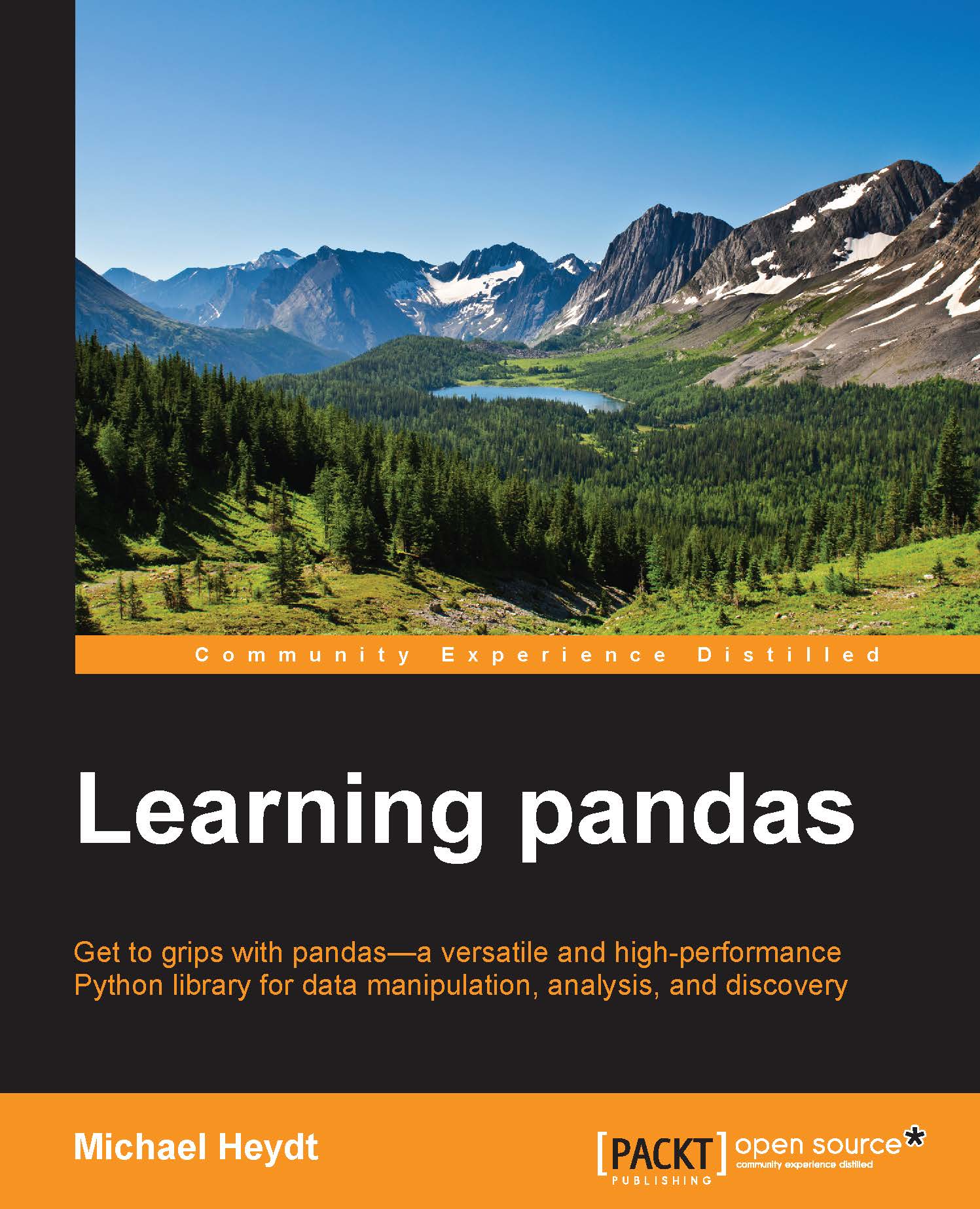
Learning Pandas

Learning Pandas

By : Michael Heydt
4.2 (10)
close
close
Learning Pandas

Learning Pandas

4.2 (10)
By: Michael Heydt

Overview of this book

If you are a Python programmer who wants to get started with performing data analysis using pandas and Python, this is the book for you. Some experience with statistical analysis would be helpful but is not mandatory.
Table of Contents (14 chapters)
close
close
13
Index

Chapter 1. A Tour of pandas

In this chapter, we will take a look at pandas, which is an open source Python-based data analysis library. It provides high-performance and easy-to-use data structures and data analysis tools built with the Python programming language. The pandas library brings many of the good things from R, specifically the DataFrame objects and R packages such as plyr and reshape2, and places them in a single library that you can use in your Python applications.

The development of pandas was begun in 2008 by Wes McKinney when he worked at AQR Capital Management. It was opened sourced in 2009 and is currently supported and actively developed by various organizations and contributors. It was initially designed with finance in mind, specifically with its ability around time series data manipulation, but emphasizes the data manipulation part of the equation leaving statistical, financial, and other types of analyses to other Python libraries.

In this chapter, we will take a brief tour of pandas and some of the associated tools such as IPython notebooks. You will be introduced to a variety of concepts in pandas for data organization and manipulation in an effort to form both a base understanding and a frame of reference for deeper coverage in later sections of this book. By the end of this chapter, you will have a good understanding of the fundamentals of pandas and even be able to perform basic data manipulations. Also, you will be ready to continue with later portions of this book for more detailed understanding.

This chapter will introduce you to:

  • pandas and why it is important
  • IPython and IPython Notebooks
  • Referencing pandas in your application
  • The Series and DataFrame objects of pandas
  • How to load data from files and the Web
  • The simplicity of visualizing pandas data

Note

pandas is always lowercase by convention in pandas documentation, and this will be a convention followed by this book.

Visually different images
CONTINUE READING
83
Tech Concepts
36
Programming languages
73
Tech Tools
Icon Unlimited access to the largest independent learning library in tech of over 8,000 expert-authored tech books and videos.
Icon Innovative learning tools, including AI book assistants, code context explainers, and text-to-speech.
Icon 50+ new titles added per month and exclusive early access to books as they are being written.
Learning Pandas
notes
bookmark Notes and Bookmarks search Search in title playlist Add to playlist font-size Font size

Change the font size

margin-width Margin width

Change margin width

day-mode Day/Sepia/Night Modes

Change background colour

Close icon Search
Country selected

Close icon Your notes and bookmarks

Confirmation

Modal Close icon
claim successful

Buy this book with your credits?

Modal Close icon
Are you sure you want to buy this book with one of your credits?
Close
YES, BUY

Submit Your Feedback

Modal Close icon
Modal Close icon
Modal Close icon