Sign In Start Free Trial
Account

Add to playlist

Create a Playlist

Modal Close icon
You need to login to use this feature.
  • Book Overview & Buying Python GUI Programming Cookbook, Second Edition
  • Table Of Contents Toc
Python GUI Programming Cookbook, Second Edition

Python GUI Programming Cookbook, Second Edition - Second Edition

By : Burkhard Meier
3.4 (5)
close
close
Python GUI Programming Cookbook, Second Edition

Python GUI Programming Cookbook, Second Edition

3.4 (5)
By: Burkhard Meier

Overview of this book

Python is a multi-domain, interpreted programming language. It is a widely used general-purpose, high-level programming language. It is often used as a scripting language because of its forgiving syntax and compatibility with a wide variety of different eco-systems. Python GUI Programming Cookbook follows a task-based approach to help you create beautiful and very effective GUIs with the least amount of code necessary. This book will guide you through the very basics of creating a fully functional GUI in Python with only a few lines of code. Each and every recipe adds more widgets to the GUIs we are creating. While the cookbook recipes all stand on their own, there is a common theme running through all of them. As our GUIs keep expanding, using more and more widgets, we start to talk to networks, databases, and graphical libraries that greatly enhance our GUI’s functionality. This book is what you need to expand your knowledge on the subject of GUIs, and make sure you’re not missing out in the long run.
Table of Contents (12 chapters)
close
close

How to create the title of a tkinter window form


The principle of changing the title of a tkinter main root window is the same as what we discussed in the previous recipe: How to create independent message boxes. We just pass in a string as the first argument to the constructor of the widget.

Getting ready

Instead of a pop-up dialog window, we create the main root window and give it a title.

How to do it…

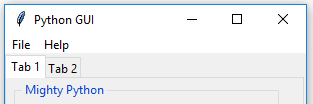
The following code creates the main window and adds a title to it. We have already done this in the previous recipes, for example, in Creating tabbed widgets, in Chapter 2, Layout Management. Here we just focus on this aspect of our GUI:

    import tkinter as tk 
    win = tk.Tk()               # Create instance 
    win.title("Python GUI")     # Add a title

How it works…

This gives a title to the main root window by using the built-in tkinter title property. After we create a Tk() instance, we can use all the built-in tkinter properties to customize our GUI.

Visually different images
CONTINUE READING
83
Tech Concepts
36
Programming languages
73
Tech Tools
Icon Unlimited access to the largest independent learning library in tech of over 8,000 expert-authored tech books and videos.
Icon Innovative learning tools, including AI book assistants, code context explainers, and text-to-speech.
Icon 50+ new titles added per month and exclusive early access to books as they are being written.
Python GUI Programming Cookbook, Second Edition
notes
bookmark Notes and Bookmarks search Search in title playlist Add to playlist download Download options font-size Font size

Change the font size

margin-width Margin width

Change margin width

day-mode Day/Sepia/Night Modes

Change background colour

Close icon Search
Country selected

Close icon Your notes and bookmarks

Confirmation

Modal Close icon
claim successful

Buy this book with your credits?

Modal Close icon
Are you sure you want to buy this book with one of your credits?
Close
YES, BUY

Submit Your Feedback

Modal Close icon
Modal Close icon
Modal Close icon