Sign In Start Free Trial
Account

Add to playlist

Create a Playlist

Modal Close icon
You need to login to use this feature.
  • Book Overview & Buying Mastering Android Development with Kotlin
  • Table Of Contents Toc
Mastering Android Development with Kotlin

Mastering Android Development with Kotlin

By : Vasić
2.7 (11)
close
close
Mastering Android Development with Kotlin

Mastering Android Development with Kotlin

2.7 (11)
By: Vasić

Overview of this book

Kotlin is a programming language intended to be a better Java, and it's designed to be usable and readable across large teams with different levels of knowledge. As a language, it helps developers build amazing Android applications in an easy and effective way. This book begins by giving you a strong grasp of Kotlin's features in the context of Android development and its APIs. Moving on, you'll take steps towards building stunning applications for Android. The book will show you how to set up the environment, and the difficulty level will grow steadily with the applications covered in the upcoming chapters. Later on, the book will introduce you to the Android Studio IDE, which plays an integral role in Android development. We'll use Kotlin's basic programming concepts such as functions, lambdas, properties, object-oriented code, safety aspects, type parameterization, testing, and concurrency, which will guide you through writing Kotlin code in production. We'll also show you how to integrate Kotlin into any existing Android project.
Table of Contents (17 chapters)
close
close

Debug your application


Now, we know how to log important application messages. During development, we will face situations when only logging messages is not enough when analyzing application behavior or investigating bugs.

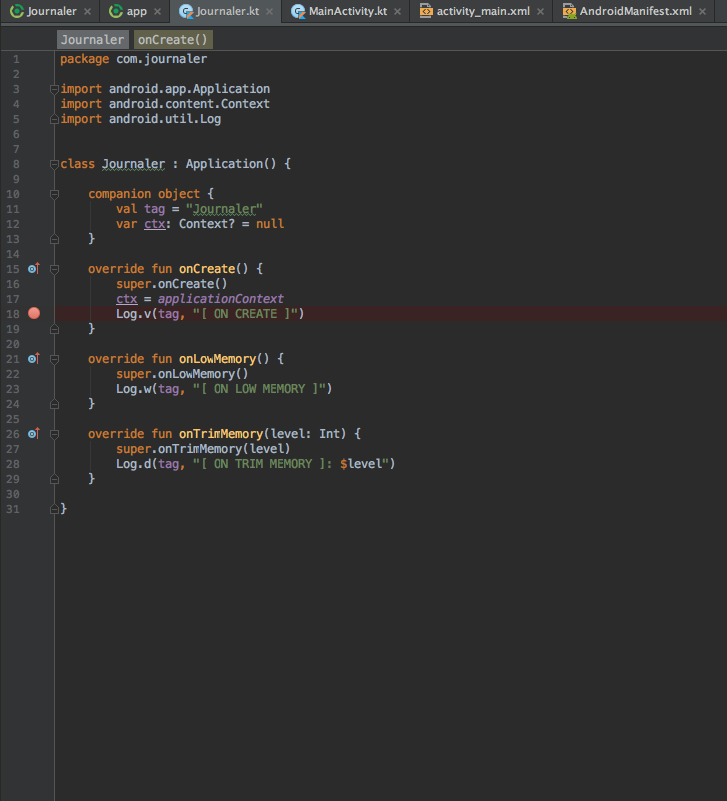
For us, it's important to have the ability to debug an application code during its execution on real Android devices or on emulators. So, let's debug something! Open the main Application class and put the break point on line where we log the onCreate() method, as shown here:

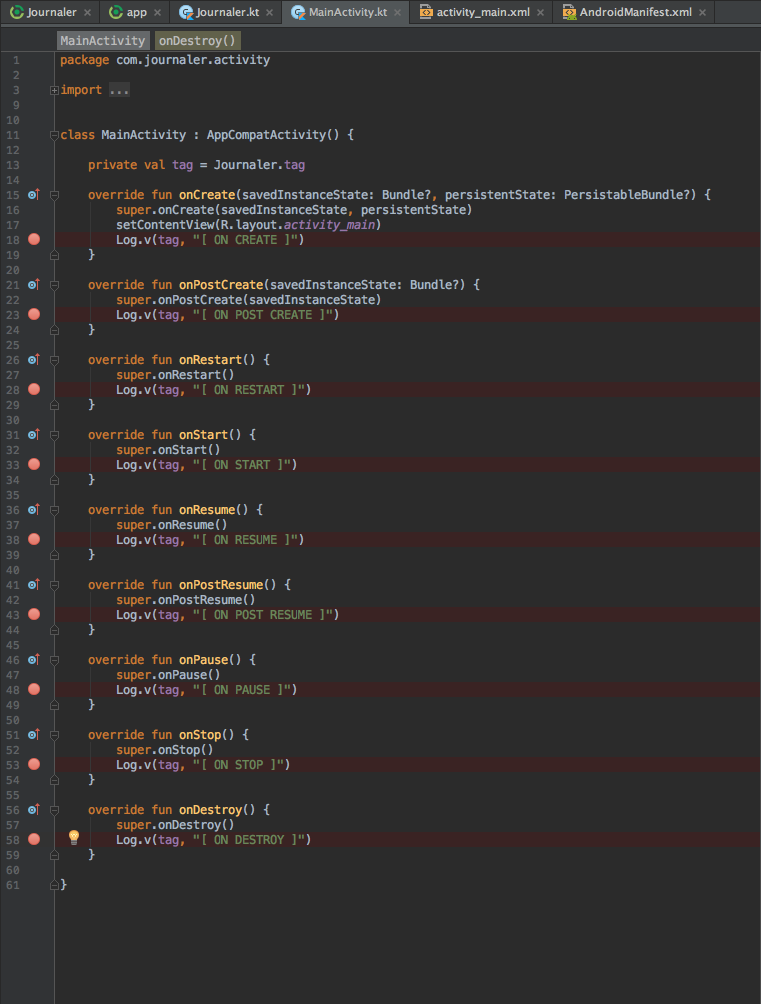
As you can see, we set the break point at line 18. We will add more break points. Let's add it in our main (and only) activity. Put a break point in each lifecycle event at lines where we perform logging. 

We set breakpoints at lines 18, 23, 28, 33, 38, and so on. Run the application in debug mode by clicking on the debug icon or by choosing Run | Debug app. The application is started in debug mode. Wait a little bit and a debugger will soon enter the first break point we set.

The following screenshot...

Visually different images
CONTINUE READING
83
Tech Concepts
36
Programming languages
73
Tech Tools
Icon Unlimited access to the largest independent learning library in tech of over 8,000 expert-authored tech books and videos.
Icon Innovative learning tools, including AI book assistants, code context explainers, and text-to-speech.
Icon 50+ new titles added per month and exclusive early access to books as they are being written.
Mastering Android Development with Kotlin
notes
bookmark Notes and Bookmarks search Search in title playlist Add to playlist download Download options font-size Font size

Change the font size

margin-width Margin width

Change margin width

day-mode Day/Sepia/Night Modes

Change background colour

Close icon Search
Country selected

Close icon Your notes and bookmarks

Confirmation

Modal Close icon
claim successful

Buy this book with your credits?

Modal Close icon
Are you sure you want to buy this book with one of your credits?
Close
YES, BUY

Submit Your Feedback

Modal Close icon
Modal Close icon
Modal Close icon