Sign In Start Free Trial
Account

Add to playlist

Create a Playlist

Modal Close icon
You need to login to use this feature.
  • Book Overview & Buying Python Deep Learning Cookbook
  • Table Of Contents Toc
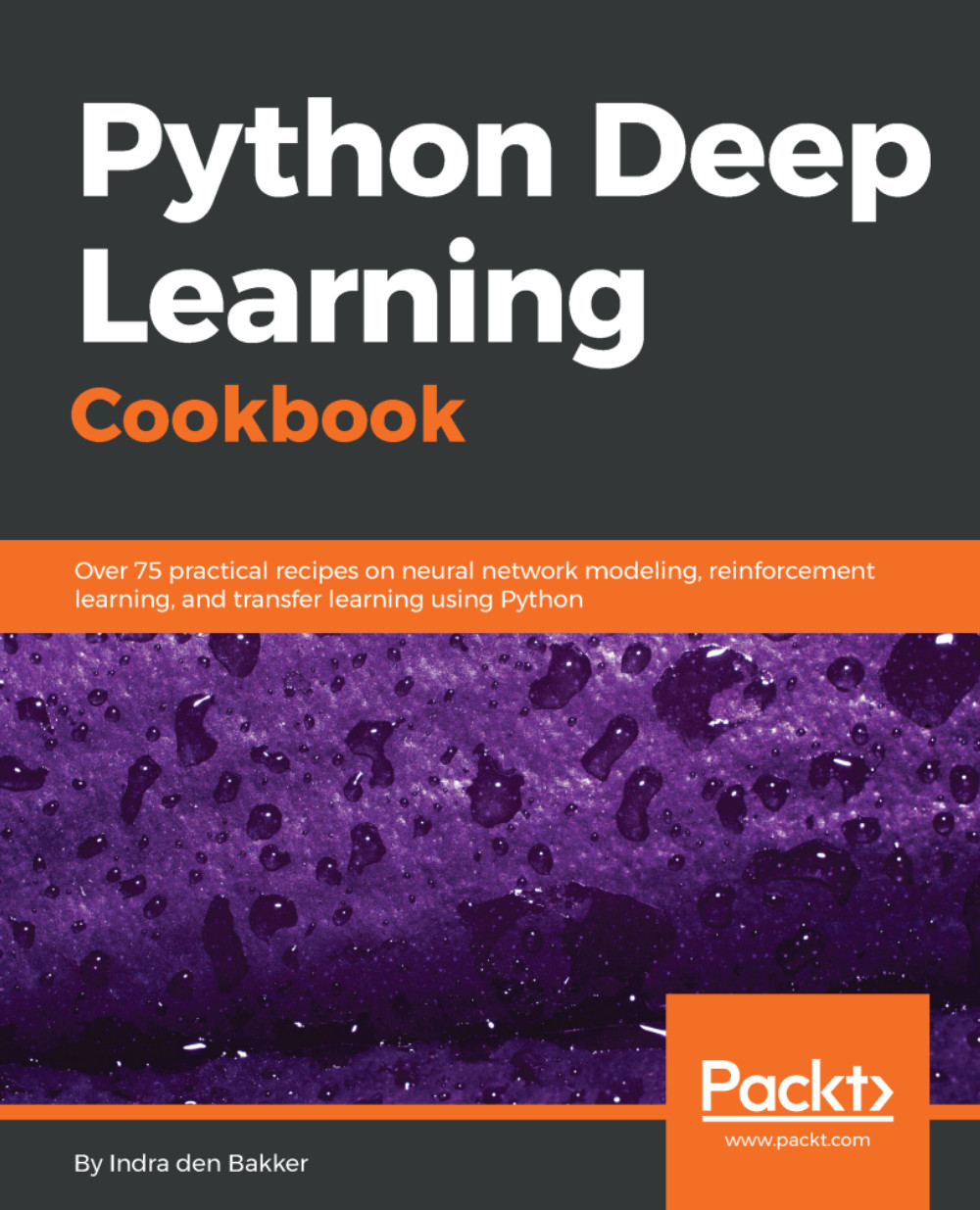
Python Deep Learning Cookbook

Python Deep Learning Cookbook

By : den Bakker
3.7 (3)
close
close
Python Deep Learning Cookbook

Python Deep Learning Cookbook

3.7 (3)
By: den Bakker

Overview of this book

Deep Learning is revolutionizing a wide range of industries. For many applications, deep learning has proven to outperform humans by making faster and more accurate predictions. This book provides a top-down and bottom-up approach to demonstrate deep learning solutions to real-world problems in different areas. These applications include Computer Vision, Natural Language Processing, Time Series, and Robotics. The Python Deep Learning Cookbook presents technical solutions to the issues presented, along with a detailed explanation of the solutions. Furthermore, a discussion on corresponding pros and cons of implementing the proposed solution using one of the popular frameworks like TensorFlow, PyTorch, Keras and CNTK is provided. The book includes recipes that are related to the basic concepts of neural networks. All techniques s, as well as classical networks topologies. The main purpose of this book is to provide Python programmers a detailed list of recipes to apply deep learning to common and not-so-common scenarios.
Table of Contents (15 chapters)
close
close

Implementing a single-layer neural network


Now we can move on to neural networks. We will start by the simplest form of a neural network: a single-layer neural network. The difference from a perceptron is that the computations are done by multiple units (neurons), hence a network. As you may expect, adding more units will increase the number of problems that can be solved. The units perform their computations separately and are in a layer; we call this layer the hidden layer. Therefore, we call the units in this layer the hidden units. For now, we will only consider a single hidden layer. The output layer performs as a perceptron. This time, as input we have the hidden units in the hidden layer instead of the input variables:

Figure 2.4: Single-layer neural network with two input variables, n hidden units, and a single output unit

In our implementation of the perceptron, we've used a unit step function to determine the class. In the next recipe, we will use a non-linear activation function...

CONTINUE READING
83
Tech Concepts
36
Programming languages
73
Tech Tools
Icon Unlimited access to the largest independent learning library in tech of over 8,000 expert-authored tech books and videos.
Icon Innovative learning tools, including AI book assistants, code context explainers, and text-to-speech.
Icon 50+ new titles added per month and exclusive early access to books as they are being written.
Python Deep Learning Cookbook
notes
bookmark Notes and Bookmarks search Search in title playlist Add to playlist download Download options font-size Font size

Change the font size

margin-width Margin width

Change margin width

day-mode Day/Sepia/Night Modes

Change background colour

Close icon Search
Country selected

Close icon Your notes and bookmarks

Confirmation

Modal Close icon
claim successful

Buy this book with your credits?

Modal Close icon
Are you sure you want to buy this book with one of your credits?
Close
YES, BUY

Submit Your Feedback

Modal Close icon
Modal Close icon
Modal Close icon