
Sign In Start Free Trial
Account

Add to playlist

Create a Playlist

Modal Close icon
You need to login to use this feature.
  • Book Overview & Buying Hands-On Enterprise Automation with Python
  • Table Of Contents Toc
  • Feedback & Rating feedback
Hands-On Enterprise Automation with Python

Hands-On Enterprise Automation with Python

By : Aly
4 (1)
close
close
Hands-On Enterprise Automation with Python

Hands-On Enterprise Automation with Python

4 (1)
By: Aly

Overview of this book

Hands-On Enterprise Automation with Python starts by covering the set up of a Python environment to perform automation tasks, as well as the modules, libraries, and tools you will be using. We’ll explore examples of network automation tasks using simple Python programs and Ansible. Next, we will walk you through automating administration tasks with Python Fabric, where you will learn to perform server configuration and administration, along with system administration tasks such as user management, database management, and process management. As you progress through this book, you’ll automate several testing services with Python scripts and perform automation tasks on virtual machines and cloud infrastructure with Python. In the concluding chapters, you will cover Python-based offensive security tools and learn how to automate your security tasks. By the end of this book, you will have mastered the skills of automating several system administration tasks with Python.
Table of Contents (20 chapters)
close
close

Introduction to regular expressions

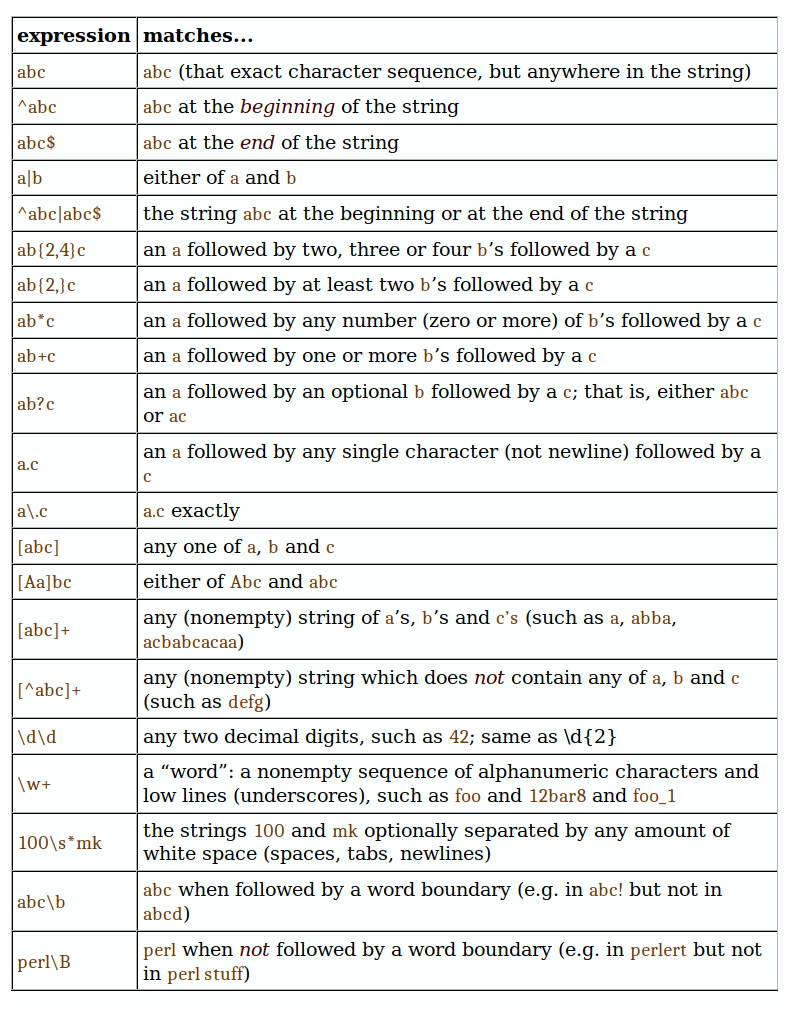
Regular expressions are a language used to match specific occurrences of strings by following their pattern across the whole string. When a match is found, the resulting matched string will be returned back to user and will be held inside a structure in Python format, such as tuple, list, or dictionary. The following table summarizes the most common patterns in regular expressions:
Also, one of the important rules in regular expressions is you can write your own regex and surround it with parentheses (), which is called the capturing group and helps you to hold important data to reference it later using the capturing group number:

line = '30 acd3.b2c6.aac9 FastEthernet0/1' 
match = re.search('(\d+) +([0-9a-f.]+) +(\S+)', line)
print match.group(1)
print match.group(2)
PyCharm will automatically color strings written as regular...
Visually different images
CONTINUE READING
83
Tech Concepts
36
Programming languages
73
Tech Tools
Icon Unlimited access to the largest independent learning library in tech of over 8,000 expert-authored tech books and videos.
Icon Innovative learning tools, including AI book assistants, code context explainers, and text-to-speech.
Icon 50+ new titles added per month and exclusive early access to books as they are being written.
Hands-On Enterprise Automation with Python
notes
bookmark Notes and Bookmarks search Search in title playlist Add to playlist download Download options font-size Font size

Change the font size

margin-width Margin width

Change margin width

day-mode Day/Sepia/Night Modes

Change background colour

Close icon Search
Country selected

Close icon Your notes and bookmarks

Confirmation

Modal Close icon
claim successful

Buy this book with your credits?

Modal Close icon
Are you sure you want to buy this book with one of your credits?
Close
YES, BUY

Submit Your Feedback

Modal Close icon
Modal Close icon
Modal Close icon