Sign In Start Free Trial
Account

Add to playlist

Create a Playlist

Modal Close icon
You need to login to use this feature.
  • Book Overview & Buying Extending SaltStack
  • Table Of Contents Toc
  • Feedback & Rating feedback
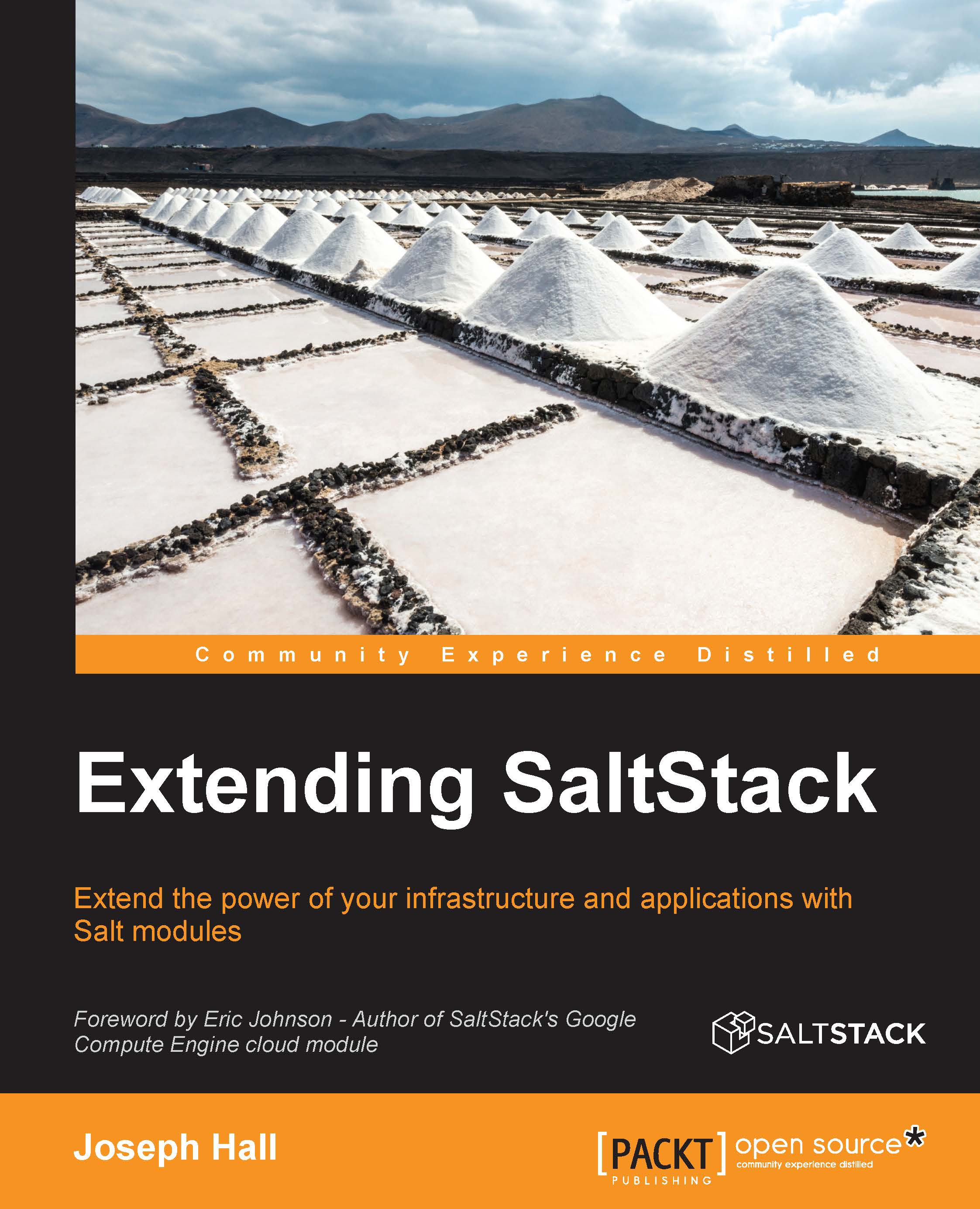
Extending SaltStack

Extending SaltStack

By : Joseph Hall
4.8 (6)
close
close
Extending SaltStack

Extending SaltStack

4.8 (6)
By: Joseph Hall

Overview of this book

Salt already ships with a very powerful set of tools, but that doesn't mean that they all suit your needs perfectly. By adding your own modules and enhancing existing ones, you can bring the functionality that you need to increase your productivity. Extending SaltStack follows a tutorial-based approach to explain different types of modules, from fundamentals to complete and full-functioning modules. Starting with the Loader system that drives Salt, this book will guide you through the most common types of modules. First you will learn how to write execution modules. Then you will extend the configuration using the grain, pillar, and SDB modules. Next up will be state modules and then the renderers that can be used with them. This will be followed with returner and output modules, which increase your options to manage return data. After that, there will be modules for external file servers, clouds, beacons, and finally external authentication and wheel modules to manage the master. With this guide in hand, you will be prepared to create, troubleshoot, and manage the most common types of Salt modules and take your infrastructure to new heights!
Table of Contents (15 chapters)
close
close
14
Index

Creating external pillars


As you know, pillars are like grains, with a key difference: grains are defined on the Minion, whereas pillars are defined for individual Minions, from the Master.

As far as users are concerned, there's not a whole lot of difference here, except that pillars must be mapped to targets on the Master, using the top.sls file in pillar_roots. One such mapping might look like this:

# cat /srv/pillar/top.sls
base:
  '*':
    - test

In this example, we would have a pillar called test defined, which might look like this:

# cat /srv/pillar/test.sls
test_pillar: True

Dynamic pillars are still mapped in the top.sls file, but that's where the similarities end, so far as configuration is concerned.

Configuring external pillars

Unlike dynamic grains, which will run so long as their __virtual__() function allows them to do so, pillars must be explicitly enabled in the master configuration file. Or, if running in local mode as we will be, in the minion configuration file. Let's go...

Visually different images
CONTINUE READING
83
Tech Concepts
36
Programming languages
73
Tech Tools
Icon Unlimited access to the largest independent learning library in tech of over 8,000 expert-authored tech books and videos.
Icon Innovative learning tools, including AI book assistants, code context explainers, and text-to-speech.
Icon 50+ new titles added per month and exclusive early access to books as they are being written.
Extending SaltStack
notes
bookmark Notes and Bookmarks search Search in title playlist Add to playlist font-size Font size

Change the font size

margin-width Margin width

Change margin width

day-mode Day/Sepia/Night Modes

Change background colour

Close icon Search
Country selected

Close icon Your notes and bookmarks

Confirmation

Modal Close icon
claim successful

Buy this book with your credits?

Modal Close icon
Are you sure you want to buy this book with one of your credits?
Close
YES, BUY

Submit Your Feedback

Modal Close icon
Modal Close icon
Modal Close icon