
Sign In Start Free Trial
Account

Add to playlist

Create a Playlist

Modal Close icon
You need to login to use this feature.
  • Book Overview & Buying Docker and Kubernetes for Java Developers
  • Table Of Contents Toc
Docker and Kubernetes for Java Developers

Docker and Kubernetes for Java Developers

By : Jaroslaw Krochmalski, Krochmalski
3.5 (4)
close
close
Docker and Kubernetes for Java Developers

Docker and Kubernetes for Java Developers

3.5 (4)
By: Jaroslaw Krochmalski, Krochmalski

Overview of this book

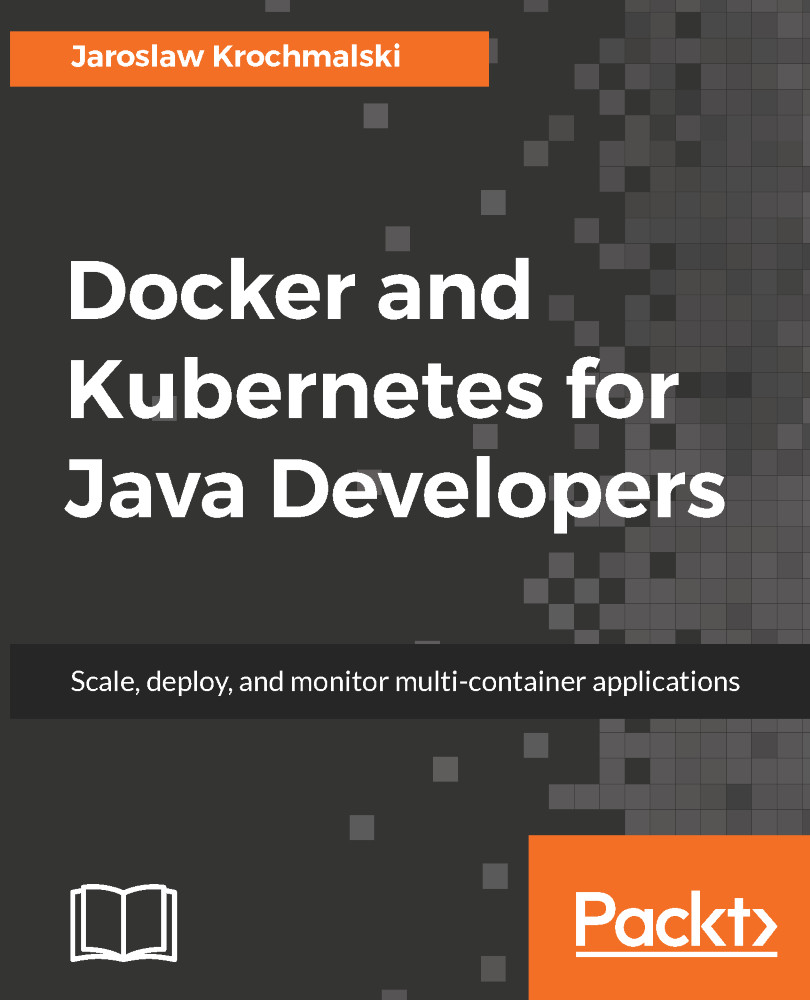
Imagine creating and testing Java EE applications on Apache Tomcat Server or Wildfly Application server in minutes along with deploying and managing Java applications swiftly. Sounds too good to be true? But you have a reason to cheer as such scenarios are only possible by leveraging Docker and Kubernetes. This book will start by introducing Docker and delve deep into its networking and persistent storage concepts. You will then proceed to learn how to refactor monolith application into separate services by building an application and then packaging it into Docker containers. Next, you will create an image containing Java Enterprise Application and later run it using Docker. Moving on, the book will focus on Kubernetes and its features and you will learn to deploy a Java application to Kubernetes using Maven and monitor a Java application in production. By the end of the book, you will get hands-on with some more advanced topics to further extend your knowledge about Docker and Kubernetes.
Table of Contents (12 chapters)
close
close
11
More Resources

Authentication

By default, the Kubernetes API server serves HTTP requests on two ports:

  • Localhost, unsecured port: By default, the IP address is localhost and a port number is 8080. There is no TLS communication, all requests on this port bypasses authentication and authorization plugins. This is intended for testing and bootstrap, and for other components of the master node. This is also used to other Kubernetes components such as scheduler or controller-manager to execute API calls. You can change the port number with the --insecure-port switch, and the default IP by using the --insecure-bind-address command-line switch.
  • Secure port: The default port number is 6443 (it can be changed with the `--secure-port switch), usually it's 443 on Cloud providers. It uses TLS communication. A certificate can be set with a --tls-cert-file switch. A private SSL key can be provided with...
CONTINUE READING
83
Tech Concepts
36
Programming languages
73
Tech Tools
Icon Unlimited access to the largest independent learning library in tech of over 8,000 expert-authored tech books and videos.
Icon Innovative learning tools, including AI book assistants, code context explainers, and text-to-speech.
Icon 50+ new titles added per month and exclusive early access to books as they are being written.
Docker and Kubernetes for Java Developers
notes
bookmark Notes and Bookmarks search Search in title playlist Add to playlist download Download options font-size Font size

Change the font size

margin-width Margin width

Change margin width

day-mode Day/Sepia/Night Modes

Change background colour

Close icon Search
Country selected

Close icon Your notes and bookmarks

Confirmation

Modal Close icon
claim successful

Buy this book with your credits?

Modal Close icon
Are you sure you want to buy this book with one of your credits?
Close
YES, BUY

Submit Your Feedback

Modal Close icon
Modal Close icon
Modal Close icon