Sign In Start Free Trial
Account

Add to playlist

Create a Playlist

Modal Close icon
You need to login to use this feature.
  • Book Overview & Buying Puppet 4.10 Beginner's Guide
  • Table Of Contents Toc
  • Feedback & Rating feedback
Puppet 4.10 Beginner's Guide

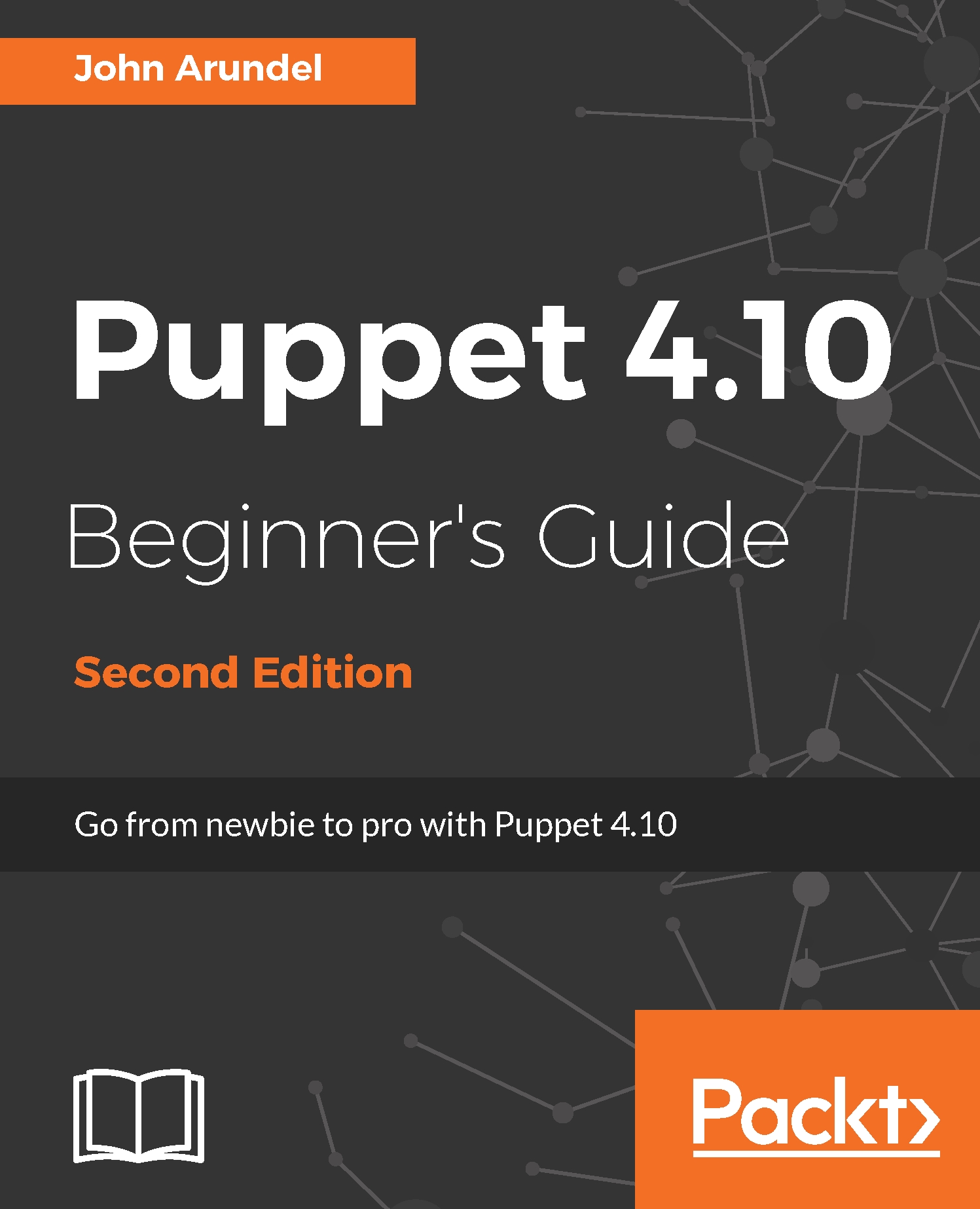
Puppet 4.10 Beginner's Guide - Second Edition

By : John Arundel
4.5 (4)
close
close
Puppet 4.10 Beginner's Guide

Puppet 4.10 Beginner's Guide

4.5 (4)
By: John Arundel

Overview of this book

Puppet 4.10 Beginner’s Guide, Second Edition, gets you up and running with the very latest features of Puppet 4.10, including Docker containers, Hiera data, and Amazon AWS cloud orchestration. Go from beginner to confident Puppet user with a series of clear, practical examples to help you manage every aspect of your server setup. Whether you’re a developer, a system administrator, or you are simply curious about Puppet, you’ll learn Puppet skills that you can put into practice right away. With practical steps giving you the key concepts you need, this book teaches you how to install packages and config files, create users, set up scheduled jobs, provision cloud instances, build containers, and so much more. Every example in this book deals with something real and practical that you’re likely to need in your work, and you’ll see the complete Puppet code that makes it happen, along with step-by-step instructions for what to type and what output you’ll see. All the examples are available in a GitHub repo for you to download and adapt for your own server setup.
Table of Contents (14 chapters)
close
close
13
Index

Creating a Git repo

It's very easy to create a Git repo. Follow these steps:

  1. Install Git on your Vagrant box with the following command:
    sudo apt-get install git
    
  2. Make a directory to hold your versioned files using the following commands:
    cd
    mkdir puppet
    
  3. Now run the following commands to turn the directory into a Git repo:
    cd puppet
    git init
    Initialized empty Git repository in /home/vagrant/puppet/.git/

Making your first commit

You can change the files in your repo as much as you like, but Git will not know about the changes until you make what's called a commit. You can think of a commit as being like a snapshot of the repo at a particular moment, but it also stores information about what changed in the repo since the previous commit. Commits are stored forever, so you will always be able to roll back the repo to the state it was in at a certain commit, or show what files were changed in a past commit and compare them to the state of the repo at any other commit.

Let's make our...

Visually different images
CONTINUE READING
83
Tech Concepts
36
Programming languages
73
Tech Tools
Icon Unlimited access to the largest independent learning library in tech of over 8,000 expert-authored tech books and videos.
Icon Innovative learning tools, including AI book assistants, code context explainers, and text-to-speech.
Icon 50+ new titles added per month and exclusive early access to books as they are being written.
Puppet 4.10 Beginner's Guide
notes
bookmark Notes and Bookmarks search Search in title playlist Add to playlist font-size Font size

Change the font size

margin-width Margin width

Change margin width

day-mode Day/Sepia/Night Modes

Change background colour

Close icon Search
Country selected

Close icon Your notes and bookmarks

Confirmation

Modal Close icon
claim successful

Buy this book with your credits?

Modal Close icon
Are you sure you want to buy this book with one of your credits?
Close
YES, BUY

Submit Your Feedback

Modal Close icon
Modal Close icon
Modal Close icon