Sign In Start Free Trial
Account

Add to playlist

Create a Playlist

Modal Close icon
You need to login to use this feature.
  • Book Overview & Buying Practical Network Automation
  • Table Of Contents Toc
Practical Network Automation

Practical Network Automation

By : Abhishek Ratan
4.4 (8)
close
close
Practical Network Automation

Practical Network Automation

4.4 (8)
By: Abhishek Ratan

Overview of this book

Network automation is the use of IT controls to supervise and carry out every-day network management functions. It plays a key role in network virtualization technologies and network functions. The book starts by providing an introduction to network automation, SDN, and its applications, which include integrating DevOps tools to automate the network efficiently. It then guides you through different network automation tasks and covers various data digging and reporting methodologies such as IPv6 migration, DC relocations, and interface parsing, all the while retaining security and improving data center robustness. The book then moves on to the use of Python and the management of SSH keys for machine-to-machine (M2M) communication, all followed by practical use cases. The book also covers the importance of Ansible for network automation including best practices in automation, ways to test automated networks using different tools, and other important techniques. By the end of the book, you will be well acquainted with the various aspects of network automation.
Table of Contents (8 chapters)
close
close

Writing Python scripts


We are now familiar with the basic concepts of Python. Now we will write an actual program or script in Python.

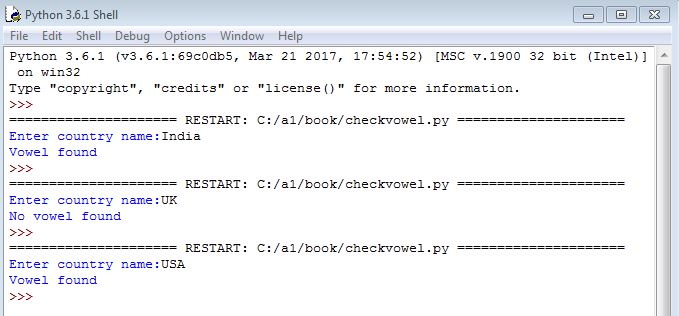
Ask for the input of a country name, and check whether the last character of the country is a vowel:

countryname=input("Enter country name:")
countryname=countryname.lower()
lastcharacter=countryname.strip()[-1]
if 'a' in lastcharacter:
    print ("Vowel found")
elif 'e' in lastcharacter:
    print ("Vowel found")
elif 'i' in lastcharacter:
    print ("Vowel found")
elif 'o' in lastcharacter:
    print ("Vowel found")
elif 'u' in lastcharacter:
    print ("Vowel found")
else:
    print ("No vowel found")

Output of the preceding code is as follows:

  1. We ask for the input of a country name. The input() method is used to get an input from the user. The value entered is in the string format, and in our case the countryname variable has been assigned the input value.
  2. In the next line, countryname.lower() specifies that the input that we receive needs to converted into...
CONTINUE READING
83
Tech Concepts
36
Programming languages
73
Tech Tools
Icon Unlimited access to the largest independent learning library in tech of over 8,000 expert-authored tech books and videos.
Icon Innovative learning tools, including AI book assistants, code context explainers, and text-to-speech.
Icon 50+ new titles added per month and exclusive early access to books as they are being written.
Practical Network Automation
notes
bookmark Notes and Bookmarks search Search in title playlist Add to playlist download Download options font-size Font size

Change the font size

margin-width Margin width

Change margin width

day-mode Day/Sepia/Night Modes

Change background colour

Close icon Search
Country selected

Close icon Your notes and bookmarks

Confirmation

Modal Close icon
claim successful

Buy this book with your credits?

Modal Close icon
Are you sure you want to buy this book with one of your credits?
Close
YES, BUY

Submit Your Feedback

Modal Close icon
Modal Close icon
Modal Close icon