
Sign In Start Free Trial
Account

Add to playlist

Create a Playlist

Modal Close icon
You need to login to use this feature.
  • Book Overview & Buying Bash Quick Start Guide
  • Table Of Contents Toc
Bash Quick Start Guide

Bash Quick Start Guide

By : Tom Ryder
5 (2)
close
close
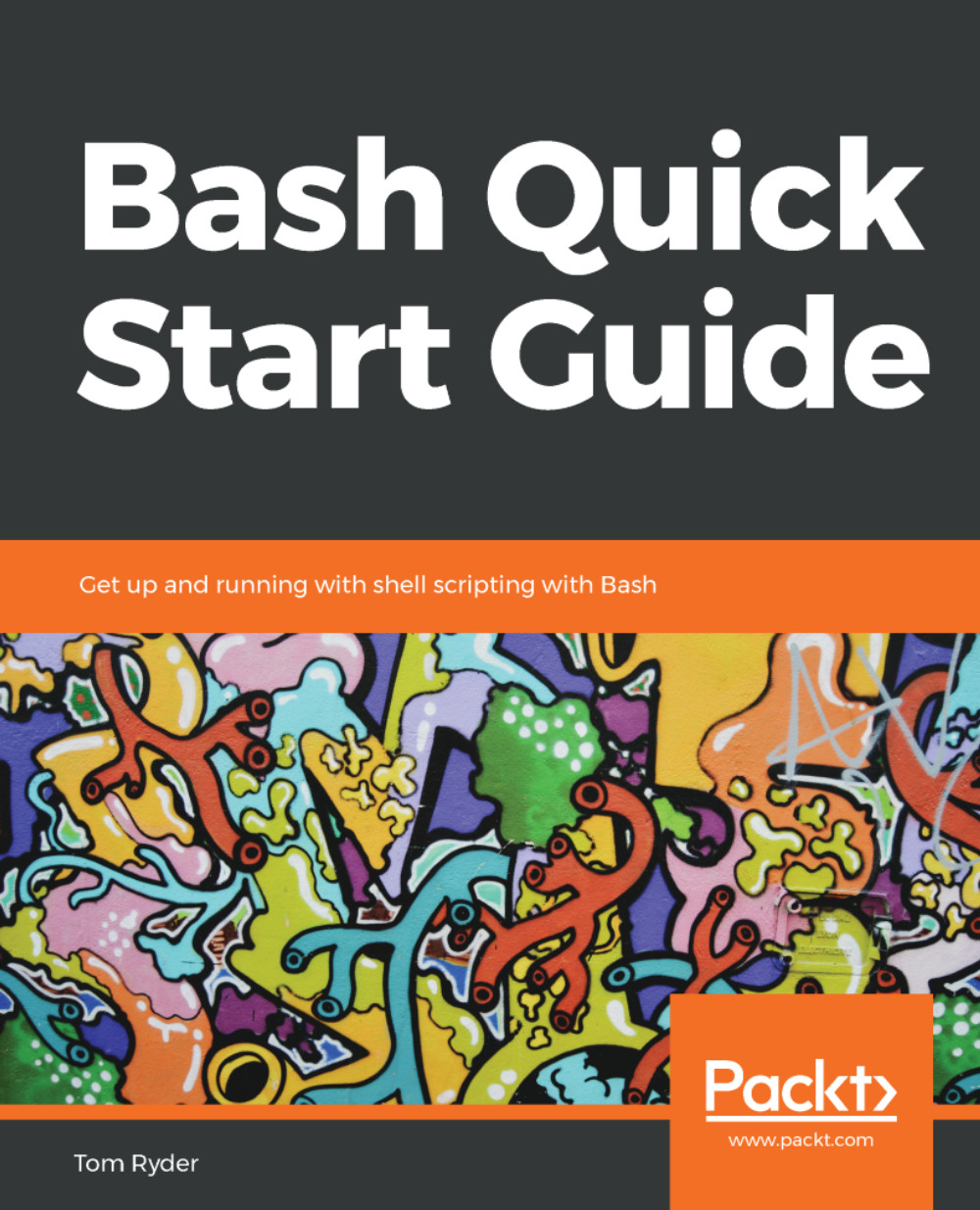
Bash Quick Start Guide

Bash Quick Start Guide

5 (2)
By: Tom Ryder

Overview of this book

Bash and shell script programming is central to using Linux, but it has many peculiar properties that are hard to understand and unfamiliar to many programmers, with a lot of misleading and even risky information online. Bash Quick Start Guide tackles these problems head on, and shows you the best practices of shell script programming. This book teaches effective shell script programming with Bash, and is ideal for people who may have used its command line but never really learned it in depth. This book will show you how even simple programming constructs in the shell can speed up and automate any kind of daily command-line work. For people who need to use the command line regularly in their daily work, this book provides practical advice for using the command-line shell beyond merely typing or copy-pasting commands into the shell. Readers will learn techniques suitable for automating processes and controlling processes, on both servers and workstations, whether for single command lines or long and complex scripts. The book even includes information on configuring your own shell environment to suit your workflow, and provides a running start for interpreting Bash scripts written by others.
Table of Contents (10 chapters)
close
close

Stopping a command list on error

Most of the time when programming in Bash, you will not actually want to test $? directly, but instead test it implicitly as success or failure, with language features in Bash itself.

If you wanted to issue a set of commands on one command line, but only to continue if every command worked, you would use the double-ampersand (&&) control operator, instead of the semicolon (;):

$ cd && rmdir ~/nonexistent && ls

When we run this command line, we see that the final ls never runs, because the rmdir command before it failed:

rmdir: failed to remove '/home/user/nonexistent': No such file or directory

Similarly, if we changed the cd command at the start of the command line to change into a directory that didn't exist, the command line would stop even earlier:

bash$ cd ~/nonexistent && rmdir ~/nonexistent...
CONTINUE READING
83
Tech Concepts
36
Programming languages
73
Tech Tools
Icon Unlimited access to the largest independent learning library in tech of over 8,000 expert-authored tech books and videos.
Icon Innovative learning tools, including AI book assistants, code context explainers, and text-to-speech.
Icon 50+ new titles added per month and exclusive early access to books as they are being written.
Bash Quick Start Guide
notes
bookmark Notes and Bookmarks search Search in title playlist Add to playlist download Download options font-size Font size

Change the font size

margin-width Margin width

Change margin width

day-mode Day/Sepia/Night Modes

Change background colour

Close icon Search
Country selected

Close icon Your notes and bookmarks

Confirmation

Modal Close icon
claim successful

Buy this book with your credits?

Modal Close icon
Are you sure you want to buy this book with one of your credits?
Close
YES, BUY

Submit Your Feedback

Modal Close icon
Modal Close icon
Modal Close icon