Sign In Start Free Trial
Account

Add to playlist

Create a Playlist

Modal Close icon
You need to login to use this feature.
  • Book Overview & Buying Cloud Security Handbook
  • Table Of Contents Toc
  • Feedback & Rating feedback
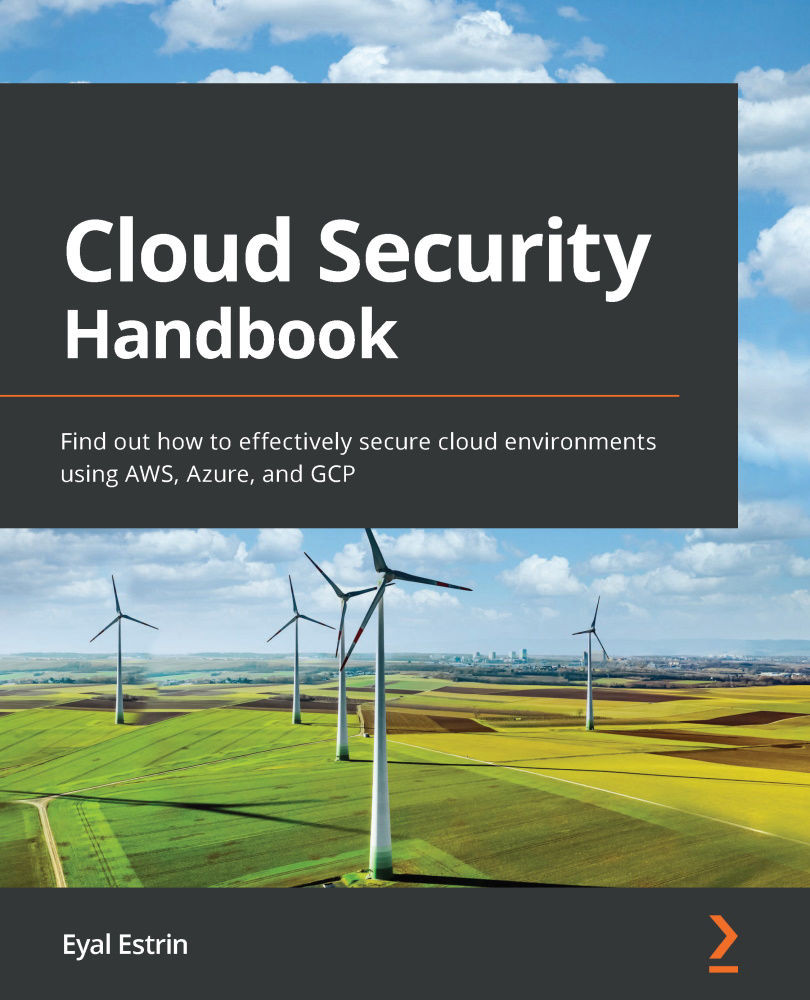
Cloud Security Handbook

Cloud Security Handbook

By : Eyal Estrin
4 (4)
close
close
Cloud Security Handbook

Cloud Security Handbook

4 (4)
By: Eyal Estrin

Overview of this book

Securing resources in the cloud is challenging, given that each provider has different mechanisms and processes. Cloud Security Handbook helps you to understand how to embed security best practices in each of the infrastructure building blocks that exist in public clouds. This book will enable information security and cloud engineers to recognize the risks involved in public cloud and find out how to implement security controls as they design, build, and maintain environments in the cloud. You'll begin by learning about the shared responsibility model, cloud service models, and cloud deployment models, before getting to grips with the fundamentals of compute, storage, networking, identity management, encryption, and more. Next, you'll explore common threats and discover how to stay in compliance in cloud environments. As you make progress, you'll implement security in small-scale cloud environments through to production-ready large-scale environments, including hybrid clouds and multi-cloud environments. This book not only focuses on cloud services in general, but it also provides actual examples for using AWS, Azure, and GCP built-in services and capabilities. By the end of this cloud security book, you'll have gained a solid understanding of how to implement security in cloud environments effectively.
Table of Contents (19 chapters)
close
close
1
Section 1: Securing Infrastructure Cloud Services
6
Section 2: Deep Dive into IAM, Auditing, and Encryption
10
Section 3: Threats and Compliance Management
14
Section 4: Advanced Use of Cloud Services

Chapter 1: Introduction to Cloud Security

This book, Cloud Security Techniques and Best Practices, is meant for various audiences. You could be taking your first steps working with cloud services, or you could be coming from an IT perspective and want to know about various compute and storage services and how to configure them securely. Or, you might be working in information security and want to know the various authentication, encryption, and audit services and how to configure them securely, or you might be working with architecture and want to know how to design large-scale environments in the cloud in a secure way.

Reading this book will allow you to make the most of cloud services while focusing on security aspects. Before discussing cloud services in more detail, let me share my opinion regarding cloud services.

The world of IT is changing. For decades, organizations used to purchase physical hardware, install operating systems, and deploy software. This routine required a lot of ongoing maintenance (for patch deployment, backup, monitoring, and so on).

The cloud introduced a new paradigm – that is, the ability to consume managed services to achieve the same goal of running software (from file servers to Enterprise Resource Planning (ERP) or Customer Relationship Management (CRM) products), while using the expertise of the hyper-scale cloud providers.

Some well-known use cases of cloud computing are as follows:

  • Netflix – one of the largest video streaming services world-wide. It uses AWS to run its media streaming services:

https://aws.amazon.com/solutions/case-studies/netflix-case-study

  • Mercedes-Benz – one of the most famous automotive brands. It uses Azure to run its research and development:

https://customers.microsoft.com/en-us/story/784791-mercedes-benz-r-and-d-creates-container-driven-cars-powered-by-microsoft-azure

  • Home Depot – the largest home improvement retailer in the United States. It uses Google Cloud to run its online stores:

https://cloud.google.com/customers/featured/the-home-depot

In this book, we will compare various aspects of cloud computing (from fundamental services such as compute, storage, and networking, to compliance management and best practices for building and maintaining large-scale environments in a secure way), while reviewing the different alternatives offered by Amazon Web Services (AWS), Microsoft Azure, and Google Cloud Platform (GCP).

It does not matter which organization you are coming from – this book will allow you to have a better understanding of how to achieve security in any of the large hyper-scale cloud providers.

You do not have to read everything – simply find out which cloud provider is common at your workplace or which cloud provider you wish to focus on, and feel free to skip the rest.

In this chapter, we will cover the following topics:

  • Why we need security
  • Cloud service models
  • Cloud deployment models
  • The shared responsibility model
Visually different images
CONTINUE READING
83
Tech Concepts
36
Programming languages
73
Tech Tools
Icon Unlimited access to the largest independent learning library in tech of over 8,000 expert-authored tech books and videos.
Icon Innovative learning tools, including AI book assistants, code context explainers, and text-to-speech.
Icon 50+ new titles added per month and exclusive early access to books as they are being written.
Cloud Security Handbook
notes
bookmark Notes and Bookmarks search Search in title playlist Add to playlist font-size Font size

Change the font size

margin-width Margin width

Change margin width

day-mode Day/Sepia/Night Modes

Change background colour

Close icon Search
Country selected

Close icon Your notes and bookmarks

Confirmation

Modal Close icon
claim successful

Buy this book with your credits?

Modal Close icon
Are you sure you want to buy this book with one of your credits?
Close
YES, BUY

Submit Your Feedback

Modal Close icon
Modal Close icon
Modal Close icon