


-
Book Overview & Buying
-
Table Of Contents

Hybrid Cloud Infrastructure and Operations Explained
By :


Hybrid Cloud Infrastructure and Operations Explained
By:
Overview of this book
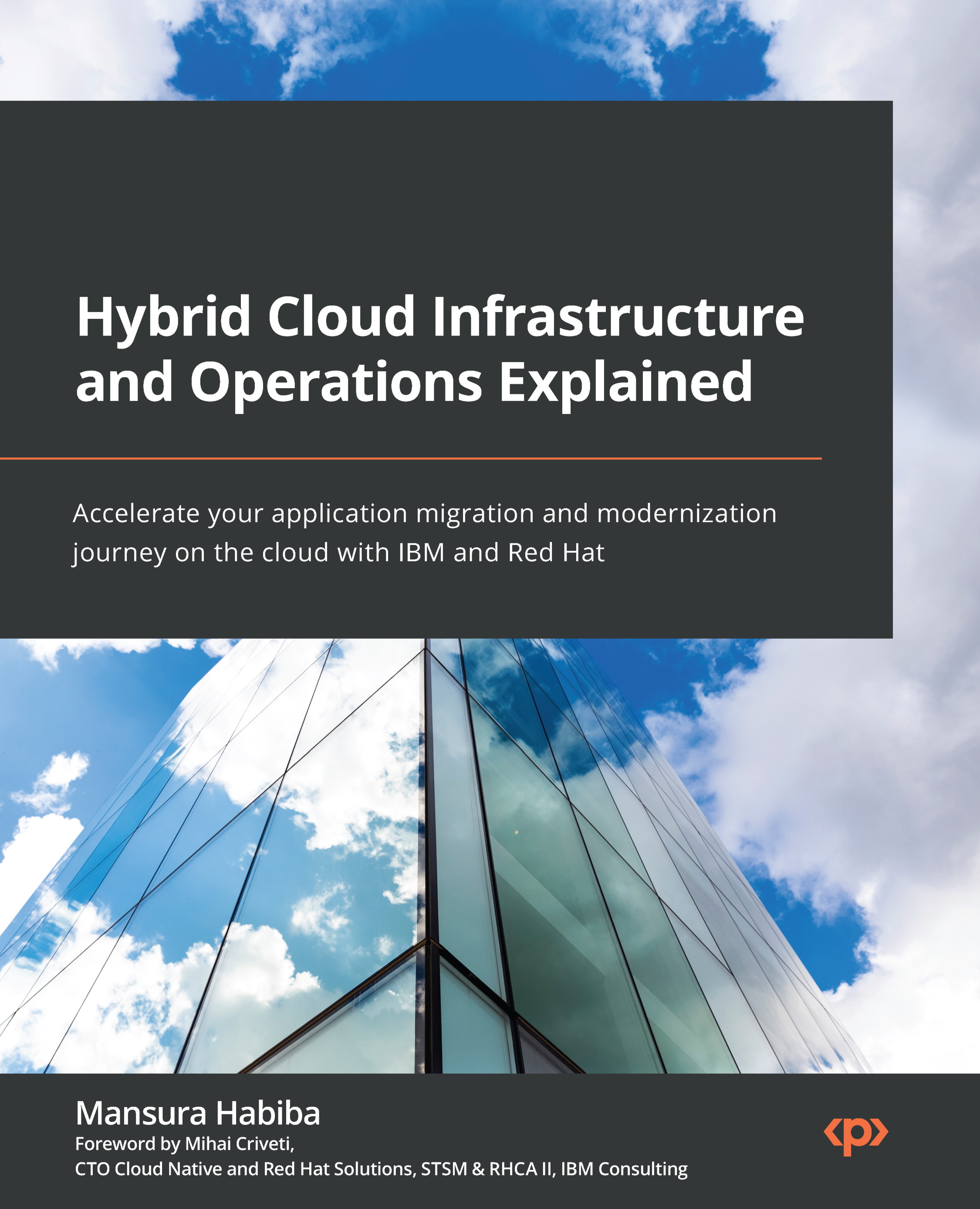
Most organizations are now either moving to the cloud through modernization or building their apps in the cloud. Hybrid cloud is one of the best approaches for cloud migration and the modernization journey for any enterprise. This is why, along with coding skills, developers need to know the big picture of cloud footprint and be aware of the integration models between apps in a hybrid and multi-cloud infrastructure. This book represents an overview of your end-to-end journey to the cloud. To be future agnostic, the journey starts with a hybrid cloud.
You'll gain an overall understanding of how to approach migration to the cloud using hybrid cloud technologies from IBM and Red Hat. Next, you’ll be able to explore the challenges, requirements (both functional and non-functional), and the process of app modernization for enterprises by analyzing various use cases. The book then provides you with insights into the different reference solutions for app modernization on the cloud, which will help you to learn how to design and implement patterns and best practices in your job.
By the end of this book, you’ll be able to successfully modernize applications and cloud infrastructure in hyperscaler public clouds such as IBM and hybrid clouds using Red Hat technologies as well as develop secure applications for cloud environments.
Table of Contents (16 chapters)
Preface


Part 1: Moving to Hybrid Cloud
 Free Chapter
Chapter 1: An Introduction to Hybrid Cloud Modernization
Chapter 2: Understanding Cloud Modernization and and Innovation Fundamentals
Chapter 3: xploring Best Practices for the Cloud Journey
Part 2: Cloud-Native Methods, Practices, and Technology
Chapter 4: Developing Applications in a Cloud Native Way
Chapter 5: Exploring Application Modernization Essentials
Part 3: Elements of Embedded Linux
Chapter 6: Designing and Implementing Cloud Storage Services
Chapter 7: Designing and Implementing Networking in Hybrid Cloud Infrastructure
Chapter 8: Understanding Security in Action
Chapter 9: Designing a Resilient Platform for Cloud Migration
Chapter 10: Managing Operations in Hybrid Cloud Infrastructure

Other Books You May Enjoy
Appendix A –Application Modernization and Migration Checklist


