


-
Book Overview & Buying
-
Table Of Contents

Learn OpenShift - Second Edition
By :


Learn OpenShift
By:
Overview of this book
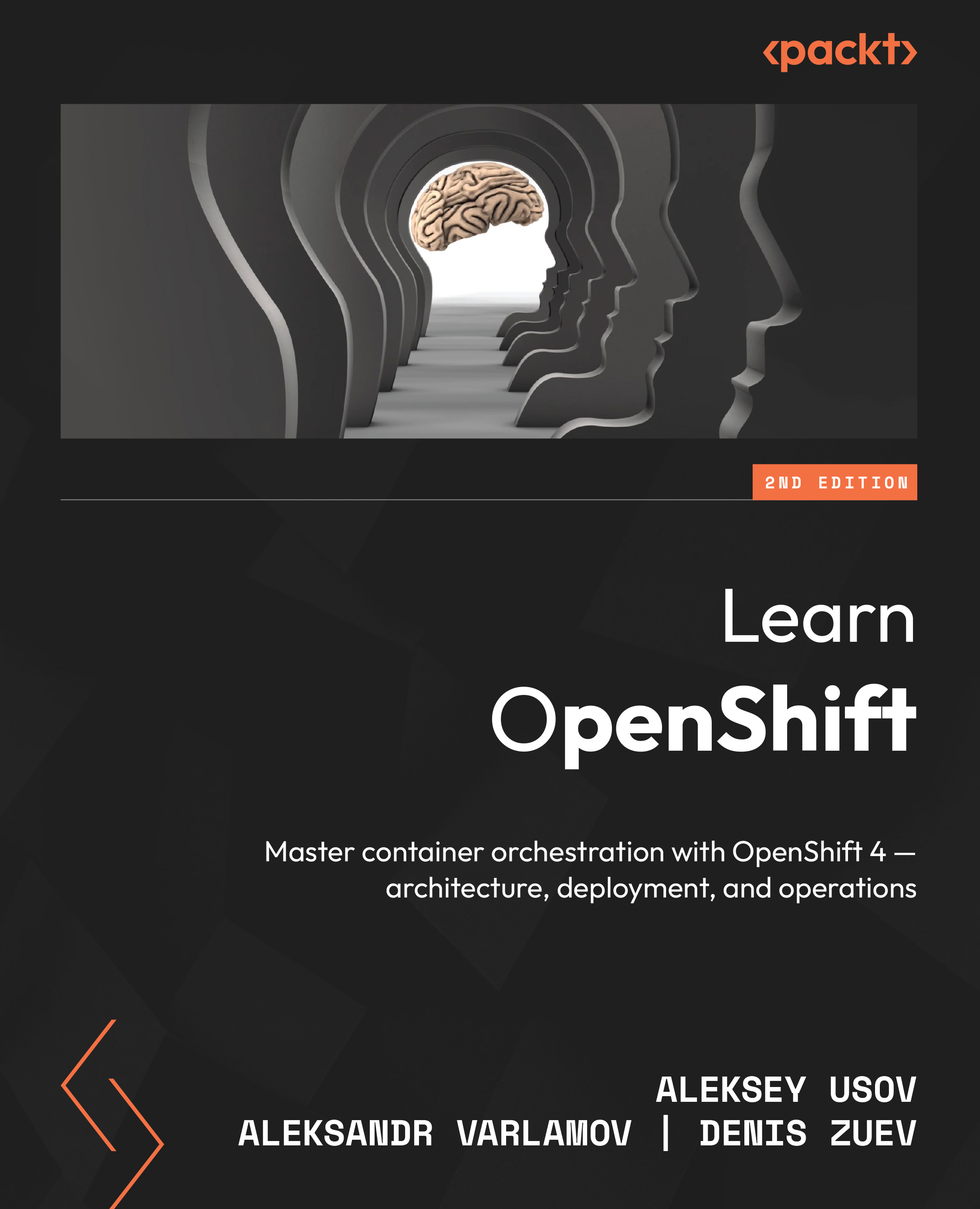
OpenShift is a powerful enterprise Kubernetes platform that simplifies the development, deployment, and management of containerized applications. Learn OpenShift is a comprehensive, hands-on guide designed for architects, DevOps engineers, SREs, and system administrators who want to take OpenShift 4 from architecture to production deployment. Drawing on the experience of seasoned architects who’ve worked on some of the world’s largest OpenShift projects, this book covers both fundamentals and advanced scenarios rarely discussed elsewhere. You’ll explore OpenShift 4 internals, understand its architecture, master cluster installation and upgrades, and gain deep insights into managing applications, configuring security, application builds, observability, and service mesh. With practical examples and real-world guidance, you’ll confidently deploy OpenShift on bare metal, virtualization, and cloud environments, and learn how to extend, maintain, and operate clusters at scale.
By the end of this book, you’ll be able to install, secure, and operate OpenShift 4 clusters in enterprise production environments, deploy containerized applications at scale, and troubleshoot real-world issues with confidence.
Table of Contents (26 chapters)
Preface


Understanding Containers
Kubernetes and OpenShift
Getting Started with OpenShift
Part 2: Post-Installation, Configuration, and Application Deployment
Post-Install Configuration
Navigating Authentication and Authorization
Exploring Scalability with OpenShift
Application Security and Isolation
Working with Persistent Storage
Developing for OpenShift
Deployment to OpenShift
Deploying Applications with Helm and Kustomize
Part 3: Logging, Monitoring, Observability, and Advanced OpenShift Services
Logging in OpenShift
Monitoring in OpenShift
Understanding Service Mesh and Distributed Tracing
Exploring Additional Services in OpenShift
Part 4: Extending, Maintaining, and Upgrading OpenShift
Understanding Operators and the Operator Framework

Upgrading OpenShift
Troubleshooting and Maintenance
Unlock Your Exclusive Benefits
Other Books You May Enjoy
Index


