
Sign In Start Free Trial
Account

Add to playlist

Create a Playlist

Modal Close icon
You need to login to use this feature.
  • Book Overview & Buying Mastering Qlik Sense
  • Table Of Contents Toc
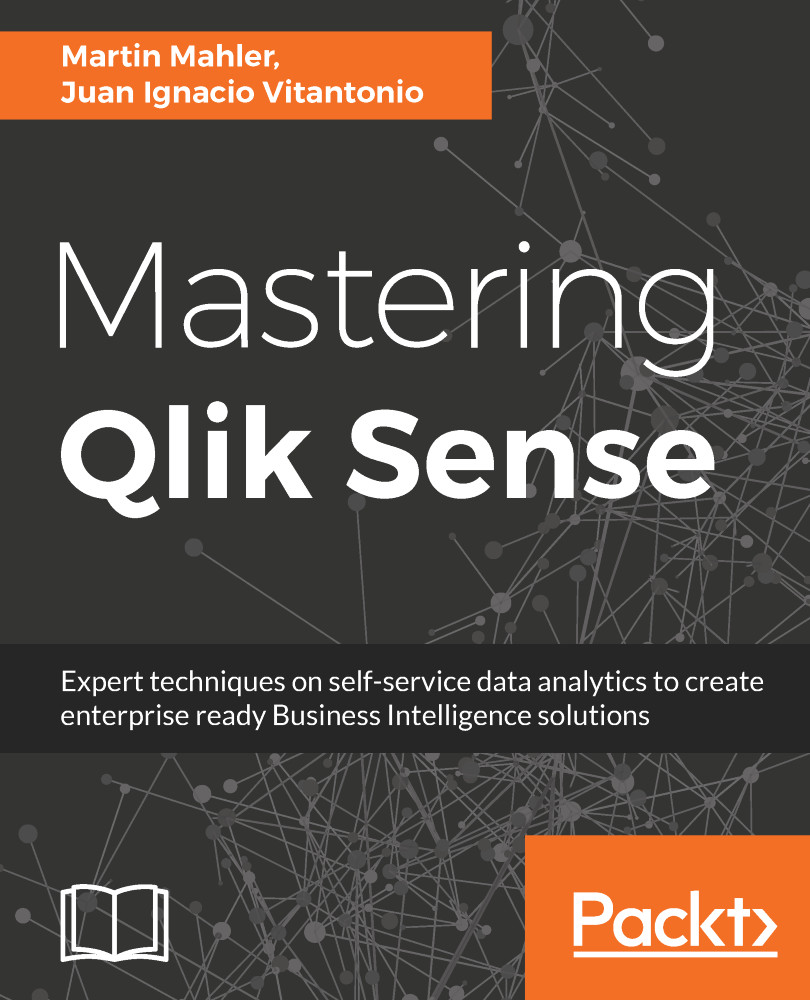
Mastering Qlik Sense

Mastering Qlik Sense

By : Juan Ignacio Vitantonio
4.1 (132)
close
close
Mastering Qlik Sense

Mastering Qlik Sense

4.1 (132)
By: Juan Ignacio Vitantonio

Overview of this book

Qlik Sense is a powerful, self-servicing Business Intelligence tool for data discovery, analytics and visualization. It allows you to create personalized Business Intelligence solutions from raw data and get actionable insights from it. This book is your one-stop guide to mastering Qlik Sense, catering to all your organizational BI needs. You'll see how you can seamlessly navigate through tons of data from multiple sources and take advantage of the various APIs available in Qlik and its components for guided analytics. You'll also learn how to embed visualizations into your existing BI solutions and extend the capabilities of Qlik Sense to create new visualizations and dashboards that work across all platforms. We also cover other advanced concepts such as porting your Qlik View applications to Qlik Sense,and working with Qlik Cloud. Finally, you'll implement enterprise-wide security and access control for resources and data sources through practical examples. With the knowledge gained from this book, you'll have become the go-to expert in your organization when it comes to designing BI solutions using Qlik Sense.
Table of Contents (16 chapters)
close
close

HTML5

HTML stands for HyperText Markup Language and it's a standard language to create website contents. It was first released in 1993 and has ever since dominated the World Wide Web. Most websites to this date have code based on HTML to display their content. Some basics were already covered in Chapter 11, Working with the Qlik Dev Hub.

HTML is a semantic language which allows you to organize and denote the structure of a website using tags such as <header>, <body>, and <footer> or more structural elements such as <img>, <section>, or <p>. It's very rich in its offering and in combination with CSS and JavaScript forms the three core cornerstones of the World Wide Web.

If you think of a human person as an example, you could compare the HTML structure of a web page to his/her skeleton, muscles, and organs.

The so-called structural...

CONTINUE READING
83
Tech Concepts
36
Programming languages
73
Tech Tools
Icon Unlimited access to the largest independent learning library in tech of over 8,000 expert-authored tech books and videos.
Icon Innovative learning tools, including AI book assistants, code context explainers, and text-to-speech.
Icon 50+ new titles added per month and exclusive early access to books as they are being written.
Mastering Qlik Sense
notes
bookmark Notes and Bookmarks search Search in title playlist Add to playlist download Download options font-size Font size

Change the font size

margin-width Margin width

Change margin width

day-mode Day/Sepia/Night Modes

Change background colour

Close icon Search
Country selected

Close icon Your notes and bookmarks

Confirmation

Modal Close icon
claim successful

Buy this book with your credits?

Modal Close icon
Are you sure you want to buy this book with one of your credits?
Close
YES, BUY

Submit Your Feedback

Modal Close icon
Modal Close icon
Modal Close icon