
Sign In Start Free Trial
Account

Add to playlist

Create a Playlist

Modal Close icon
You need to login to use this feature.
  • Book Overview & Buying Machine Learning for OpenCV
  • Table Of Contents Toc
  • Feedback & Rating feedback
Machine Learning for OpenCV

Machine Learning for OpenCV

By : Michael Beyeler, Michael Beyeler (USD)
4.4 (13)
close
close
Machine Learning for OpenCV

Machine Learning for OpenCV

4.4 (13)
By: Michael Beyeler, Michael Beyeler (USD)

Overview of this book

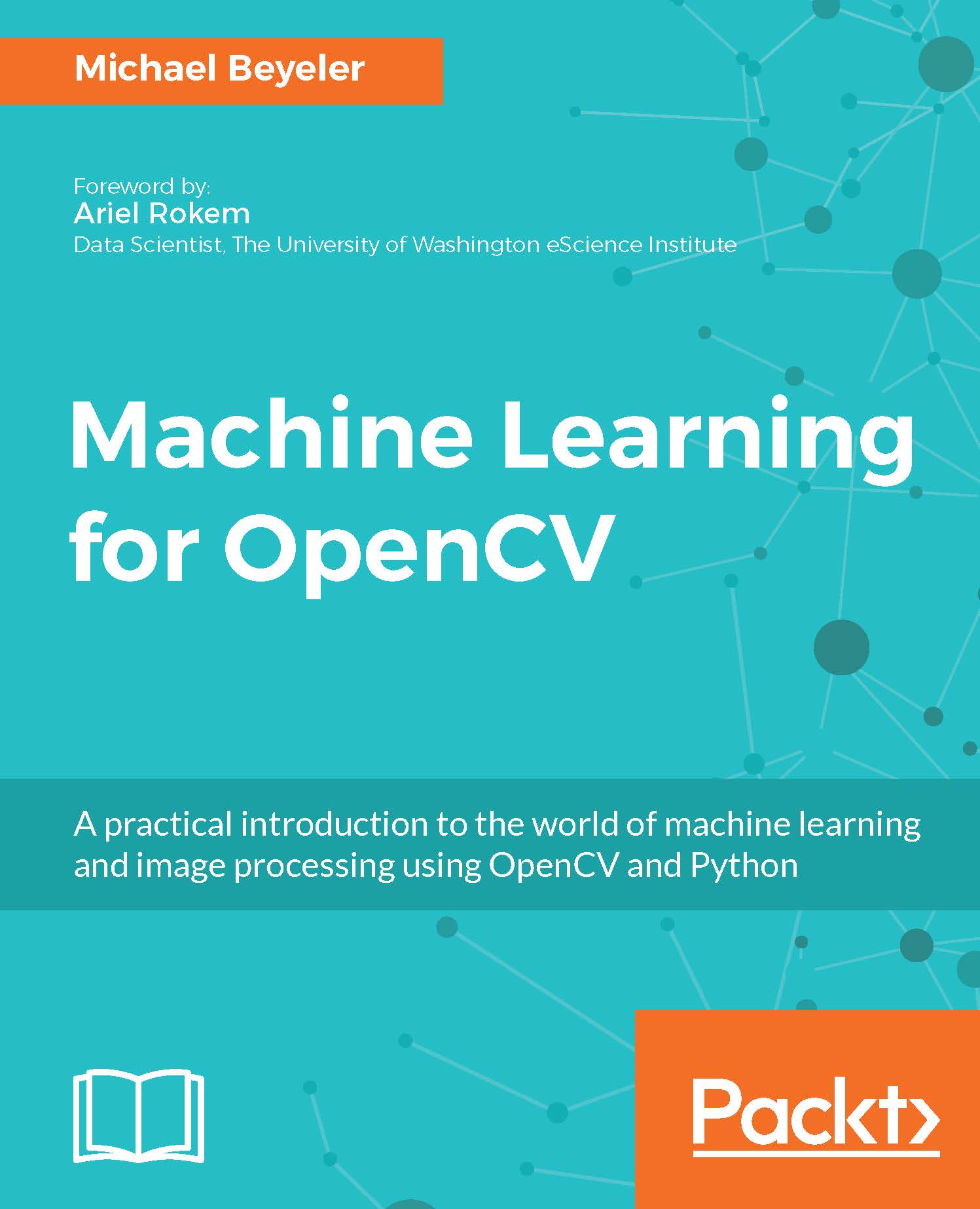
Machine learning is no longer just a buzzword, it is all around us: from protecting your email, to automatically tagging friends in pictures, to predicting what movies you like. Computer vision is one of today's most exciting application fields of machine learning, with Deep Learning driving innovative systems such as self-driving cars and Google’s DeepMind. OpenCV lies at the intersection of these topics, providing a comprehensive open-source library for classic as well as state-of-the-art computer vision and machine learning algorithms. In combination with Python Anaconda, you will have access to all the open-source computing libraries you could possibly ask for. Machine learning for OpenCV begins by introducing you to the essential concepts of statistical learning, such as classification and regression. Once all the basics are covered, you will start exploring various algorithms such as decision trees, support vector machines, and Bayesian networks, and learn how to combine them with other OpenCV functionality. As the book progresses, so will your machine learning skills, until you are ready to take on today's hottest topic in the field: Deep Learning. By the end of this book, you will be ready to take on your own machine learning problems, either by building on the existing source code or developing your own algorithm from scratch!
Table of Contents (13 chapters)
close
close

Compressing color spaces using k-means

One interesting use case of k-means is the compression of image color spaces. For example, a standard color image comes with 24-bit color depth, providing for a total of 16,777,216 color varieties. However, in most images, a large number of colors will be unused, and many of the pixels in the image will have similar values. The compressed image can then be sent over the internet at a faster speed, and at the receiver end, it can be decompressed to get back the original image. Hence, reducing the storage and transmission cost. However, the image color space compression will be lossy and you might not notice fine details in the image after compression.

Alternatively, we can use k-means to reduce the color palette too. The idea here is to think of the cluster centers as the decreased color palette. Then, k-means will organize the millions of...

Visually different images
CONTINUE READING
83
Tech Concepts
36
Programming languages
73
Tech Tools
Icon Unlimited access to the largest independent learning library in tech of over 8,000 expert-authored tech books and videos.
Icon Innovative learning tools, including AI book assistants, code context explainers, and text-to-speech.
Icon 50+ new titles added per month and exclusive early access to books as they are being written.
Machine Learning for OpenCV
notes
bookmark Notes and Bookmarks search Search in title playlist Add to playlist download Download options font-size Font size

Change the font size

margin-width Margin width

Change margin width

day-mode Day/Sepia/Night Modes

Change background colour

Close icon Search
Country selected

Close icon Your notes and bookmarks

Confirmation

Modal Close icon
claim successful

Buy this book with your credits?

Modal Close icon
Are you sure you want to buy this book with one of your credits?
Close
YES, BUY

Submit Your Feedback

Modal Close icon
Modal Close icon
Modal Close icon