Sign In Start Free Trial
Account

Add to playlist

Create a Playlist

Modal Close icon
You need to login to use this feature.
  • Book Overview & Buying Mastering Data analysis with R
  • Table Of Contents Toc
Mastering Data analysis with R

Mastering Data analysis with R

By : Daróczi
4.5 (2)
close
close
Mastering Data analysis with R

Mastering Data analysis with R

4.5 (2)
By: Daróczi

Overview of this book

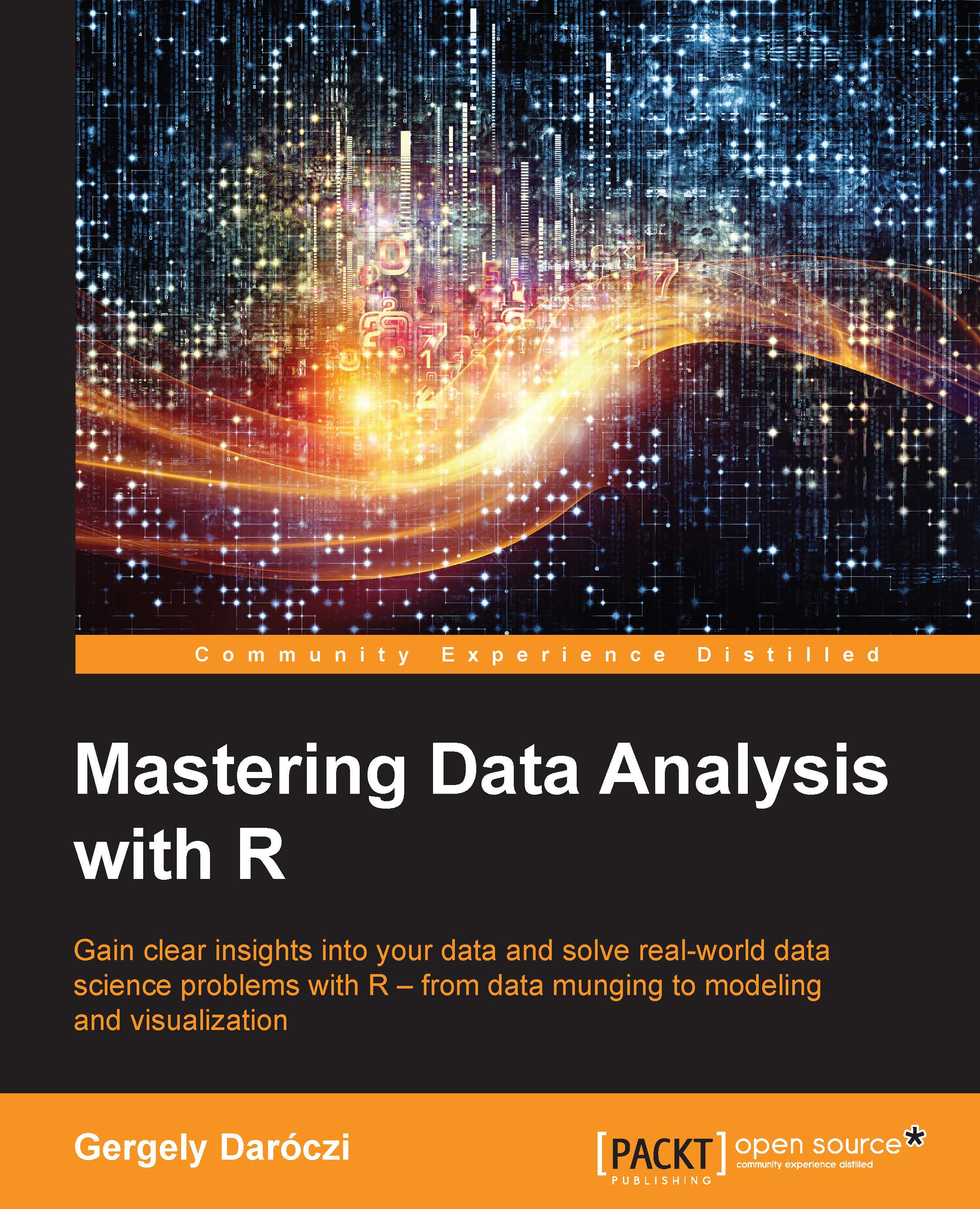
Gain sharp insights into your data and solve real-world data science problems with R—from data munging to modeling and visualization About This Book Handle your data with precision and care for optimal business intelligence Restructure and transform your data to inform decision-making Packed with practical advice and tips to help you get to grips with data mining Who This Book Is For If you are a data scientist or R developer who wants to explore and optimize your use of R’s advanced features and tools, this is the book for you. A basic knowledge of R is required, along with an understanding of database logic. What You Will Learn Connect to and load data from R’s range of powerful databases Successfully fetch and parse structured and unstructured data Transform and restructure your data with efficient R packages Define and build complex statistical models with glm Develop and train machine learning algorithms Visualize social networks and graph data Deploy supervised and unsupervised classification algorithms Discover how to visualize spatial data with R In Detail R is an essential language for sharp and successful data analysis. Its numerous features and ease of use make it a powerful way of mining, managing, and interpreting large sets of data. In a world where understanding big data has become key, by mastering R you will be able to deal with your data effectively and efficiently. This book will give you the guidance you need to build and develop your knowledge and expertise. Bridging the gap between theory and practice, this book will help you to understand and use data for a competitive advantage. Beginning with taking you through essential data mining and management tasks such as munging, fetching, cleaning, and restructuring, the book then explores different model designs and the core components of effective analysis. You will then discover how to optimize your use of machine learning algorithms for classification and recommendation systems beside the traditional and more recent statistical methods. Style and approach Covering the essential tasks and skills within data science, Mastering Data Analysis provides you with solutions to the challenges of data science. Each section gives you a theoretical overview before demonstrating how to put the theory to work with real-world use cases and hands-on examples.
Table of Contents (17 chapters)
close
close
16
Index

Chapter 1. Hello, Data!

Most projects in R start with loading at least some data into the running R session. As R supports a variety of file formats and database backend, there are several ways to do so. In this chapter, we will not deal with basic data structures, which are already familiar to you, but will concentrate on the performance issue of loading larger datasets and dealing with special file formats.

Note

For a quick overview on the standard tools and to refresh your knowledge on importing general data, please see Chapter 7 of the official An Introduction to R manual of CRAN at http://cran.r-project.org/doc/manuals/R-intro.html#Reading-data-from-files or Rob Kabacoff's Quick-R site, which offers keywords and cheat-sheets for most general tasks in R at http://www.statmethods.net/input/importingdata.html. For further materials, please see the References section in the Appendix.

Although R has its own (serialized) binary RData and rds file formats, which are extremely convenient to use for all R users as these also store R object meta-information in an efficient way, most of the time we have to deal with other input formats—provided by our employer or client.

One of the most popular data file formats is flat files, which are simple text files in which the values are separated by white-space, the pipe character, commas, or more often by semi-colon in Europe. This chapter will discuss several options R has to offer to load these kinds of documents, and we will benchmark which of these is the most efficient approach to import larger files.

Sometimes we are only interested in a subset of a dataset; thus, there is no need to load all the data from the sources. In such cases, database backend can provide the best performance, where the data is stored in a structured way preloaded on our system, so we can query any subset of that with simple and efficient commands. The second section of this chapter will focus on the three most popular databases (MySQL, PostgreSQL, and Oracle Database), and how to interact with those in R.

Besides some other helper tools and a quick overview on other database backend, we will also discuss how to load Excel spreadsheets into R—without the need to previously convert those to text files in Excel or Open/LibreOffice.

Of course this chapter is not just about data file formats, database connections, and such boring internals. But please bear in mind that data analytics always starts with loading data. This is unavoidable, so that our computer and statistical environment know the structure of the data before doing some real analytics.

CONTINUE READING
83
Tech Concepts
36
Programming languages
73
Tech Tools
Icon Unlimited access to the largest independent learning library in tech of over 8,000 expert-authored tech books and videos.
Icon Innovative learning tools, including AI book assistants, code context explainers, and text-to-speech.
Icon 50+ new titles added per month and exclusive early access to books as they are being written.
Mastering Data analysis with R
notes
bookmark Notes and Bookmarks search Search in title playlist Add to playlist font-size Font size

Change the font size

margin-width Margin width

Change margin width

day-mode Day/Sepia/Night Modes

Change background colour

Close icon Search
Country selected

Close icon Your notes and bookmarks

Confirmation

Modal Close icon
claim successful

Buy this book with your credits?

Modal Close icon
Are you sure you want to buy this book with one of your credits?
Close
YES, BUY

Submit Your Feedback

Modal Close icon
Modal Close icon
Modal Close icon