Sign In Start Free Trial
Account

Add to playlist

Create a Playlist

Modal Close icon
You need to login to use this feature.
  • Book Overview & Buying Introduction to R for Business Intelligence
  • Table Of Contents Toc
  • Feedback & Rating feedback
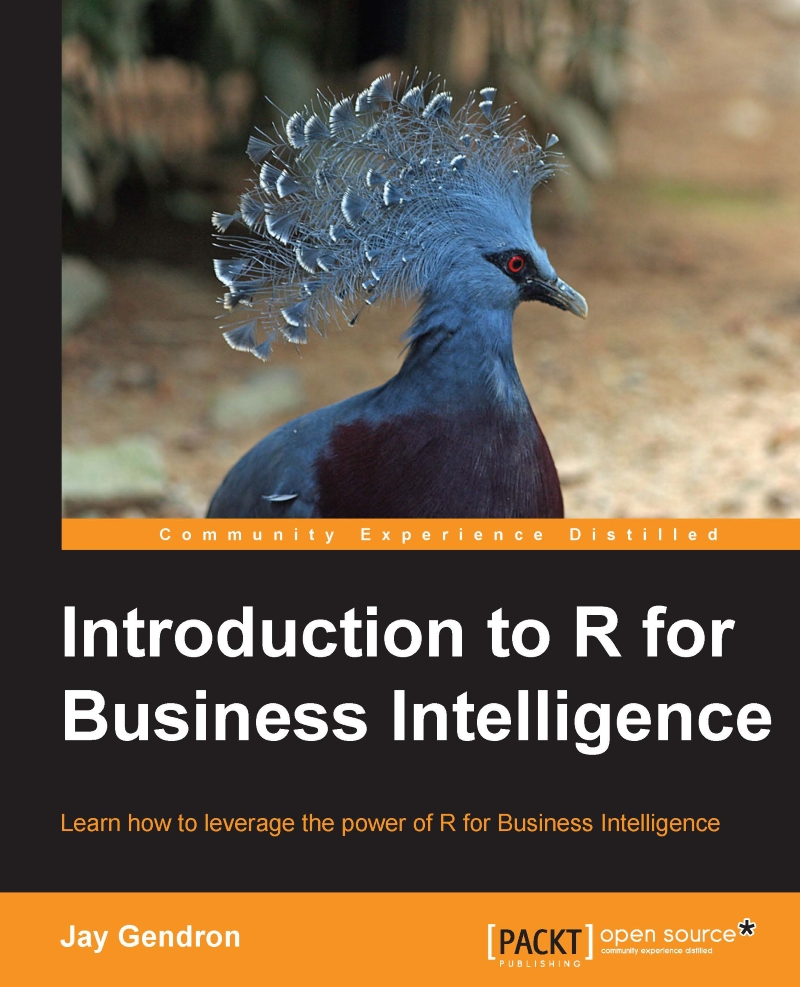
Introduction to R for Business Intelligence

Introduction to R for Business Intelligence

By : Gendron
close
close
Introduction to R for Business Intelligence

Introduction to R for Business Intelligence

By: Gendron

Overview of this book

Explore the world of Business Intelligence through the eyes of an analyst working in a successful and growing company. Learn R through use cases supporting different functions within that company. This book provides data-driven and analytically focused approaches to help you answer questions in operations, marketing, and finance. In Part 1, you will learn about extracting data from different sources, cleaning that data, and exploring its structure. In Part 2, you will explore predictive models and cluster analysis for Business Intelligence and analyze financial times series. Finally, in Part 3, you will learn to communicate results with sharp visualizations and interactive, web-based dashboards. After completing the use cases, you will be able to work with business data in the R programming environment and realize how data science helps make informed decisions and develops business strategy. Along the way, you will find helpful tips about R and Business Intelligence.
Table of Contents (13 chapters)
close
close
9
A. References
11
C. R Packages Used in the Book
12
D. R Code for Supporting Market Segment Business Case Calculations

Chapter 5. Data Mining with Cluster Analysis

Data mining is a term that is been around since the 1990s. What exactly is data mining? Data mining is the process of working with a large amount of data to gather insights and detect patterns. Analysts often use it when the data does not include a response variable, yet there is a belief that a relationship or information about the structure of the data lies within it. This chapter will cover the following three introductory topics of data mining:

  • Explaining cluster analysis
  • Partitioning using k-means clustering
  • Clustering using hierarchical techniques

As in the previous chapters, you learned through use cases. There are two different use cases provided that teach data mining with two different cluster analysis approaches. Before we begin working, it is worthwhile to understand cluster analysis in context.

Visually different images
CONTINUE READING
83
Tech Concepts
36
Programming languages
73
Tech Tools
Icon Unlimited access to the largest independent learning library in tech of over 8,000 expert-authored tech books and videos.
Icon Innovative learning tools, including AI book assistants, code context explainers, and text-to-speech.
Icon 50+ new titles added per month and exclusive early access to books as they are being written.
Introduction to R for Business Intelligence
notes
bookmark Notes and Bookmarks search Search in title playlist Add to playlist download Download options font-size Font size

Change the font size

margin-width Margin width

Change margin width

day-mode Day/Sepia/Night Modes

Change background colour

Close icon Search
Country selected

Close icon Your notes and bookmarks

Confirmation

Modal Close icon
claim successful

Buy this book with your credits?

Modal Close icon
Are you sure you want to buy this book with one of your credits?
Close
YES, BUY

Submit Your Feedback

Modal Close icon
Modal Close icon
Modal Close icon