Sign In Start Free Trial
Account

Add to playlist

Create a Playlist

Modal Close icon
You need to login to use this feature.
  • Book Overview & Buying Data Analysis and Business Modeling with Excel 2013
  • Table Of Contents Toc
  • Feedback & Rating feedback
Data Analysis and Business Modeling with Excel 2013

Data Analysis and Business Modeling with Excel 2013

By : Rojas
4.5 (2)
close
close
Data Analysis and Business Modeling with Excel 2013

Data Analysis and Business Modeling with Excel 2013

4.5 (2)
By: Rojas

Overview of this book

Excel 2013 is one of the easiest to use data analysis tools you will ever come across. Its simplicity and powerful features has made it the go to tool for all your data needs. Complex operations with Excel, such as creating charts and graphs, visualization, and analyzing data make it a great tool for managers, data scientists, financial data analysts, and those who work closely with data. Learning data analysis and will help you bring your data skills to the next level. This book starts by walking you through creating your own data and bringing data into Excel from various sources. You’ll learn the basics of SQL syntax and how to connect it to a Microsoft SQL Server Database using Excel’s data connection tools. You will discover how to spot bad data and strategies to clean that data to make it useful to you. Next, you'll learn to create custom columns, identify key metrics, and make decisions based on business rules. You’ll create macros using VBA and use Excel 2013’s shiny new macros. Finally, at the end of the book, you'll be provided with useful shortcuts and tips, enabling you to do efficient data analysis and business modeling with Excel 2013.
Table of Contents (13 chapters)
close
close
10
10. Creating Interactive Spreadsheets Using Tables and Slicers
11
A. Tips, Tricks, and Shortcuts
12
Index

Leading/trailing/in-between spaces


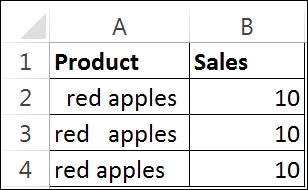
There are times when your cells will contain leading spaces, trailing spaces, or extra spaces in between strings. These are issues that can lead you to draw incorrect conclusions about your data. Let's perform the following steps to create some data:

  1. Fire up Excel 2013 and create a new spreadsheet. In columns A and B, enter the following information:

    Product, Sales

    red apples, 10

    red apples, 10

    red apples , 10

    By applying some of the concepts that you learned in Chapter 1, Getting Data into Excel, you should be able to reproduce a table, as shown in the following figure. Note that I have made the column headings bold and applied a border around the cells.

    Figure 3.1

    Another important fact about this data is that I added two extra spaces to cells A2, A3, and A4. In cell A2, I added the spaces before the word red. In cell A3, I added the spaces in between red and apples. In cell A4, I added the spaces after the word apples.

    If I were to ask you to give...

Visually different images
CONTINUE READING
83
Tech Concepts
36
Programming languages
73
Tech Tools
Icon Unlimited access to the largest independent learning library in tech of over 8,000 expert-authored tech books and videos.
Icon Innovative learning tools, including AI book assistants, code context explainers, and text-to-speech.
Icon 50+ new titles added per month and exclusive early access to books as they are being written.
Data Analysis and Business Modeling with Excel 2013
notes
bookmark Notes and Bookmarks search Search in title playlist Add to playlist font-size Font size

Change the font size

margin-width Margin width

Change margin width

day-mode Day/Sepia/Night Modes

Change background colour

Close icon Search
Country selected

Close icon Your notes and bookmarks

Confirmation

Modal Close icon
claim successful

Buy this book with your credits?

Modal Close icon
Are you sure you want to buy this book with one of your credits?
Close
YES, BUY

Submit Your Feedback

Modal Close icon
Modal Close icon
Modal Close icon