
Sign In Start Free Trial
Account

Add to playlist

Create a Playlist

Modal Close icon
You need to login to use this feature.
  • Book Overview & Buying Machine Learning Algorithms
  • Table Of Contents Toc
  • Feedback & Rating feedback
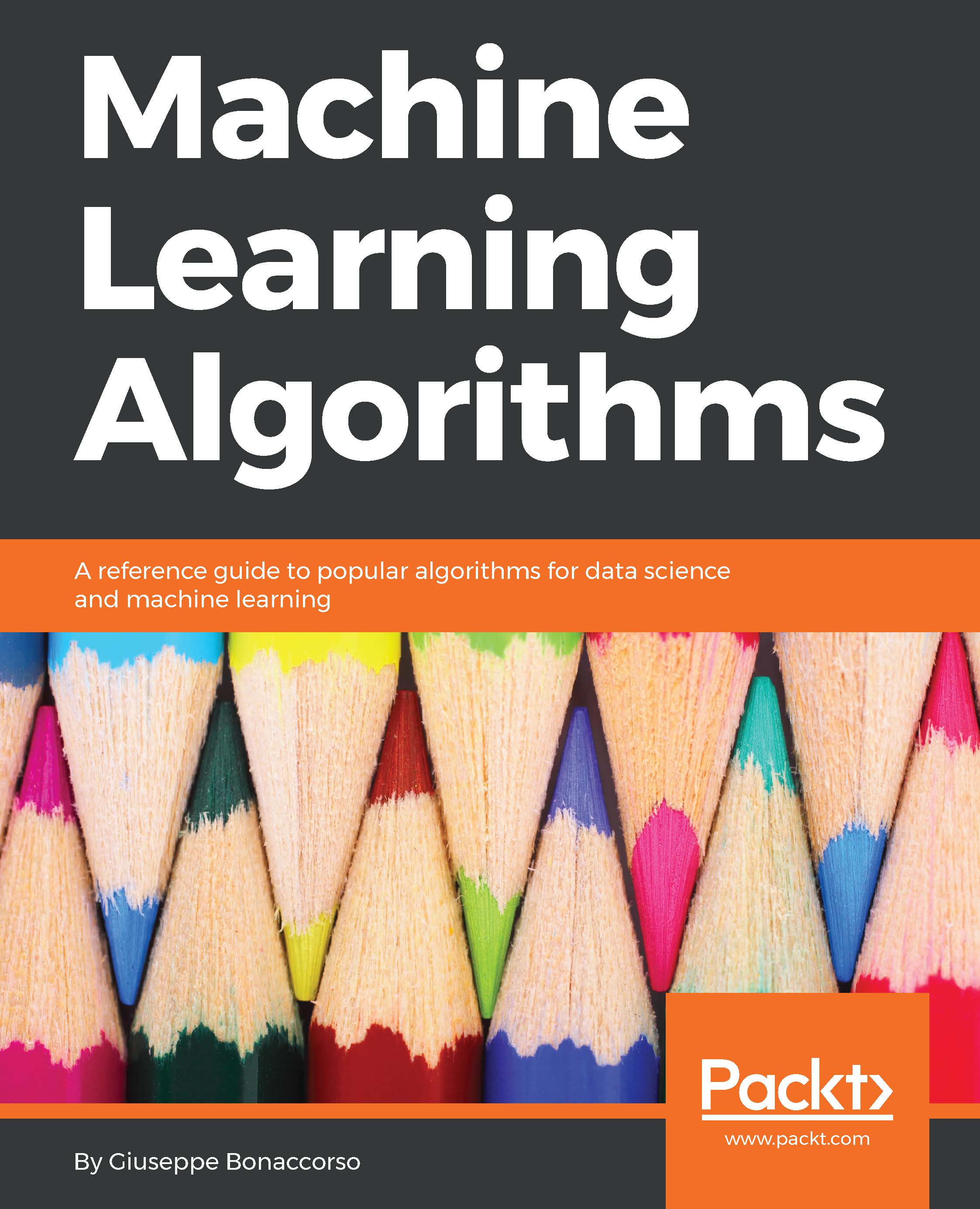
Machine Learning Algorithms

Machine Learning Algorithms

By : Giuseppe Bonaccorso
4.5 (4)
close
close
Machine Learning Algorithms

Machine Learning Algorithms

4.5 (4)
By: Giuseppe Bonaccorso

Overview of this book

In this book, you will learn all the important machine learning algorithms that are commonly used in the field of data science. These algorithms can be used for supervised as well as unsupervised learning, reinforcement learning, and semi-supervised learning. The algorithms that are covered in this book are linear regression, logistic regression, SVM, naïve Bayes, k-means, random forest, TensorFlow and feature engineering. In this book, you will how to use these algorithms to resolve your problems, and how they work. This book will also introduce you to natural language processing and recommendation systems, which help you to run multiple algorithms simultaneously. On completion of the book, you will know how to pick the right machine learning algorithm for clustering, classification, or regression for your problem
Table of Contents (16 chapters)
close
close

Linear regression with scikit-learn and higher dimensionality

The scikit-learn library offers the LinearRegression class, which works with n-dimensional spaces. For this purpose, we're going to use the Boston dataset:

from sklearn.datasets import load_boston

boston = load_boston()

print(boston.data.shape)
(506L, 13L)

print(boston.target.shape)
(506L,)

It has 506 samples with 13 input features and one output. In the following graph, there's a collection of the plots of the first 12 features:

The plot of the first 12 features of the Boston dataset
When working with datasets, it's useful to have a tabular view to manipulate data. Pandas is a perfect framework for this task, and even though it's beyond the scope of this book, I suggest you create a data frame with the pandas.DataFrame(boston.data, columns=boston.feature_names) command and use Jupyter to visualize it...

Visually different images
CONTINUE READING
83
Tech Concepts
36
Programming languages
73
Tech Tools
Icon Unlimited access to the largest independent learning library in tech of over 8,000 expert-authored tech books and videos.
Icon Innovative learning tools, including AI book assistants, code context explainers, and text-to-speech.
Icon 50+ new titles added per month and exclusive early access to books as they are being written.
Machine Learning Algorithms
notes
bookmark Notes and Bookmarks search Search in title playlist Add to playlist download Download options font-size Font size

Change the font size

margin-width Margin width

Change margin width

day-mode Day/Sepia/Night Modes

Change background colour

Close icon Search
Country selected

Close icon Your notes and bookmarks

Confirmation

Modal Close icon
claim successful

Buy this book with your credits?

Modal Close icon
Are you sure you want to buy this book with one of your credits?
Close
YES, BUY

Submit Your Feedback

Modal Close icon
Modal Close icon
Modal Close icon