Sign In Start Free Trial
Account

Add to playlist

Create a Playlist

Modal Close icon
You need to login to use this feature.
  • Book Overview & Buying Python Deep Learning
  • Table Of Contents Toc
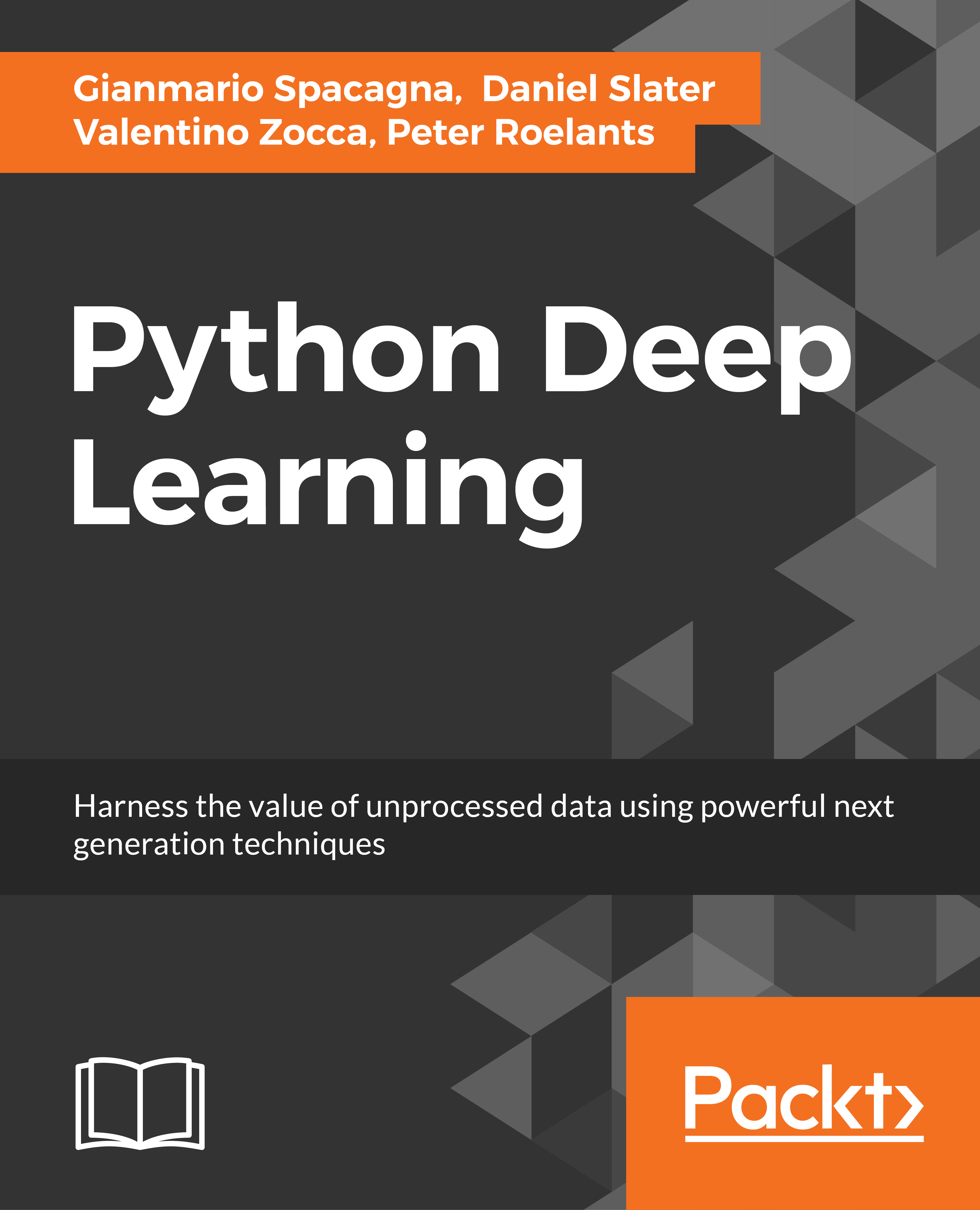
Python Deep Learning

Python Deep Learning

By : Valentino Zocca, Gianmario Spacagna, Daniel Slater, Peter Roelants
4.1 (10)
close
close
Python Deep Learning

Python Deep Learning

4.1 (10)
By: Valentino Zocca, Gianmario Spacagna, Daniel Slater, Peter Roelants

Overview of this book

With an increasing interest in AI around the world, deep learning has attracted a great deal of public attention. Every day, deep learning algorithms are used broadly across different industries. The book will give you all the practical information available on the subject, including the best practices, using real-world use cases. You will learn to recognize and extract information to increase predictive accuracy and optimize results. Starting with a quick recap of important machine learning concepts, the book will delve straight into deep learning principles using Sci-kit learn. Moving ahead, you will learn to use the latest open source libraries such as Theano, Keras, Google's TensorFlow, and H20. Use this guide to uncover the difficulties of pattern recognition, scaling data with greater accuracy and discussing deep learning algorithms and techniques. Whether you want to dive deeper into Deep Learning, or want to investigate how to get more out of this powerful technology, you’ll find everything inside.
Table of Contents (12 chapters)
close
close
11
Index

Chapter 3. Deep Learning Fundamentals

In Chapter 1, Machine Learning – An Introduction, we introduced machine learning and some of its applications, and we briefly talked about a few different algorithms and techniques that can be used to implement machine learning. In Chapter 2, Neural Networks, we concentrated on neural networks; we have shown that 1-layer networks are too simple and can only work on linear problems, and we have introduced the Universal Approximation Theorem, showing how 2-layer neural networks with just one hidden layer are able to approximate to any degree any continuous function on a compact subset of R n.

In this chapter, we will introduce deep learning and deep neural networks, that is, neural networks with at least two or more hidden layers. The reader may wonder what is the point of using more than one hidden layer, given the Universal Approximation Theorem, and this is in no way a naïve question, since for a long period the neural networks...

CONTINUE READING
83
Tech Concepts
36
Programming languages
73
Tech Tools
Icon Unlimited access to the largest independent learning library in tech of over 8,000 expert-authored tech books and videos.
Icon Innovative learning tools, including AI book assistants, code context explainers, and text-to-speech.
Icon 50+ new titles added per month and exclusive early access to books as they are being written.
Python Deep Learning
notes
bookmark Notes and Bookmarks search Search in title playlist Add to playlist download Download options font-size Font size

Change the font size

margin-width Margin width

Change margin width

day-mode Day/Sepia/Night Modes

Change background colour

Close icon Search
Country selected

Close icon Your notes and bookmarks

Confirmation

Modal Close icon
claim successful

Buy this book with your credits?

Modal Close icon
Are you sure you want to buy this book with one of your credits?
Close
YES, BUY

Submit Your Feedback

Modal Close icon
Modal Close icon
Modal Close icon