Sign In Start Free Trial
Account

Add to playlist

Create a Playlist

Modal Close icon
You need to login to use this feature.
  • Book Overview & Buying R Deep Learning Cookbook
  • Table Of Contents Toc
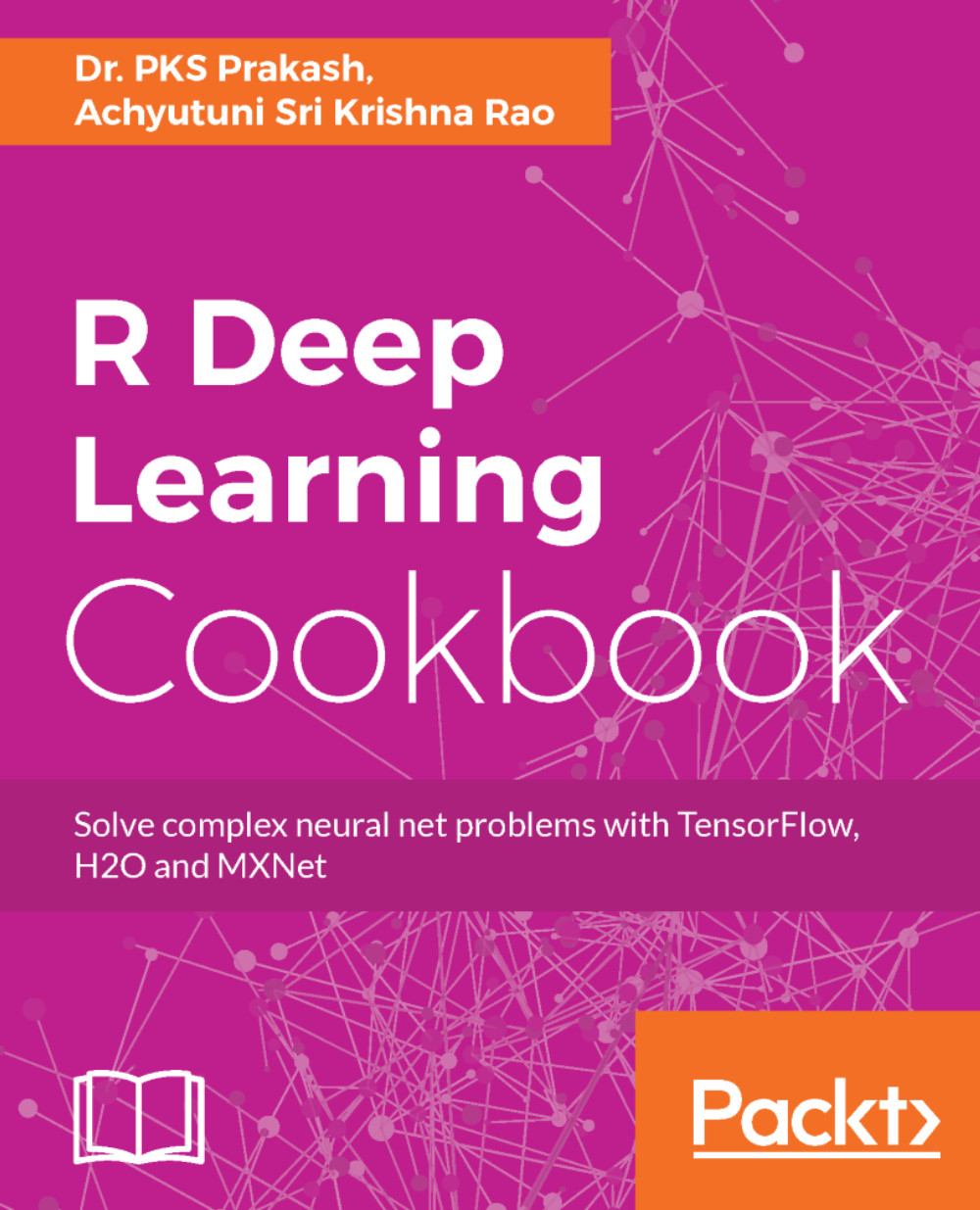
R Deep Learning Cookbook

R Deep Learning Cookbook

By : PKS Prakash, Sri Krishna Rao
1 (1)
close
close
R Deep Learning Cookbook

R Deep Learning Cookbook

1 (1)
By: PKS Prakash, Sri Krishna Rao

Overview of this book

Deep Learning is the next big thing. It is a part of machine learning. It's favorable results in applications with huge and complex data is remarkable. Simultaneously, R programming language is very popular amongst the data miners and statisticians. This book will help you to get through the problems that you face during the execution of different tasks and Understand hacks in deep learning, neural networks, and advanced machine learning techniques. It will also take you through complex deep learning algorithms and various deep learning packages and libraries in R. It will be starting with different packages in Deep Learning to neural networks and structures. You will also encounter the applications in text mining and processing along with a comparison between CPU and GPU performance. By the end of the book, you will have a logical understanding of Deep learning and different deep learning packages to have the most appropriate solutions for your problems.
Table of Contents (11 chapters)
close
close

Building an RBM model


In this recipe, we will build an RBM model as discussed (in detail) in Chapter 5, Generative Models in Deep Learning.

Getting ready

Let's set up our system for the model:

  1. In Piano, the lowest note is 24 and the highest is 102; hence, the range of notes is 78. Thus, the number of columns in the encoded matrix is 156 (that is, 78 for note-on and 78 for note-off):
lowest_note = 24L 
highest_note = 102L 
note_range = highest_note-lowest_note 
  1. We will create notes for 15 number of steps at a time with 2,340 nodes in the input layer and 50 nodes in the hidden layer:
num_timesteps  = 15L 
num_input      = 2L*note_range*num_timesteps 
num_hidden       = 50L 
 
  1. The learning rate (alpha) is 0.1:
alpha<-0.1 
 

How to do it...

Looking into the steps of building an RBM model:

  1. Define the placeholder variables:
vb <- tf$placeholder(tf$float32, shape = shape(num_input)) 
hb <- tf$placeholder(tf$float32, shape = shape(num_hidden)) 
W <- tf$placeholder(tf$float32, shape = shape(num_input...
CONTINUE READING
83
Tech Concepts
36
Programming languages
73
Tech Tools
Icon Unlimited access to the largest independent learning library in tech of over 8,000 expert-authored tech books and videos.
Icon Innovative learning tools, including AI book assistants, code context explainers, and text-to-speech.
Icon 50+ new titles added per month and exclusive early access to books as they are being written.
R Deep Learning Cookbook
notes
bookmark Notes and Bookmarks search Search in title playlist Add to playlist download Download options font-size Font size

Change the font size

margin-width Margin width

Change margin width

day-mode Day/Sepia/Night Modes

Change background colour

Close icon Search
Country selected

Close icon Your notes and bookmarks

Confirmation

Modal Close icon
claim successful

Buy this book with your credits?

Modal Close icon
Are you sure you want to buy this book with one of your credits?
Close
YES, BUY

Submit Your Feedback

Modal Close icon
Modal Close icon
Modal Close icon