Sign In Start Free Trial
Account

Add to playlist

Create a Playlist

Modal Close icon
You need to login to use this feature.
  • Book Overview & Buying Learning Data Mining with Python
  • Table Of Contents Toc
Learning Data Mining with Python

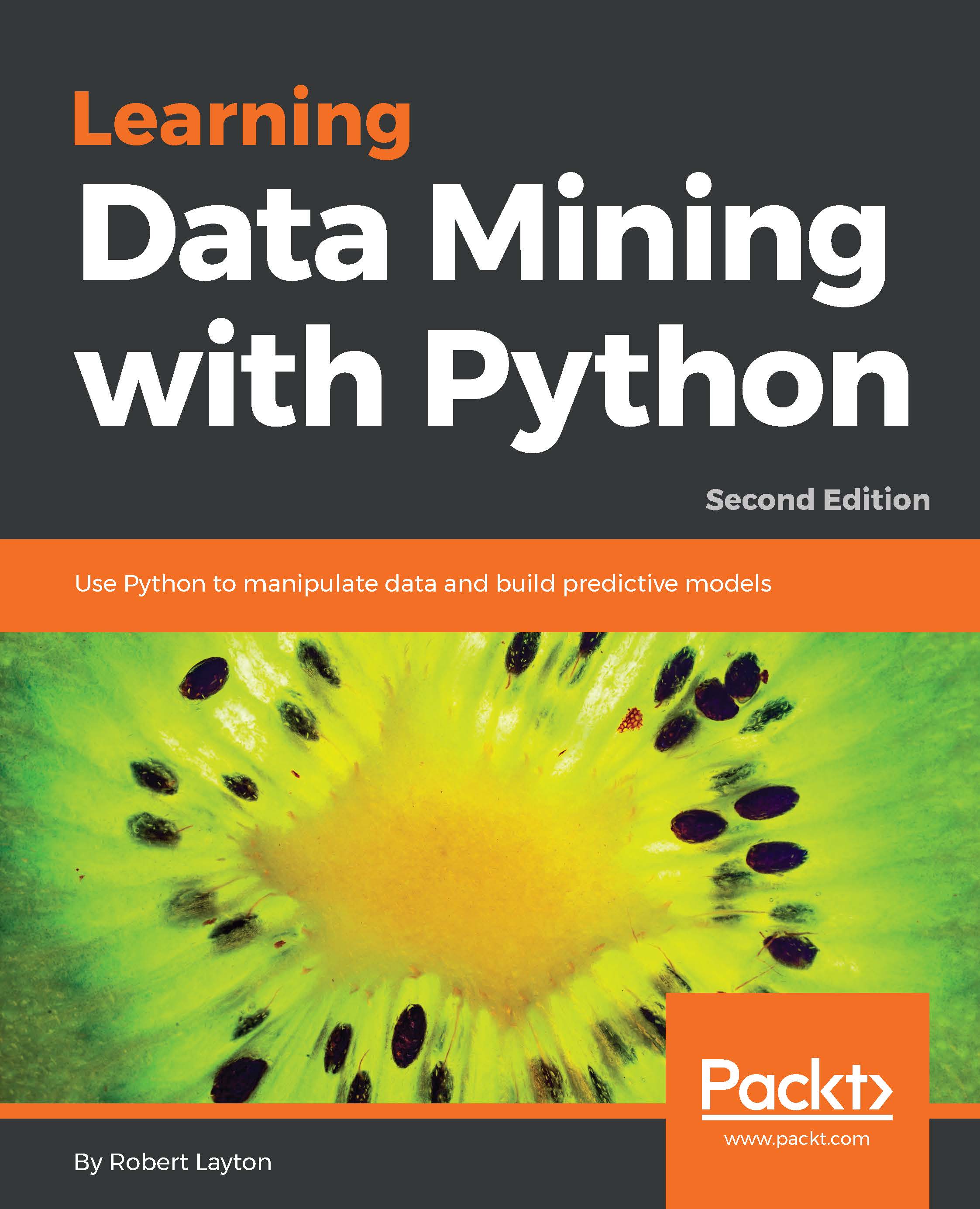
Learning Data Mining with Python - Second Edition

By : Robert Layton
close
close
Learning Data Mining with Python

Learning Data Mining with Python

By: Robert Layton

Overview of this book

This book teaches you to design and develop data mining applications using a variety of datasets, starting with basic classification and affinity analysis. This book covers a large number of libraries available in Python, including the Jupyter Notebook, pandas, scikit-learn, and NLTK. You will gain hands on experience with complex data types including text, images, and graphs. You will also discover object detection using Deep Neural Networks, which is one of the big, difficult areas of machine learning right now. With restructured examples and code samples updated for the latest edition of Python, each chapter of this book introduces you to new algorithms and techniques. By the end of the book, you will have great insights into using Python for data mining and understanding of the algorithms as well as implementations.
Table of Contents (14 chapters)
close
close

The k-means algorithm


The k-means clustering algorithm finds centroids that best represent the data using an iterative process. The algorithm starts with a predefined set of centroids, which are normally data points taken from the training data. The k in k-means is the number of centroids to look for and how many clusters the algorithm will find. For instance, setting k to 3 will find three clusters in the dataset.

There are two phases to the k-means: assignment and updating. They are explained as below:

  • In the assignment step, we set a label to every sample in the dataset linking it to the nearest centroid. For each sample nearest to centroid 1, we assign the label 1. For each sample nearest to centroid 2, we assign a label 2 and so on for each of the k centroids. These labels form the clusters, so we say that each data point with the label 1 is in cluster 1 (at this time only, as assignments can change as the algorithm runs).
  • In the updating step, we take each of the clusters and compute...
CONTINUE READING
83
Tech Concepts
36
Programming languages
73
Tech Tools
Icon Unlimited access to the largest independent learning library in tech of over 8,000 expert-authored tech books and videos.
Icon Innovative learning tools, including AI book assistants, code context explainers, and text-to-speech.
Icon 50+ new titles added per month and exclusive early access to books as they are being written.
Learning Data Mining with Python
notes
bookmark Notes and Bookmarks search Search in title playlist Add to playlist download Download options font-size Font size

Change the font size

margin-width Margin width

Change margin width

day-mode Day/Sepia/Night Modes

Change background colour

Close icon Search
Country selected

Close icon Your notes and bookmarks

Confirmation

Modal Close icon
claim successful

Buy this book with your credits?

Modal Close icon
Are you sure you want to buy this book with one of your credits?
Close
YES, BUY

Submit Your Feedback

Modal Close icon
Modal Close icon
Modal Close icon