Sign In Start Free Trial
Account

Add to playlist

Create a Playlist

Modal Close icon
You need to login to use this feature.
  • Book Overview & Buying Practical Data Science Cookbook, Second Edition
  • Table Of Contents Toc
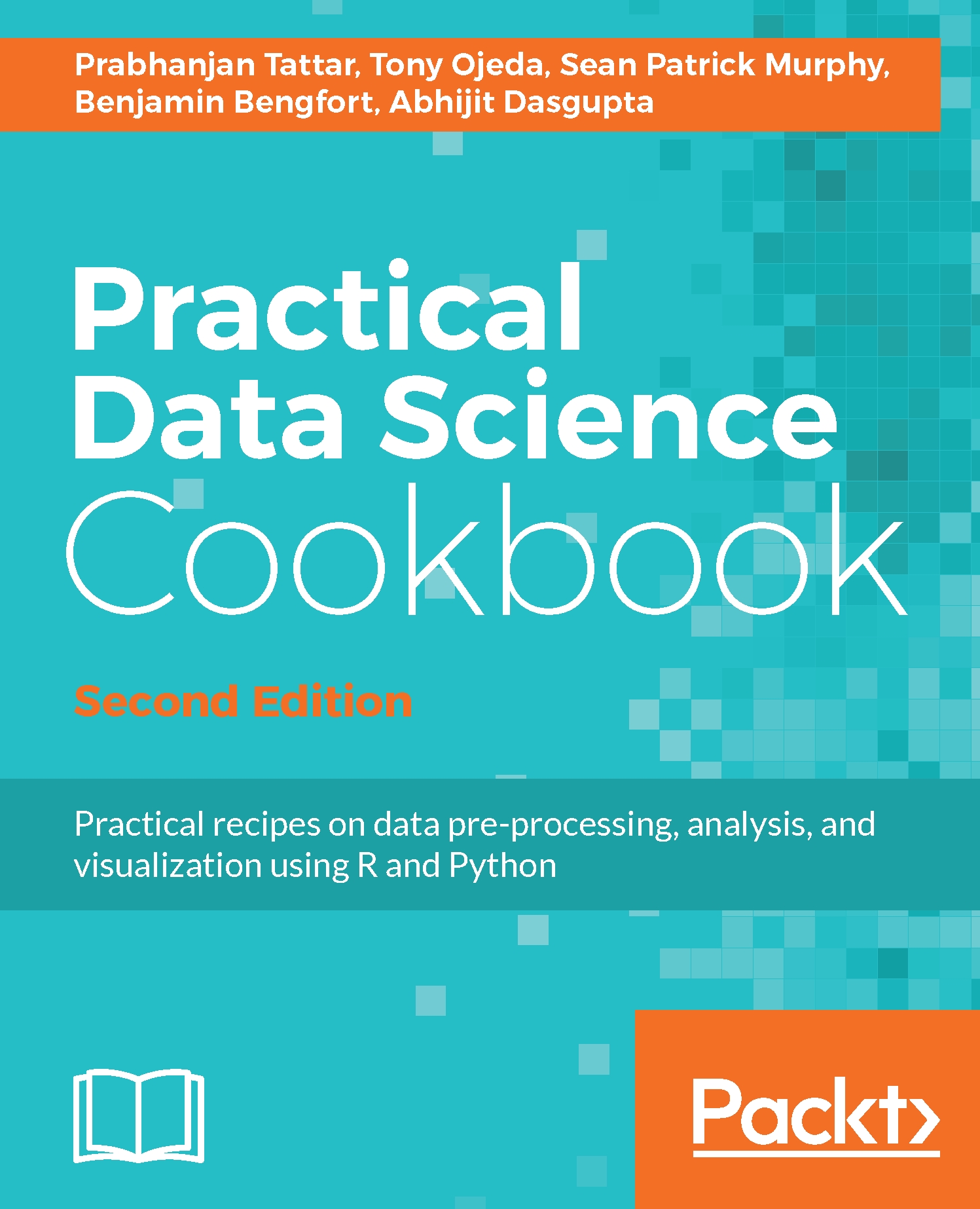
Practical Data Science Cookbook, Second Edition

Practical Data Science Cookbook, Second Edition - Second Edition

By : Tattar, Bhushan Purushottam Joshi, Sean P Murphy, ABHIJIT DASGUPTA, Anthony Ojeda
close
close
Practical Data Science Cookbook, Second Edition

Practical Data Science Cookbook, Second Edition

By: Tattar, Bhushan Purushottam Joshi, Sean P Murphy, ABHIJIT DASGUPTA, Anthony Ojeda

Overview of this book

As increasing amounts of data are generated each year, the need to analyze and create value out of it is more important than ever. Companies that know what to do with their data and how to do it well will have a competitive advantage over companies that don’t. Because of this, there will be an increasing demand for people that possess both the analytical and technical abilities to extract valuable insights from data and create valuable solutions that put those insights to use. Starting with the basics, this book covers how to set up your numerical programming environment, introduces you to the data science pipeline, and guides you through several data projects in a step-by-step format. By sequentially working through the steps in each chapter, you will quickly familiarize yourself with the process and learn how to apply it to a variety of situations with examples using the two most popular programming languages for data analysis—R and Python.
Table of Contents (12 chapters)
close
close

Introduction


Weather prediction, Sensex prediction, sales prediction, and so on, are some of the common problems that are of interest to most who look up to Statistics or Machine Learning methods. The purpose is, of course, to get the prediction for the next few periods using models with reasonable accuracy. Weather prediction helps in planning for the vocational trip, Sensex prediction helps in investment planning, and sales prediction in an optimum inventory planning. The common structure among each of the three problems is that the observations are available, in general, at equally spaced time/epoch. The observations may have been obtained on a daily, weekly, or monthly basis and we will refer to such data as time series data. The observations are collected over a long time in the past and we believe that we have captured enough characteristics/traits of the series so that analytical models built on such historic data will have predictable power and we can obtain fairly accurate forecasts...

CONTINUE READING
83
Tech Concepts
36
Programming languages
73
Tech Tools
Icon Unlimited access to the largest independent learning library in tech of over 8,000 expert-authored tech books and videos.
Icon Innovative learning tools, including AI book assistants, code context explainers, and text-to-speech.
Icon 50+ new titles added per month and exclusive early access to books as they are being written.
Practical Data Science Cookbook, Second Edition
notes
bookmark Notes and Bookmarks search Search in title playlist Add to playlist download Download options font-size Font size

Change the font size

margin-width Margin width

Change margin width

day-mode Day/Sepia/Night Modes

Change background colour

Close icon Search
Country selected

Close icon Your notes and bookmarks

Confirmation

Modal Close icon
claim successful

Buy this book with your credits?

Modal Close icon
Are you sure you want to buy this book with one of your credits?
Close
YES, BUY

Submit Your Feedback

Modal Close icon
Modal Close icon
Modal Close icon