Sign In Start Free Trial
Account

Add to playlist

Create a Playlist

Modal Close icon
You need to login to use this feature.
  • Book Overview & Buying Java Data Analysis
  • Table Of Contents Toc
Java Data Analysis

Java Data Analysis

By : John R. Hubbard
close
close
Java Data Analysis

Java Data Analysis

By: John R. Hubbard

Overview of this book

Data analysis is a process of inspecting, cleansing, transforming, and modeling data with the aim of discovering useful information. Java is one of the most popular languages to perform your data analysis tasks. This book will help you learn the tools and techniques in Java to conduct data analysis without any hassle. After getting a quick overview of what data science is and the steps involved in the process, you’ll learn the statistical data analysis techniques and implement them using the popular Java APIs and libraries. Through practical examples, you will also learn the machine learning concepts such as classification and regression. In the process, you’ll familiarize yourself with tools such as Rapidminer and WEKA and see how these Java-based tools can be used effectively for analysis. You will also learn how to analyze text and other types of multimedia. Learn to work with relational, NoSQL, and time-series data. This book will also show you how you can utilize different Java-based libraries to create insightful and easy to understand plots and graphs. By the end of this book, you will have a solid understanding of the various data analysis techniques, and how to implement them using Java.
Table of Contents (14 chapters)
close
close
13
Index

Conditional probability


A conditional probability is one that is computed under the assumption that some related event is known to have occurred. For example, in the marble experiment, if we know that the first marble drawn was red, then the probability that the second marble is green is 4/5 = 80%. This is a conditional probability, the condition being that the first marble was red. It is written as:

(The vertical bar symbol | is read as "given").

On the other hand, the (unconditional) probability that the second marble is green is:

It should seem sensible that the probability that the second marble is green is greater (80%) after having removed a red marble. It should also seem sensible that the unconditional probability of green on the second (67%) is the same as the probability that the first is green (4/6).

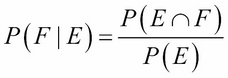
The general formula for the conditional probability of an event F, given an event E, is

The symbolism E ∩ F means "E and F".

To apply this formula to our marbles example, let E be the...

CONTINUE READING
83
Tech Concepts
36
Programming languages
73
Tech Tools
Icon Unlimited access to the largest independent learning library in tech of over 8,000 expert-authored tech books and videos.
Icon Innovative learning tools, including AI book assistants, code context explainers, and text-to-speech.
Icon 50+ new titles added per month and exclusive early access to books as they are being written.
Java Data Analysis
notes
bookmark Notes and Bookmarks search Search in title playlist Add to playlist download Download options font-size Font size

Change the font size

margin-width Margin width

Change margin width

day-mode Day/Sepia/Night Modes

Change background colour

Close icon Search
Country selected

Close icon Your notes and bookmarks

Confirmation

Modal Close icon
claim successful

Buy this book with your credits?

Modal Close icon
Are you sure you want to buy this book with one of your credits?
Close
YES, BUY

Submit Your Feedback

Modal Close icon
Modal Close icon
Modal Close icon