
Sign In Start Free Trial
Account

Add to playlist

Create a Playlist

Modal Close icon
You need to login to use this feature.
  • Book Overview & Buying Statistics for Data Science
  • Table Of Contents Toc
Statistics for Data Science

Statistics for Data Science

By : James D. Miller
3.6 (5)
close
close
Statistics for Data Science

Statistics for Data Science

3.6 (5)
By: James D. Miller

Overview of this book

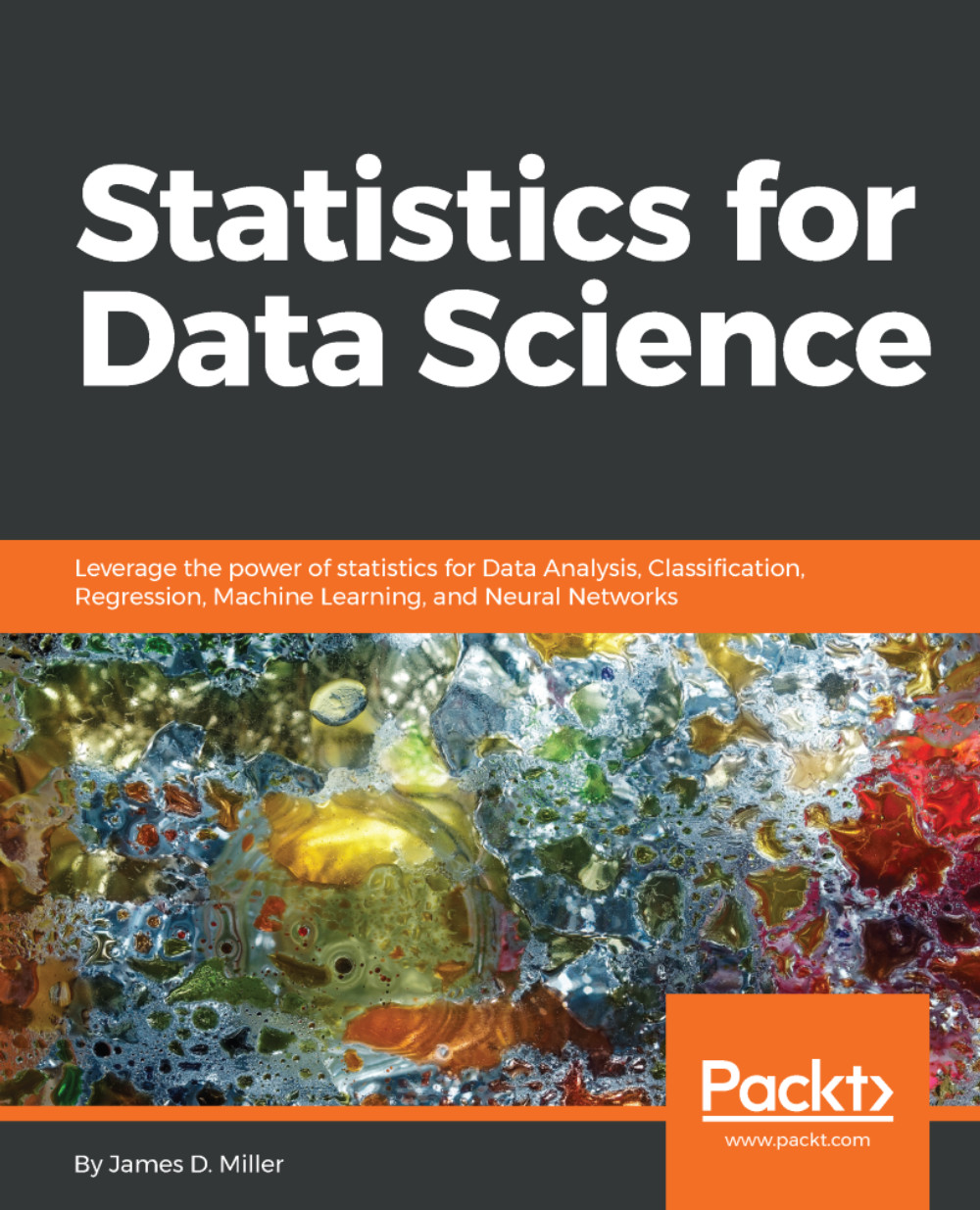
Data science is an ever-evolving field, which is growing in popularity at an exponential rate. Data science includes techniques and theories extracted from the fields of statistics; computer science, and, most importantly, machine learning, databases, data visualization, and so on. This book takes you through an entire journey of statistics, from knowing very little to becoming comfortable in using various statistical methods for data science tasks. It starts off with simple statistics and then move on to statistical methods that are used in data science algorithms. The R programs for statistical computation are clearly explained along with logic. You will come across various mathematical concepts, such as variance, standard deviation, probability, matrix calculations, and more. You will learn only what is required to implement statistics in data science tasks such as data cleaning, mining, and analysis. You will learn the statistical techniques required to perform tasks such as linear regression, regularization, model assessment, boosting, SVMs, and working with neural networks. By the end of the book, you will be comfortable with performing various statistical computations for data science programmatically.
Table of Contents (13 chapters)
close
close

Transitioning from Data Developer to Data Scientist

In this chapter (and throughout all of the chapters of this book), we will chart your course for starting and continuing the journey from thinking like a data developer to thinking like a data scientist.

Using developer terminologies and analogies, we will discuss a developer's objectives, what a typical developer mindset might be like, how it differs from a data scientist's mindset, why there are important differences (as well as similarities) between the two and suggest how to transition yourself into thinking like a data scientist. Finally, we will suggest certain advantages of understanding statistics and data science, taking a data perspective, as well as simply thinking like a data scientist.

In this chapter, we've broken things into the following topics:

  • The objectives of the data developer role
  • How a data developer thinks
  • The differences between a data developer and a data scientist
  • Advantages of thinking like a data scientist
  • The steps for transitioning into a data scientist mindset

So, let's get started!

CONTINUE READING
83
Tech Concepts
36
Programming languages
73
Tech Tools
Icon Unlimited access to the largest independent learning library in tech of over 8,000 expert-authored tech books and videos.
Icon Innovative learning tools, including AI book assistants, code context explainers, and text-to-speech.
Icon 50+ new titles added per month and exclusive early access to books as they are being written.
Statistics for Data Science
notes
bookmark Notes and Bookmarks search Search in title playlist Add to playlist download Download options font-size Font size

Change the font size

margin-width Margin width

Change margin width

day-mode Day/Sepia/Night Modes

Change background colour

Close icon Search
Country selected

Close icon Your notes and bookmarks

Confirmation

Modal Close icon
claim successful

Buy this book with your credits?

Modal Close icon
Are you sure you want to buy this book with one of your credits?
Close
YES, BUY

Submit Your Feedback

Modal Close icon
Modal Close icon
Modal Close icon