Sign In Start Free Trial
Account

Add to playlist

Create a Playlist

Modal Close icon
You need to login to use this feature.
  • Book Overview & Buying Deep Learning with TensorFlow
  • Table Of Contents Toc
Deep Learning with TensorFlow

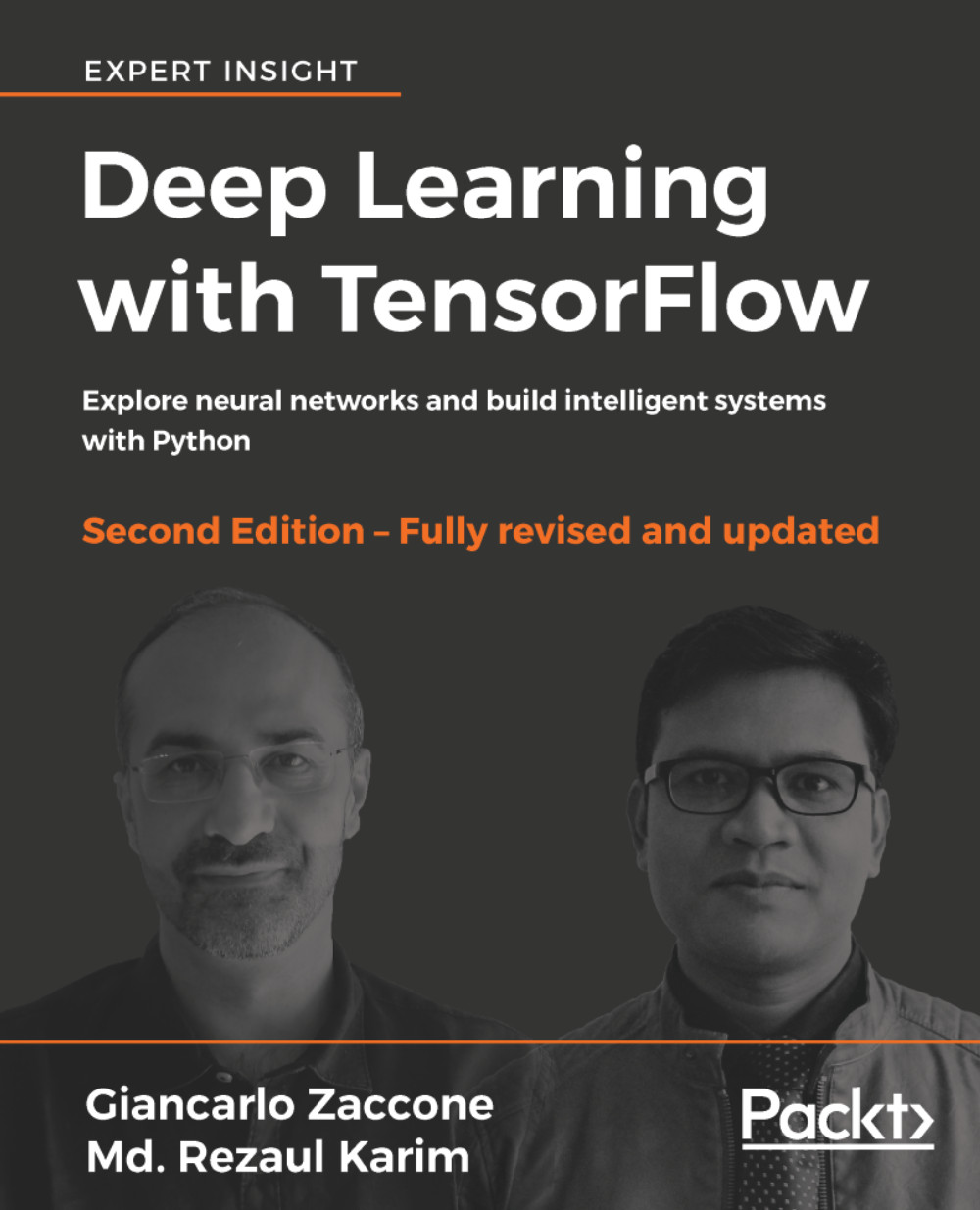
Deep Learning with TensorFlow - Second Edition

By : Zaccone, Karim
3 (4)
close
close
Deep Learning with TensorFlow

Deep Learning with TensorFlow

3 (4)
By: Zaccone, Karim

Overview of this book

Deep learning is a branch of machine learning algorithms based on learning multiple levels of abstraction. Neural networks, which are at the core of deep learning, are being used in predictive analytics, computer vision, natural language processing, time series forecasting, and to perform a myriad of other complex tasks. This book is conceived for developers, data analysts, machine learning practitioners and deep learning enthusiasts who want to build powerful, robust, and accurate predictive models with the power of TensorFlow, combined with other open source Python libraries. Throughout the book, you’ll learn how to develop deep learning applications for machine learning systems using Feedforward Neural Networks, Convolutional Neural Networks, Recurrent Neural Networks, Autoencoders, and Factorization Machines. Discover how to attain deep learning programming on GPU in a distributed way. You'll come away with an in-depth knowledge of machine learning techniques and the skills to apply them to real-world projects.
Table of Contents (13 chapters)
close
close
12
Index

Chapter 5. Optimizing TensorFlow Autoencoders

In Machine Learning (ML), the so-called curse of dimensionality is a progressive decline in performance with an increase in the input space, often with hundreds or thousands of dimensions, which does not occur in low-dimensional settings such as three-dimensional space. This occurs because the number of samples needed to obtain a sufficient sampling of the input space increases exponentially with the number of dimensions. To overcome this problem, some optimizing networks have been developed.

The first one is autoencoder networks. These are designed and trained to transform an input pattern in itself so that in the presence of a degraded or incomplete version of an input pattern, it is possible to obtain the original pattern. An autoencoder is a Neural Network (NN). The network is trained to create output data like those presented in the entrance and the hidden layer stores the compressed data.

The second optimizing networks are Boltzmann...

CONTINUE READING
83
Tech Concepts
36
Programming languages
73
Tech Tools
Icon Unlimited access to the largest independent learning library in tech of over 8,000 expert-authored tech books and videos.
Icon Innovative learning tools, including AI book assistants, code context explainers, and text-to-speech.
Icon 50+ new titles added per month and exclusive early access to books as they are being written.
Deep Learning with TensorFlow
notes
bookmark Notes and Bookmarks search Search in title playlist Add to playlist download Download options font-size Font size

Change the font size

margin-width Margin width

Change margin width

day-mode Day/Sepia/Night Modes

Change background colour

Close icon Search
Country selected

Close icon Your notes and bookmarks

Confirmation

Modal Close icon
claim successful

Buy this book with your credits?

Modal Close icon
Are you sure you want to buy this book with one of your credits?
Close
YES, BUY

Submit Your Feedback

Modal Close icon
Modal Close icon
Modal Close icon