
Sign In Start Free Trial
Account

Add to playlist

Create a Playlist

Modal Close icon
You need to login to use this feature.
  • Book Overview & Buying Hands-On Transfer Learning with Python
  • Table Of Contents Toc
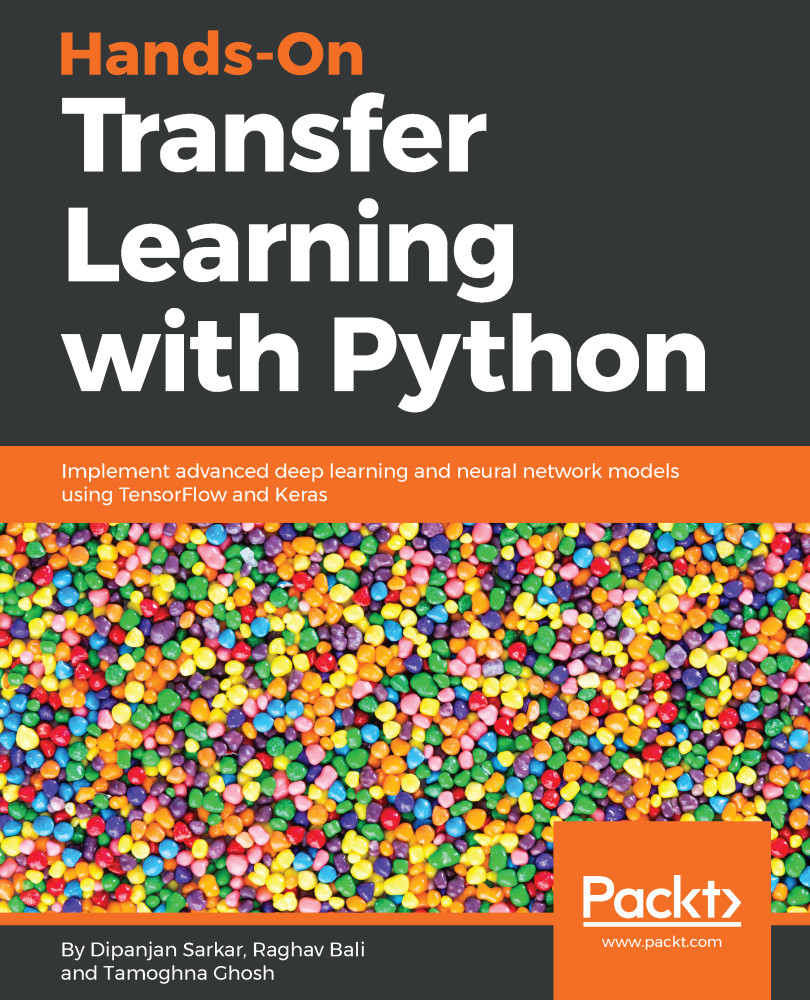
Hands-On Transfer Learning with Python

Hands-On Transfer Learning with Python

By : Nitin Panwar, Sarkar, Raghav Bali, Tamoghna Ghosh
4 (3)
close
close
Hands-On Transfer Learning with Python

Hands-On Transfer Learning with Python

4 (3)
By: Nitin Panwar, Sarkar, Raghav Bali, Tamoghna Ghosh

Overview of this book

Transfer learning is a machine learning (ML) technique where knowledge gained during training a set of problems can be used to solve other similar problems. The purpose of this book is two-fold; firstly, we focus on detailed coverage of deep learning (DL) and transfer learning, comparing and contrasting the two with easy-to-follow concepts and examples. The second area of focus is real-world examples and research problems using TensorFlow, Keras, and the Python ecosystem with hands-on examples. The book starts with the key essential concepts of ML and DL, followed by depiction and coverage of important DL architectures such as convolutional neural networks (CNNs), deep neural networks (DNNs), recurrent neural networks (RNNs), long short-term memory (LSTM), and capsule networks. Our focus then shifts to transfer learning concepts, such as model freezing, fine-tuning, pre-trained models including VGG, inception, ResNet, and how these systems perform better than DL models with practical examples. In the concluding chapters, we will focus on a multitude of real-world case studies and problems associated with areas such as computer vision, audio analysis and natural language processing (NLP). By the end of this book, you will be able to implement both DL and transfer learning principles in your own systems.
Table of Contents (14 chapters)
close
close

Machine Learning Fundamentals

One day the AIs are going to look back on us the same way we look at fossil skeletons on the plains of Africa. An upright ape living in dust with crude language and tools, all set for extinction.
– Nathan Bateman, Ex Machina (Movie 2014)

This quote may seem exaggerated to the core and difficult to digest, yet, with the pace at which technology and science are improving, who knows? We as a species have always dreamt of creating intelligent, self-aware machines. With recent advancements in research, technology, and the democratization of computing power, artificial intelligence (AI), machine learning (ML), and deep learning have gotten enormous attention and hype amongst technologists and the population in general. Though Hollywood's promised future is debatable, we have started to see and use glimpses of intelligent systems in our daily lives. From intelligent conversational engines, such as Google Now, Siri, Alexa, and Cortana, to self-driving cars, we are gradually accepting such smart technologies in our daily routines.

As we step into the new era of learning machines, it is important to understand that the fundamental ideas and concepts have existed for some time and have constantly been improved upon by intelligent people across the planet. It is well known that 90% of the world's data has been created in just the last couple of years, and we continue to create far more data at ever increasing rates. The realm of ML, deep learning, and AI helps us utilize these massive amounts of data to solve various real-world problems.

This book is divided into three sections. In this first section, we will get started with the basic concepts and terminologies associated with AI, ML, and deep learning, followed by in-depth details on deep learning architectures.

This chapter provides our readers with a quick primer on the basic concepts of ML before we get started with deep learning in subsequent chapters. This chapter covers the following aspects:

  • Introduction to ML
  • ML methodologies
  • CRISP-DM—workflow for ML projects
  • ML pipelines
  • Exploratory data analysis
  • Feature extraction and engineering
  • Feature selection

Every chapter of the book builds upon concepts and techniques from the previous chapters. Readers who are well-versed with the basics of ML and deep learning may pick and choose the topics as they deem necessary, yet it is advised to go through the chapters sequentially. The code for this chapter is available for quick reference in the Chapter 1 folder in the GitHub repository at https://github.com/dipanjanS/hands-on-transfer-learning-with-python which you can refer to as needed to follow along with the chapter.

CONTINUE READING
83
Tech Concepts
36
Programming languages
73
Tech Tools
Icon Unlimited access to the largest independent learning library in tech of over 8,000 expert-authored tech books and videos.
Icon Innovative learning tools, including AI book assistants, code context explainers, and text-to-speech.
Icon 50+ new titles added per month and exclusive early access to books as they are being written.
Hands-On Transfer Learning with Python
notes
bookmark Notes and Bookmarks search Search in title playlist Add to playlist download Download options font-size Font size

Change the font size

margin-width Margin width

Change margin width

day-mode Day/Sepia/Night Modes

Change background colour

Close icon Search
Country selected

Close icon Your notes and bookmarks

Confirmation

Modal Close icon
claim successful

Buy this book with your credits?

Modal Close icon
Are you sure you want to buy this book with one of your credits?
Close
YES, BUY

Submit Your Feedback

Modal Close icon
Modal Close icon
Modal Close icon