
Sign In Start Free Trial
Account

Add to playlist

Create a Playlist

Modal Close icon
You need to login to use this feature.
  • Book Overview & Buying Big Data Architect???s Handbook
  • Table Of Contents Toc
  • Feedback & Rating feedback
Big Data Architect???s Handbook

Big Data Architect???s Handbook

By : Akhtar
3 (2)
close
close
Big Data Architect???s Handbook

Big Data Architect???s Handbook

3 (2)
By: Akhtar

Overview of this book

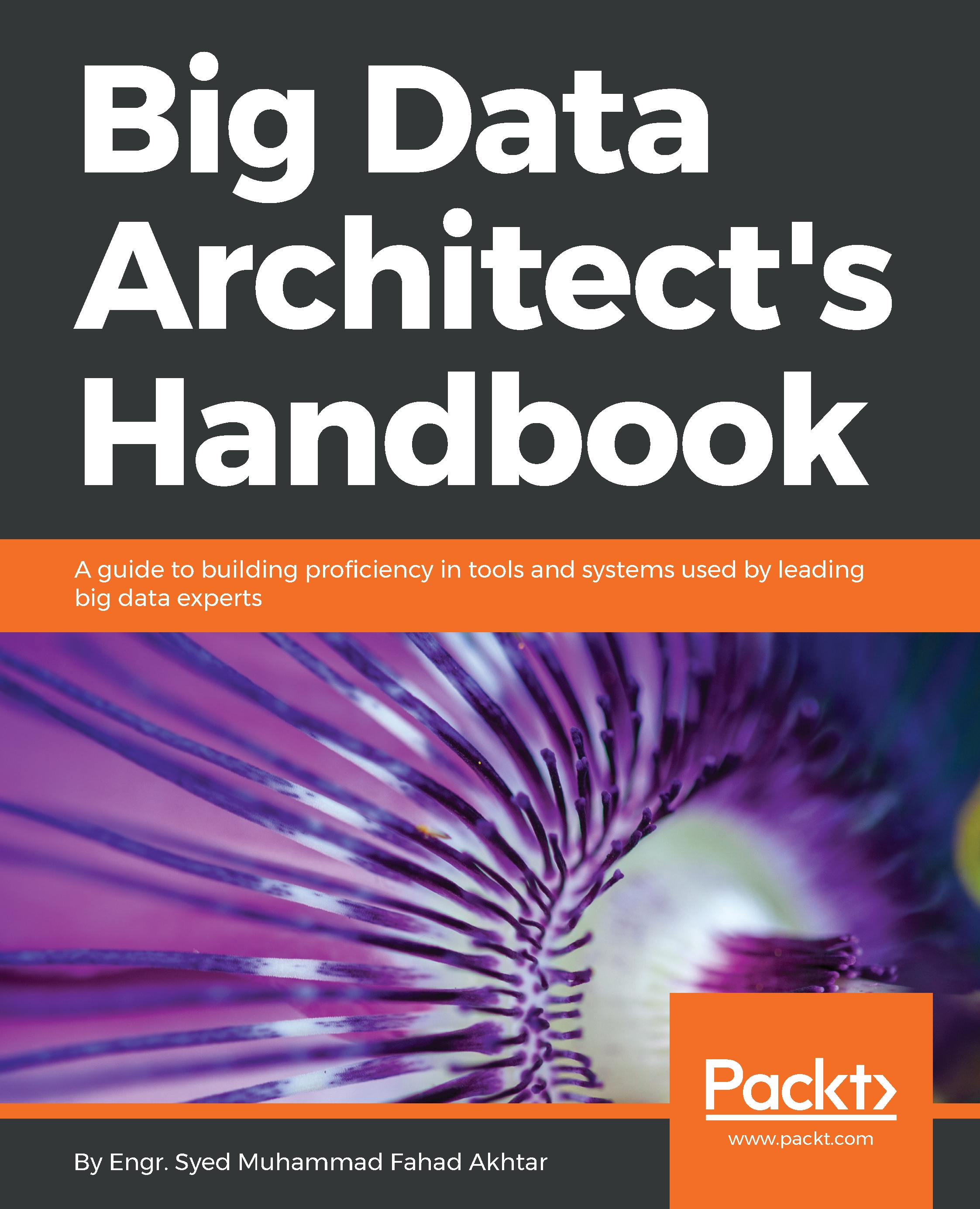
The big data architects are the “masters” of data, and hold high value in today’s market. Handling big data, be it of good or bad quality, is not an easy task. The prime job for any big data architect is to build an end-to-end big data solution that integrates data from different sources and analyzes it to find useful, hidden insights. Big Data Architect’s Handbook takes you through developing a complete, end-to-end big data pipeline, which will lay the foundation for you and provide the necessary knowledge required to be an architect in big data. Right from understanding the design considerations to implementing a solid, efficient, and scalable data pipeline, this book walks you through all the essential aspects of big data. It also gives you an overview of how you can leverage the power of various big data tools such as Apache Hadoop and ElasticSearch in order to bring them together and build an efficient big data solution. By the end of this book, you will be able to build your own design system which integrates, maintains, visualizes, and monitors your data. In addition, you will have a smooth design flow in each process, putting insights in action.
Table of Contents (21 chapters)
close
close
10
Frontend Architecture
17
Data Visualization

Hadoop Distributed File System

The Hadoop Distributed File System (HDFS) is a file system, as the name states, similar to Windows (FAT or NTFS) and Linux (swap, ext3, and so on) that is specifically designed for distributed systems that need to process large datasets with high availability. It is optimized to work with multiple nodes and spread data across them in a clustered computing environment to assure the maximum availability of data. The main difference between HDFS and other distributed file systems is that it is designed to run in a low-cost hardware setup and is highly fault-tolerant. The basic architecture of HDFS is shown in the following diagram:

Figure-3.1.1

HDFS has two main components that basically work using the master and slave concept. These two components are called the Name Node, which is the master node, and the DataNode, which is a slave...

Visually different images
CONTINUE READING
83
Tech Concepts
36
Programming languages
73
Tech Tools
Icon Unlimited access to the largest independent learning library in tech of over 8,000 expert-authored tech books and videos.
Icon Innovative learning tools, including AI book assistants, code context explainers, and text-to-speech.
Icon 50+ new titles added per month and exclusive early access to books as they are being written.
Big Data Architect???s Handbook
notes
bookmark Notes and Bookmarks search Search in title playlist Add to playlist download Download options font-size Font size

Change the font size

margin-width Margin width

Change margin width

day-mode Day/Sepia/Night Modes

Change background colour

Close icon Search
Country selected

Close icon Your notes and bookmarks

Confirmation

Modal Close icon
claim successful

Buy this book with your credits?

Modal Close icon
Are you sure you want to buy this book with one of your credits?
Close
YES, BUY

Submit Your Feedback

Modal Close icon
Modal Close icon
Modal Close icon