
Sign In Start Free Trial
Account

Add to playlist

Create a Playlist

Modal Close icon
You need to login to use this feature.
  • Book Overview & Buying Mastering Numerical Computing with NumPy
  • Table Of Contents Toc
  • Feedback & Rating feedback
Mastering Numerical Computing with NumPy

Mastering Numerical Computing with NumPy

By : Mert Cakmak, Tiago Antao, Cuhadaroglu
5 (1)
close
close
Mastering Numerical Computing with NumPy

Mastering Numerical Computing with NumPy

5 (1)
By: Mert Cakmak, Tiago Antao, Cuhadaroglu

Overview of this book

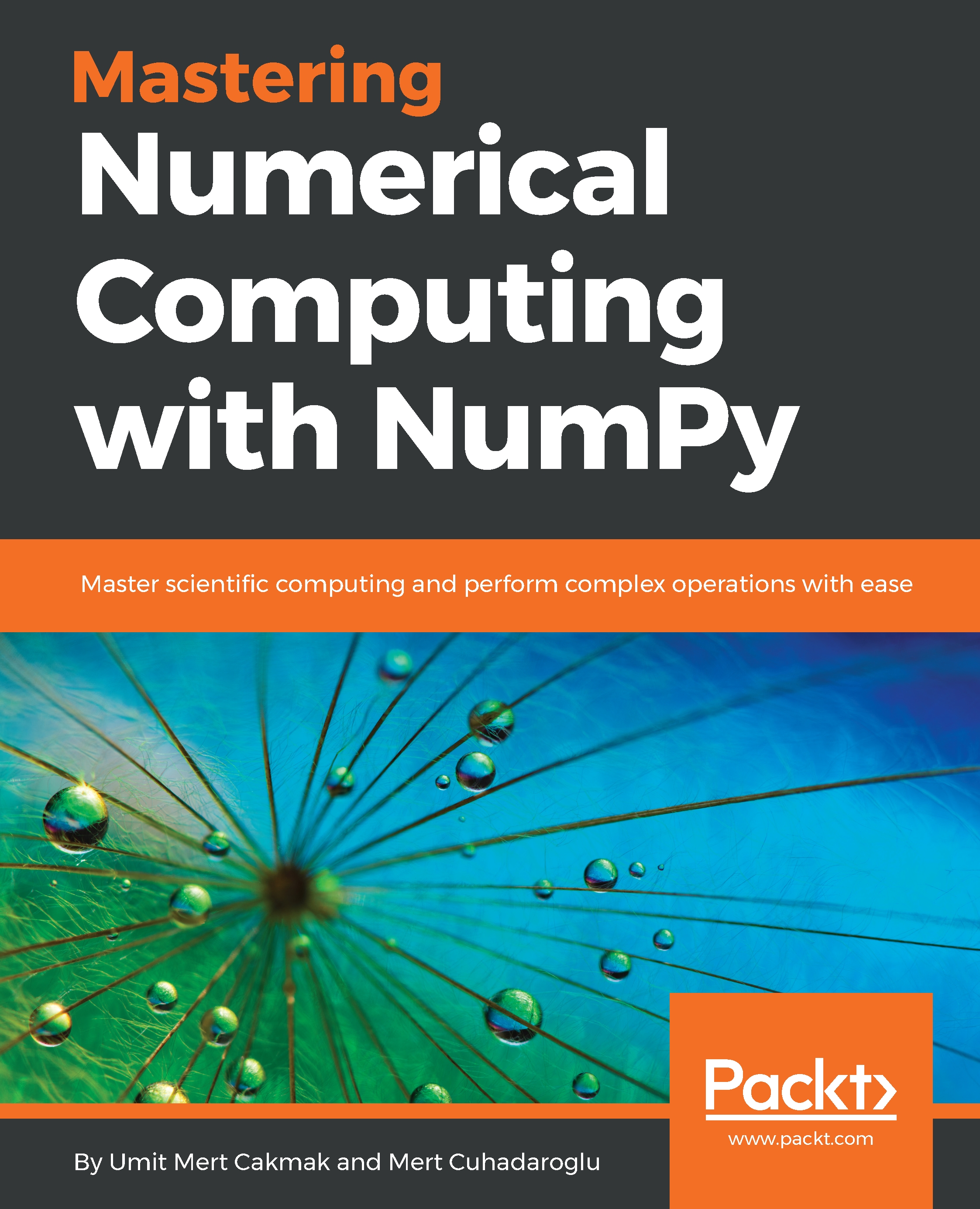
NumPy is one of the most important scientific computing libraries available for Python. Mastering Numerical Computing with NumPy teaches you how to achieve expert level competency to perform complex operations, with in-depth coverage of advanced concepts. Beginning with NumPy's arrays and functions, you will familiarize yourself with linear algebra concepts to perform vector and matrix math operations. You will thoroughly understand and practice data processing, exploratory data analysis (EDA), and predictive modeling. You will then move on to working on practical examples which will teach you how to use NumPy statistics in order to explore US housing data and develop a predictive model using simple and multiple linear regression techniques. Once you have got to grips with the basics, you will explore unsupervised learning and clustering algorithms, followed by understanding how to write better NumPy code while keeping advanced considerations in mind. The book also demonstrates the use of different high-performance numerical computing libraries and their relationship with NumPy. You will study how to benchmark the performance of different configurations and choose the best for your system. By the end of this book, you will have become an expert in handling and performing complex data manipulations.
Table of Contents (11 chapters)
close
close

Working with NumPy Arrays

Scientific computing is a multidisciplinary field, with its applications spanning across disciplines such as numerical analysis, computational finance, and bioinformatics.

Let's consider a case for financial markets. When you think about financial markets, there is a huge interconnected web of interactions. Governments, banks, investment funds, insurance companies, pensions, individual investors, and others are involved in this exchange of financial instruments. You can't simply model all the interactions between market participants because everyone who is involved in financial transactions has different motives and different risk/return objectives. There are also other factors which affect the prices of financial assets. Even modeling one asset price requires you to do a tremendous amount of work, and your success is not guaranteed. In mathematical terms, this doesn't have a closed-form solution and this makes a great case for utilizing scientific computing where you can use advanced computing techniques to attack such problems.

By writing computer programs, you will have the power to better understand the system you are working on. Usually, the computer program you will be writing will be some sort of simulation, such as the Monte Carlo simulation. By using a simulation such as Monte Carlo, you can model the price of option contracts. Pricing financial assets is a good material for simulations, simply because of the complexity of financial markets. All of these mathematical computations need a powerful, scalable and convenient structure for your data (which is mostly in matrix form) when you do your computation. In other words, you need a more compact structure than a list in order to simplify your task. NumPy is a perfect candidate for performant vector/matrix operations and its extensive library of mathematical operations makes numeric computing easy and efficient.

In this chapter, we will cover the following topics:

  • The importance of NumPy
  • Theoretical and practical information about vectors and matrices
  • NumPy array operations and their usage in multidimensional arrays

The question is, where should we start practicing coding skills? In this book, you will be using Python because of its huge adoption in the scientific community, and you will mainly work with a specific library called NumPy, which stands for numerical Python.

Visually different images
CONTINUE READING
83
Tech Concepts
36
Programming languages
73
Tech Tools
Icon Unlimited access to the largest independent learning library in tech of over 8,000 expert-authored tech books and videos.
Icon Innovative learning tools, including AI book assistants, code context explainers, and text-to-speech.
Icon 50+ new titles added per month and exclusive early access to books as they are being written.
Mastering Numerical Computing with NumPy
notes
bookmark Notes and Bookmarks search Search in title playlist Add to playlist download Download options font-size Font size

Change the font size

margin-width Margin width

Change margin width

day-mode Day/Sepia/Night Modes

Change background colour

Close icon Search
Country selected

Close icon Your notes and bookmarks

Confirmation

Modal Close icon
claim successful

Buy this book with your credits?

Modal Close icon
Are you sure you want to buy this book with one of your credits?
Close
YES, BUY

Submit Your Feedback

Modal Close icon
Modal Close icon
Modal Close icon