Sign In Start Free Trial
Account

Add to playlist

Create a Playlist

Modal Close icon
You need to login to use this feature.
  • Book Overview & Buying Machine Learning for Finance
  • Table Of Contents Toc
Machine Learning for Finance

Machine Learning for Finance

By : James Le , Jannes Klaas
4.1 (59)
close
close
Machine Learning for Finance

Machine Learning for Finance

4.1 (59)
By: James Le , Jannes Klaas

Overview of this book

Machine Learning for Finance explores new advances in machine learning and shows how they can be applied across the financial sector, including insurance, transactions, and lending. This book explains the concepts and algorithms behind the main machine learning techniques and provides example Python code for implementing the models yourself. The book is based on Jannes Klaas’ experience of running machine learning training courses for financial professionals. Rather than providing ready-made financial algorithms, the book focuses on advanced machine learning concepts and ideas that can be applied in a wide variety of ways. The book systematically explains how machine learning works on structured data, text, images, and time series. You'll cover generative adversarial learning, reinforcement learning, debugging, and launching machine learning products. Later chapters will discuss how to fight bias in machine learning. The book ends with an exploration of Bayesian inference and probabilistic programming.
Table of Contents (15 chapters)
close
close
Machine Learning for Finance
Contributors
Preface
Other Books You May Enjoy
1
Index

Tensors and the computational graph


Tensors are arrays of numbers that transform based on specific rules. The simplest kind of tensor is a single number. This is also called a scalar. Scalars are sometimes referred to as rank-zero tensors.

The next tensor is a vector, also known as a rank-one tensor. The next The next ones up the order are matrices, called rank-two tensors; cube matrices, called rank-three tensors; and so on. You can see the rankings in the following table:

Rank

Name

Expresses

0

Scalar

Magnitude

1

Vector

Magnitude and Direction

2

Matrix

Table of numbers

3

Cube Matrix

Cube of numbers

n

n-dimensional matrix

You get the idea

This book mostly uses the word tensor for rank-three or higher tensors.

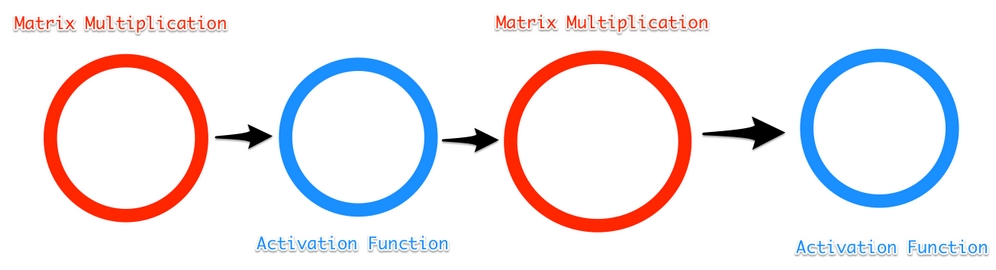
TensorFlow and every other deep learning library perform calculations along a computational graph. In a computational graph, operations, such as matrix multiplication or an activation function, are nodes in a network. Tensors get passed along the edges of the graph between the different operations.

A forward pass through our simple neural network has the following graph:

A simple computational graph

The advantage of structuring computations as a graph is that it's easier to run nodes in parallel. Through parallel computation, we do not need one very fast machine; we can also achieve fast computation with many slow computers that split up the tasks.

This is the reason why GPUs are so useful for deep learning. GPUs have many small cores, as opposed to CPUs, which only have a few fast cores. A modern CPU might only have four cores, whereas a modern GPU can have hundreds or even thousands of cores.

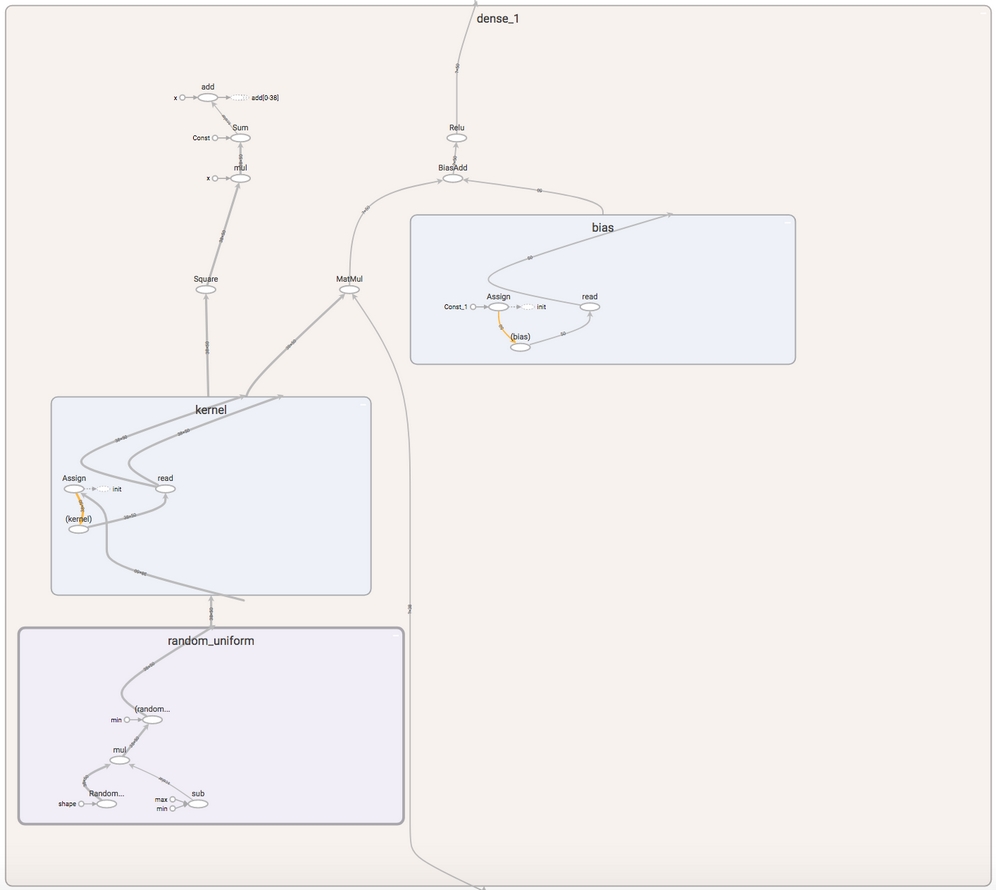
The entire graph of just a very simple model can look quite complex, but you can see the components of the dense layer. There is a matrix multiplication (matmul), adding bias and a ReLU activation function:

The computational graph of a single layer in TensorFlow. Screenshot from TensorBoard.

Another advantage of using computational graphs such as this is that TensorFlow and other libraries can quickly and automatically calculate derivatives along this graph. As we have explored throughout this chapter, calculating derivatives is key for training neural networks.

CONTINUE READING
83
Tech Concepts
36
Programming languages
73
Tech Tools
Icon Unlimited access to the largest independent learning library in tech of over 8,000 expert-authored tech books and videos.
Icon Innovative learning tools, including AI book assistants, code context explainers, and text-to-speech.
Icon 50+ new titles added per month and exclusive early access to books as they are being written.
Machine Learning for Finance
notes
bookmark Notes and Bookmarks search Search in title playlist Add to playlist download Download options font-size Font size

Change the font size

margin-width Margin width

Change margin width

day-mode Day/Sepia/Night Modes

Change background colour

Close icon Search
Country selected

Close icon Your notes and bookmarks

Confirmation

Modal Close icon
claim successful

Buy this book with your credits?

Modal Close icon
Are you sure you want to buy this book with one of your credits?
Close
YES, BUY

Submit Your Feedback

Modal Close icon
Modal Close icon
Modal Close icon