Sign In Start Free Trial
Account

Add to playlist

Create a Playlist

Modal Close icon
You need to login to use this feature.
  • Book Overview & Buying Machine Learning for Finance
  • Table Of Contents Toc
Machine Learning for Finance

Machine Learning for Finance

By : James Le , Jannes Klaas
4.1 (59)
close
close
Machine Learning for Finance

Machine Learning for Finance

4.1 (59)
By: James Le , Jannes Klaas

Overview of this book

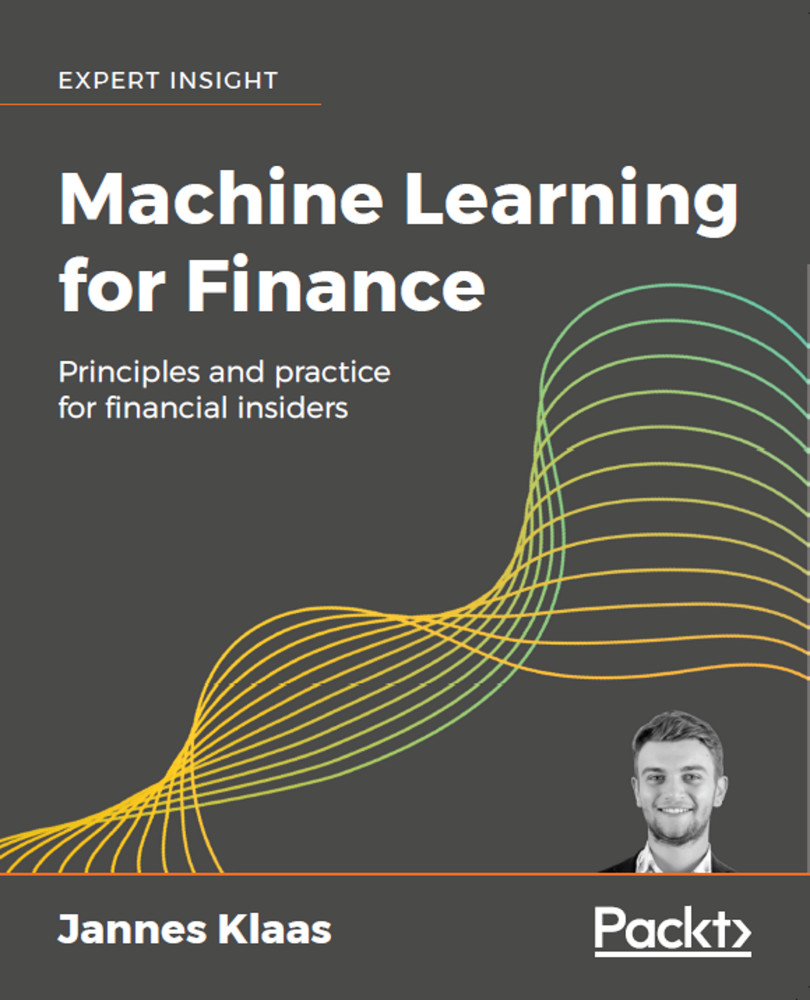
Machine Learning for Finance explores new advances in machine learning and shows how they can be applied across the financial sector, including insurance, transactions, and lending. This book explains the concepts and algorithms behind the main machine learning techniques and provides example Python code for implementing the models yourself. The book is based on Jannes Klaas’ experience of running machine learning training courses for financial professionals. Rather than providing ready-made financial algorithms, the book focuses on advanced machine learning concepts and ideas that can be applied in a wide variety of ways. The book systematically explains how machine learning works on structured data, text, images, and time series. You'll cover generative adversarial learning, reinforcement learning, debugging, and launching machine learning products. Later chapters will discuss how to fight bias in machine learning. The book ends with an exploration of Bayesian inference and probabilistic programming.
Table of Contents (15 chapters)
close
close
Machine Learning for Finance
Contributors
Preface
Other Books You May Enjoy
1
Index

Heuristic, feature-based, and E2E models


Before we dive into developing models to detect fraud, let's take a second to pause and ponder over the different kinds of models we could build.

  • A heuristic-based model is a simple "rule of thumb" developed purely by humans. Usually, the heuristic model stems from having an expert knowledge of the problem.

  • A feature-based model relies heavily on humans modifying the data to create new and meaningful features, which are then fed into a (simple) machine learning algorithm. This approach mixes expert knowledge with learning from data.

  • An E2E model learns purely from raw data. No human expertise is used, and the model learns everything directly from observations.

In our case, a heuristic-based model could be created to mark all transactions with the TRANSFER transaction type and an amount over $200,000 as fraudulent. Heuristic-based models have the advantage that they are both fast to develop and easy to implement; however, this comes with a pay-off, their...

CONTINUE READING
83
Tech Concepts
36
Programming languages
73
Tech Tools
Icon Unlimited access to the largest independent learning library in tech of over 8,000 expert-authored tech books and videos.
Icon Innovative learning tools, including AI book assistants, code context explainers, and text-to-speech.
Icon 50+ new titles added per month and exclusive early access to books as they are being written.
Machine Learning for Finance
notes
bookmark Notes and Bookmarks search Search in title playlist Add to playlist download Download options font-size Font size

Change the font size

margin-width Margin width

Change margin width

day-mode Day/Sepia/Night Modes

Change background colour

Close icon Search
Country selected

Close icon Your notes and bookmarks

Confirmation

Modal Close icon
claim successful

Buy this book with your credits?

Modal Close icon
Are you sure you want to buy this book with one of your credits?
Close
YES, BUY

Submit Your Feedback

Modal Close icon
Modal Close icon
Modal Close icon