
Sign In Start Free Trial
Account

Add to playlist

Create a Playlist

Modal Close icon
You need to login to use this feature.
  • Book Overview & Buying Hands-On Natural Language Processing with Python
  • Table Of Contents Toc
Hands-On Natural Language Processing with Python

Hands-On Natural Language Processing with Python

By : Shanmugamani, Arumugam, Byiringiro, Joshi, Muthuswamy
2.8 (4)
close
close
Hands-On Natural Language Processing with Python

Hands-On Natural Language Processing with Python

2.8 (4)
By: Shanmugamani, Arumugam, Byiringiro, Joshi, Muthuswamy

Overview of this book

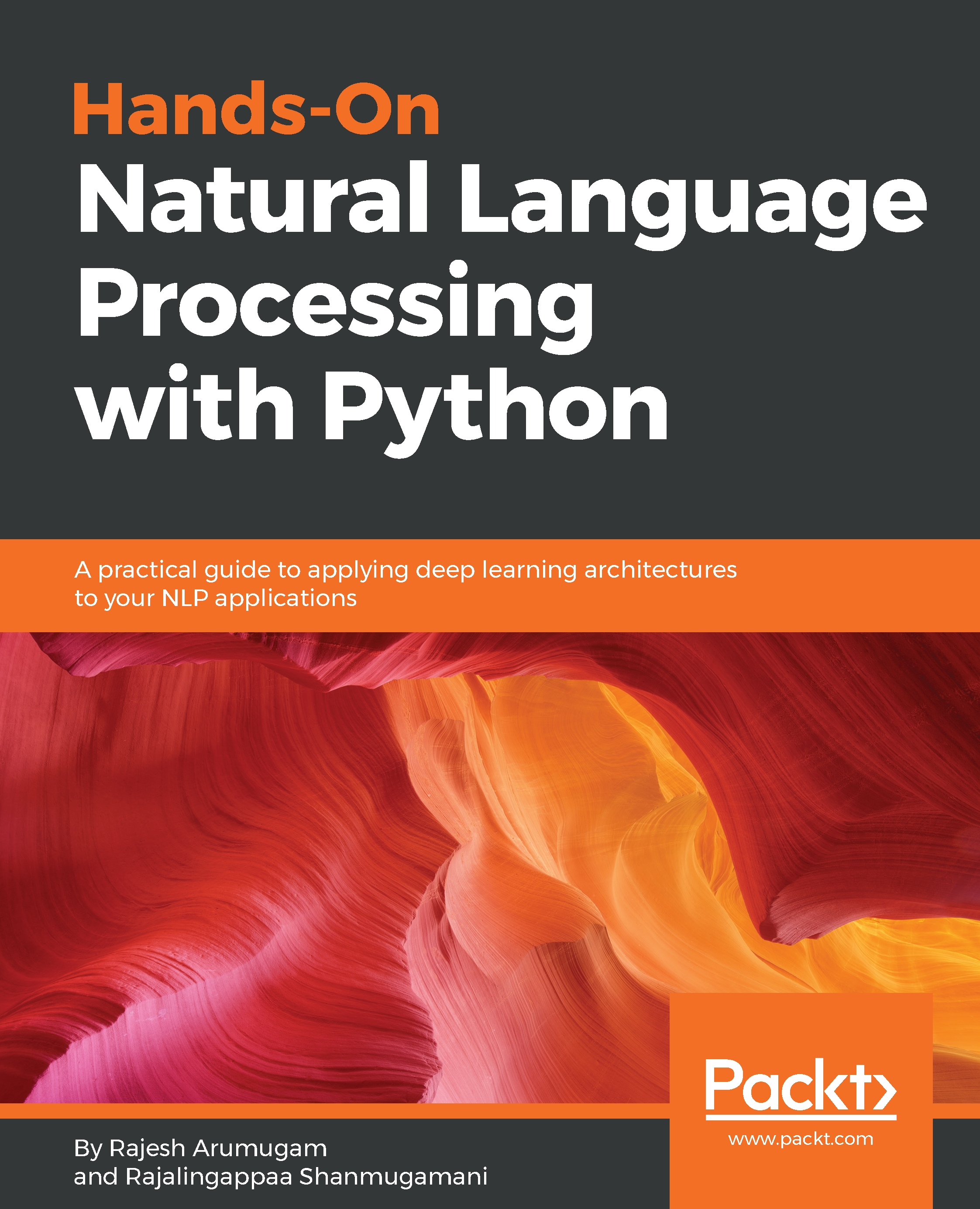
Natural language processing (NLP) has found its application in various domains, such as web search, advertisements, and customer services, and with the help of deep learning, we can enhance its performances in these areas. Hands-On Natural Language Processing with Python teaches you how to leverage deep learning models for performing various NLP tasks, along with best practices in dealing with today’s NLP challenges. To begin with, you will understand the core concepts of NLP and deep learning, such as Convolutional Neural Networks (CNNs), recurrent neural networks (RNNs), semantic embedding, Word2vec, and more. You will learn how to perform each and every task of NLP using neural networks, in which you will train and deploy neural networks in your NLP applications. You will get accustomed to using RNNs and CNNs in various application areas, such as text classification and sequence labeling, which are essential in the application of sentiment analysis, customer service chatbots, and anomaly detection. You will be equipped with practical knowledge in order to implement deep learning in your linguistic applications using Python's popular deep learning library, TensorFlow. By the end of this book, you will be well versed in building deep learning-backed NLP applications, along with overcoming NLP challenges with best practices developed by domain experts.
Table of Contents (15 chapters)
close
close
6
Searching and DeDuplicating Using CNNs
7
Named Entity Recognition Using Character LSTM

Speech Recognition Using DeepSpeech

Speech recognition is the task in which a machine or computer transforms spoken language into text. A good example is the voice typing feature in Google Docs which converts speech to text as you speak. In this chapter, we will look into how to build such systems using deep learning models. In particular, we will focus on using recurrent neural network (RNNs) models as these are found to be effective in practice for speech recognition. This is because RNNs can capture temporal dependencies in the speech data that is important in the task of converting it into text.

The following is an overview of the topics that will be covered in this chapter:

  • Overview of speech recognition
  • RNN models for isolated spoken word recognition
  • Speech recognition using the DeepSpeech model for continuous speech
CONTINUE READING
83
Tech Concepts
36
Programming languages
73
Tech Tools
Icon Unlimited access to the largest independent learning library in tech of over 8,000 expert-authored tech books and videos.
Icon Innovative learning tools, including AI book assistants, code context explainers, and text-to-speech.
Icon 50+ new titles added per month and exclusive early access to books as they are being written.
Hands-On Natural Language Processing with Python
notes
bookmark Notes and Bookmarks search Search in title playlist Add to playlist download Download options font-size Font size

Change the font size

margin-width Margin width

Change margin width

day-mode Day/Sepia/Night Modes

Change background colour

Close icon Search
Country selected

Close icon Your notes and bookmarks

Confirmation

Modal Close icon
claim successful

Buy this book with your credits?

Modal Close icon
Are you sure you want to buy this book with one of your credits?
Close
YES, BUY

Submit Your Feedback

Modal Close icon
Modal Close icon
Modal Close icon