
Sign In Start Free Trial
Account

Add to playlist

Create a Playlist

Modal Close icon
You need to login to use this feature.
  • Book Overview & Buying Hands-On Meta Learning with Python
  • Table Of Contents Toc
  • Feedback & Rating feedback
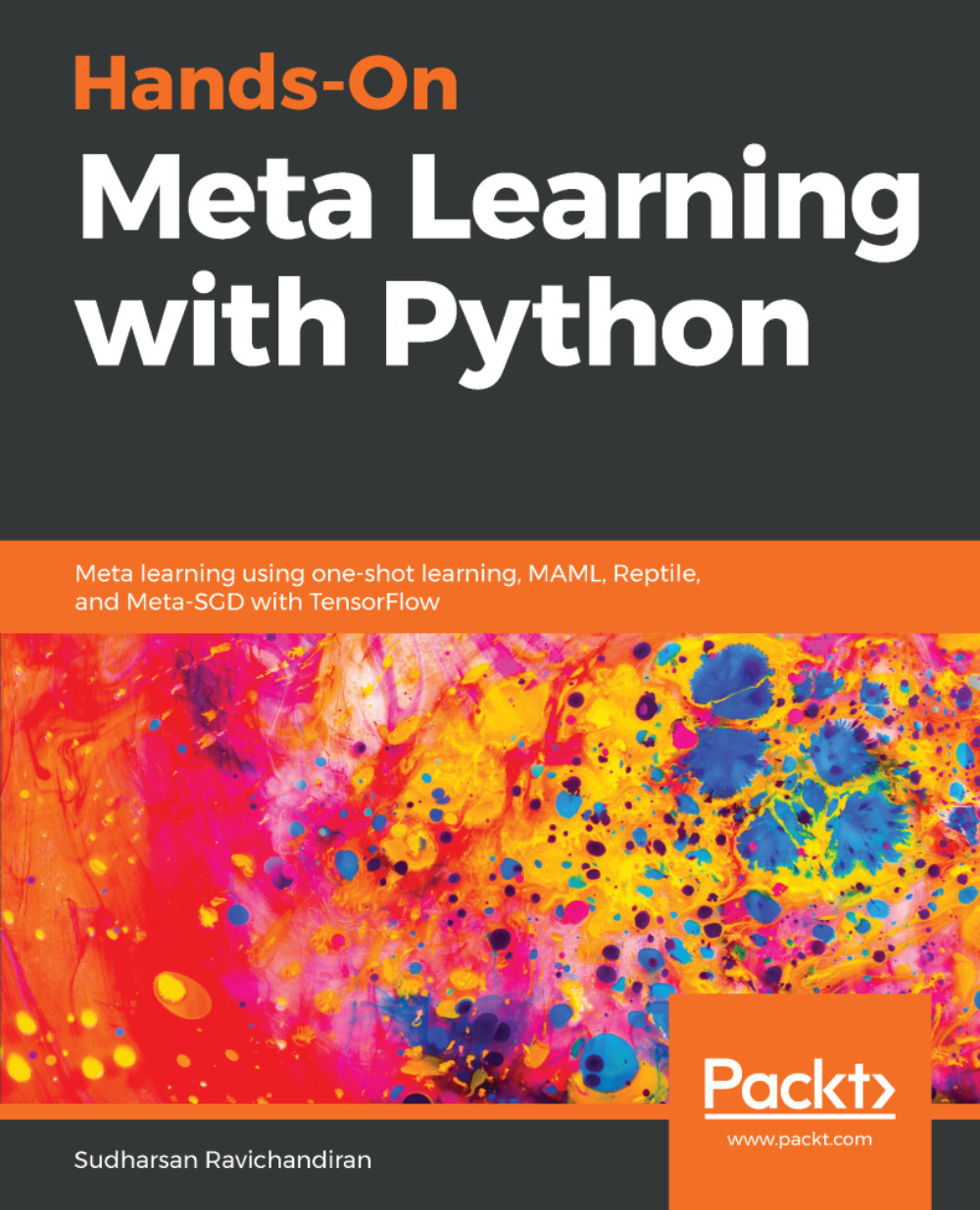
Hands-On Meta Learning with Python

Hands-On Meta Learning with Python

By : Sudharsan Ravichandiran
2.5 (6)
close
close
Hands-On Meta Learning with Python

Hands-On Meta Learning with Python

2.5 (6)
By: Sudharsan Ravichandiran

Overview of this book

Meta learning is an exciting research trend in machine learning, which enables a model to understand the learning process. Unlike other ML paradigms, with meta learning you can learn from small datasets faster. Hands-On Meta Learning with Python starts by explaining the fundamentals of meta learning and helps you understand the concept of learning to learn. You will delve into various one-shot learning algorithms, like siamese, prototypical, relation and memory-augmented networks by implementing them in TensorFlow and Keras. As you make your way through the book, you will dive into state-of-the-art meta learning algorithms such as MAML, Reptile, and CAML. You will then explore how to learn quickly with Meta-SGD and discover how you can perform unsupervised learning using meta learning with CACTUs. In the concluding chapters, you will work through recent trends in meta learning such as adversarial meta learning, task agnostic meta learning, and meta imitation learning. By the end of this book, you will be familiar with state-of-the-art meta learning algorithms and able to enable human-like cognition for your machine learning models.
Table of Contents (12 chapters)
close
close

Relation and Matching Networks Using TensorFlow

In the last chapter, we learned about prototypical networks and how variants of prototypical networks, such as Gaussian prototypical and semi-prototypical networks, are used for one-shot learning. We have seen how prototypical networks make use of embeddings to perform classification tasks.

In this chapter, we will learn about relation networks and matching networks. First, we will see what a relation network is and how it is used in one-shot, few-shot, and zero-shot learning settings, after which we will learn how to build a relation network using TensorFlow. Later in this chapter, we will learn about matching networks and how they are used in few-shot learning. We will also see different types of embedding functions used in matching networks. At the end of this chapter, we will see how to build matching networks in Tensorflow.

...

Visually different images
CONTINUE READING
83
Tech Concepts
36
Programming languages
73
Tech Tools
Icon Unlimited access to the largest independent learning library in tech of over 8,000 expert-authored tech books and videos.
Icon Innovative learning tools, including AI book assistants, code context explainers, and text-to-speech.
Icon 50+ new titles added per month and exclusive early access to books as they are being written.
Hands-On Meta Learning with Python
notes
bookmark Notes and Bookmarks search Search in title playlist Add to playlist download Download options font-size Font size

Change the font size

margin-width Margin width

Change margin width

day-mode Day/Sepia/Night Modes

Change background colour

Close icon Search
Country selected

Close icon Your notes and bookmarks

Confirmation

Modal Close icon
claim successful

Buy this book with your credits?

Modal Close icon
Are you sure you want to buy this book with one of your credits?
Close
YES, BUY

Submit Your Feedback

Modal Close icon
Modal Close icon
Modal Close icon