
Sign In Start Free Trial
Account

Add to playlist

Create a Playlist

Modal Close icon
You need to login to use this feature.
  • Book Overview & Buying Keras 2.x Projects
  • Table Of Contents Toc
Keras 2.x Projects

Keras 2.x Projects

By : Giuseppe Ciaburro
3 (2)
close
close
Keras 2.x Projects

Keras 2.x Projects

3 (2)
By: Giuseppe Ciaburro

Overview of this book

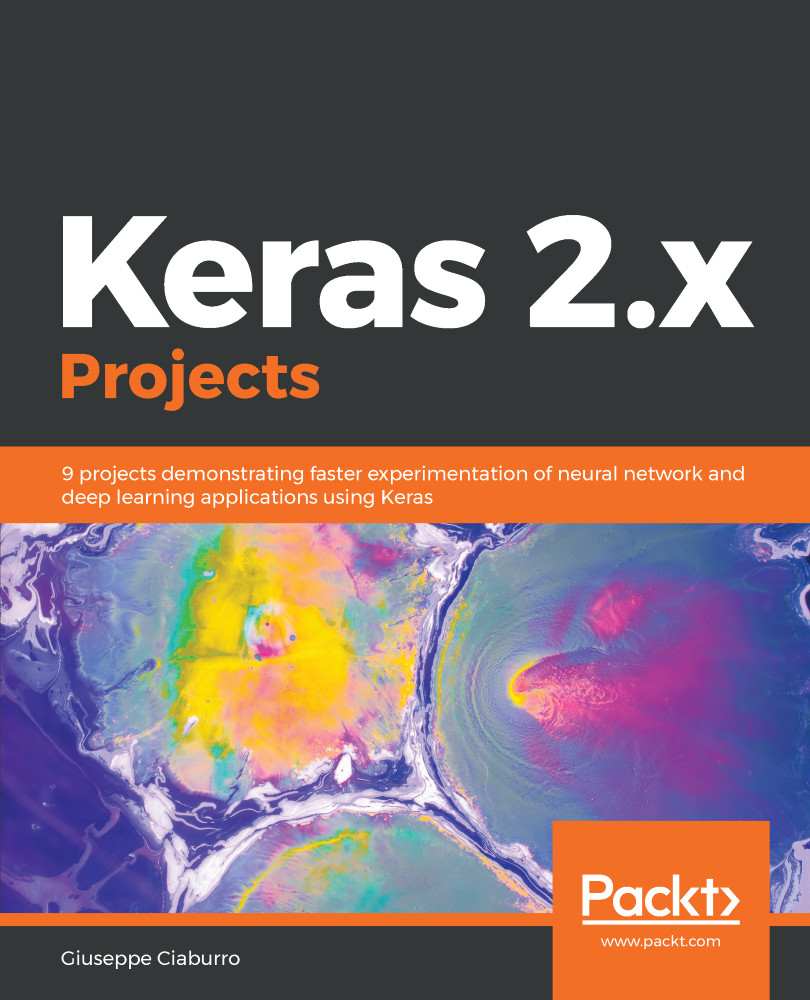
Keras 2.x Projects explains how to leverage the power of Keras to build and train state-of-the-art deep learning models through a series of practical projects that look at a range of real-world application areas. To begin with, you will quickly set up a deep learning environment by installing the Keras library. Through each of the projects, you will explore and learn the advanced concepts of deep learning and will learn how to compute and run your deep learning models using the advanced offerings of Keras. You will train fully-connected multilayer networks, convolutional neural networks, recurrent neural networks, autoencoders and generative adversarial networks using real-world training datasets. The projects you will undertake are all based on real-world scenarios of all complexity levels, covering topics such as language recognition, stock volatility, energy consumption prediction, faster object classification for self-driving vehicles, and more. By the end of this book, you will be well versed with deep learning and its implementation with Keras. You will have all the knowledge you need to train your own deep learning models to solve different kinds of problems.
Table of Contents (13 chapters)
close
close

Getting Started with Keras

Keras is an open source neural network library written in Python. This book will help you to experiment with deep neural networks as simply as possible. Its principal author and maintainer is François Chollet, a Google engineer. In 2017, Google's TensorFlow team decided to support Keras in TensorFlow's main library. Keras contains several implementations of commonly used neural network blocks, such as levels, objectives, activation functions, optimizers, and a set of tools to facilitate work with image and text data. In this chapter, an overview of the Keras environment will be addressed.

The following topics are covered:

  • Introduction to Keras
  • Keras backend options
  • Installation
  • Model fitting in Keras

At the end of the chapter, the reader will learn how to work with the keras library, and how to install and configure Keras. We will also discover the basic concepts of the Keras architecture. We will learn how Keras uses TensorFlow as its tensor manipulation library. We will also understand the different type of Keras models, sequential and functional APIs, and learn how to implement Keras layers.

CONTINUE READING
83
Tech Concepts
36
Programming languages
73
Tech Tools
Icon Unlimited access to the largest independent learning library in tech of over 8,000 expert-authored tech books and videos.
Icon Innovative learning tools, including AI book assistants, code context explainers, and text-to-speech.
Icon 50+ new titles added per month and exclusive early access to books as they are being written.
Keras 2.x Projects
notes
bookmark Notes and Bookmarks search Search in title playlist Add to playlist download Download options font-size Font size

Change the font size

margin-width Margin width

Change margin width

day-mode Day/Sepia/Night Modes

Change background colour

Close icon Search
Country selected

Close icon Your notes and bookmarks

Confirmation

Modal Close icon
claim successful

Buy this book with your credits?

Modal Close icon
Are you sure you want to buy this book with one of your credits?
Close
YES, BUY

Submit Your Feedback

Modal Close icon
Modal Close icon
Modal Close icon