Sign In Start Free Trial
Account

Add to playlist

Create a Playlist

Modal Close icon
You need to login to use this feature.
  • Book Overview & Buying Machine Learning Fundamentals
  • Table Of Contents Toc
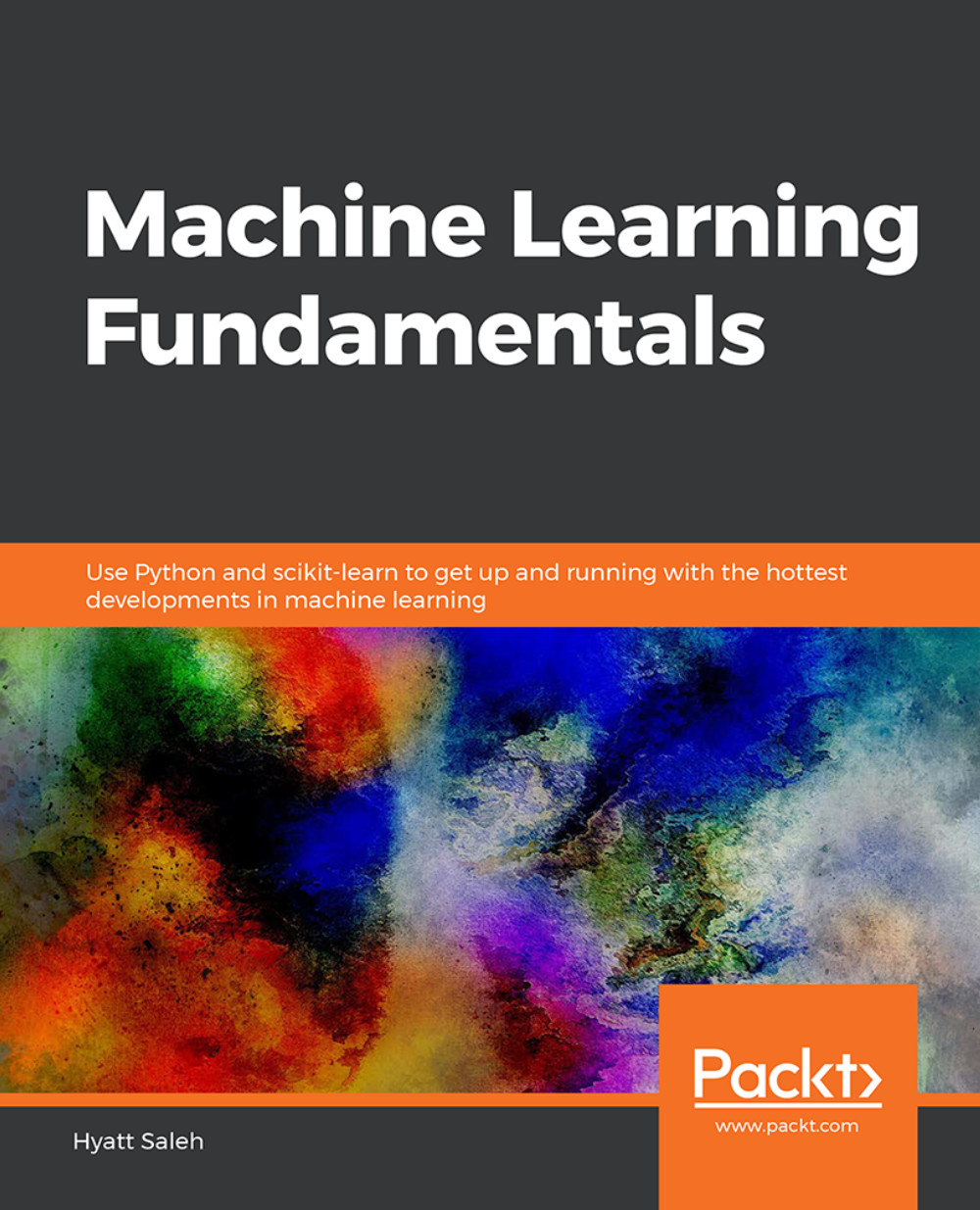
Machine Learning Fundamentals

Machine Learning Fundamentals

By : Hyatt Saleh
5 (3)
close
close
Machine Learning Fundamentals

Machine Learning Fundamentals

5 (3)
By: Hyatt Saleh

Overview of this book

As machine learning algorithms become popular, new tools that optimize these algorithms are also developed. Machine Learning Fundamentals explains you how to use the syntax of scikit-learn. You'll study the difference between supervised and unsupervised models, as well as the importance of choosing the appropriate algorithm for each dataset. You'll apply unsupervised clustering algorithms over real-world datasets, to discover patterns and profiles, and explore the process to solve an unsupervised machine learning problem. The focus of the book then shifts to supervised learning algorithms. You'll learn to implement different supervised algorithms and develop neural network structures using the scikit-learn package. You'll also learn how to perform coherent result analysis to improve the performance of the algorithm by tuning hyperparameters. By the end of this book, you will have gain all the skills required to start programming machine learning algorithms.
Table of Contents (8 chapters)
close
close

Mean-Shift Algorithm


The mean-shift algorithm works by assigning each data point a cluster based on the density of data points in the data space, also known as the mode in a distribution function. Contrary to the k-means algorithm, the mean-shift algorithm does not require you to specify the number of clusters as a parameter.

The algorithm works by modeling the data points as a distribution function, where high-density areas (high concentration of data points) represent high peaks. Then, the general idea is to shift each data point until it reaches its nearest peak, which becomes a cluster.

Understanding the Algorithm

The first step of the mean-shift algorithm is the representation of the data points as a density distribution. To do so, the algorithm builds upon the idea of Kernel Density Estimation (KDE), which is a method used to estimate the distribution of a set of data:

Figure 2.10: An image depicting the idea behind Kernel Density Estimation

In the preceding diagram, the red dots represent...

CONTINUE READING
83
Tech Concepts
36
Programming languages
73
Tech Tools
Icon Unlimited access to the largest independent learning library in tech of over 8,000 expert-authored tech books and videos.
Icon Innovative learning tools, including AI book assistants, code context explainers, and text-to-speech.
Icon 50+ new titles added per month and exclusive early access to books as they are being written.
Machine Learning Fundamentals
notes
bookmark Notes and Bookmarks search Search in title playlist Add to playlist font-size Font size

Change the font size

margin-width Margin width

Change margin width

day-mode Day/Sepia/Night Modes

Change background colour

Close icon Search
Country selected

Close icon Your notes and bookmarks

Confirmation

Modal Close icon
claim successful

Buy this book with your credits?

Modal Close icon
Are you sure you want to buy this book with one of your credits?
Close
YES, BUY

Submit Your Feedback

Modal Close icon
Modal Close icon
Modal Close icon