


- k-nearest neighbors algorithm: An algorithm that estimates an unknown data item as being like the majority of the k-closest neighbors to that item.
- Naive Bayes classifier: A way to classify a data item using Bayes' theorem concerning the conditional probabilities P(A|B)=(P(B|A) * P(A))/P(B). It also assumes that variables in the data are independent, which means that no variable affects the probability of the remaining variables attaining a certain value.
- Decision tree: A model classifying a data item into one of the classes at the leaf node, based on matching properties between the branches on the tree and the actual data item.
- Random decision tree: A decision tree in which every branch is formed using only a random subset of the available variables during its construction.
- Random forest: An ensemble of random decision...
-
Book Overview & Buying
-
Table Of Contents

-
Feedback & Rating

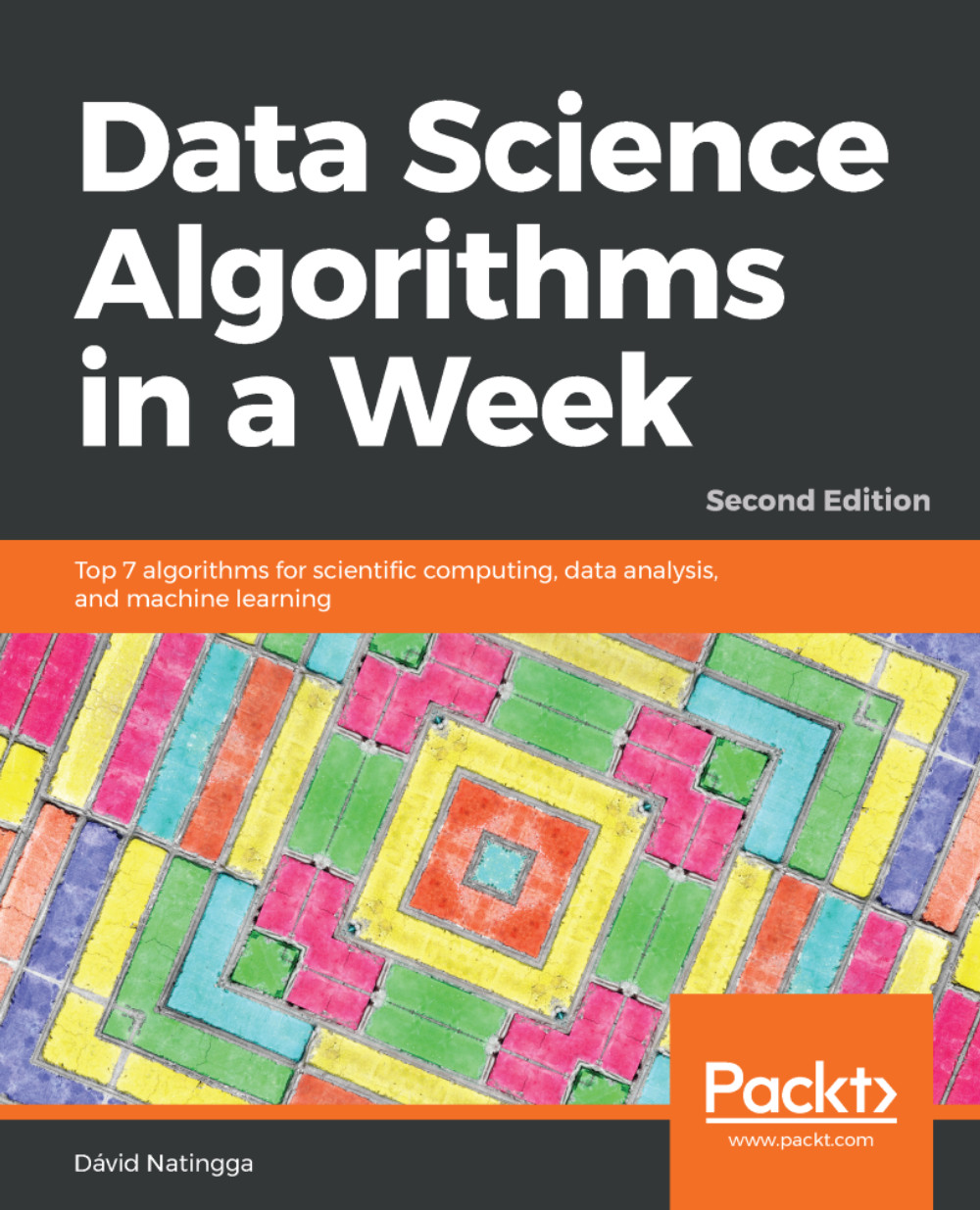
Data Science Algorithms in a Week - Second Edition
By :


Data Science Algorithms in a Week
By:
Overview of this book
Machine learning applications are highly automated and self-modifying, and continue to improve over time with minimal human intervention, as they learn from the trained data. To address the complex nature of various real-world data problems, specialized machine learning algorithms have been developed. Through algorithmic and statistical analysis, these models can be leveraged to gain new knowledge from existing data as well.
Data Science Algorithms in a Week addresses all problems related to accurate and efficient data classification and prediction. Over the course of seven days, you will be introduced to seven algorithms, along with exercises that will help you understand different aspects of machine learning. You will see how to pre-cluster your data to optimize and classify it for large datasets. This book also guides you in predicting data based on existing trends in your dataset. This book covers algorithms such as k-nearest neighbors, Naive Bayes, decision trees, random forest, k-means, regression, and time-series analysis.
By the end of this book, you will understand how to choose machine learning algorithms for clustering, classification, and regression and know which is best suited for your problem
Table of Contents (12 chapters)
Preface

 Free Chapter
Classification Using K-Nearest Neighbors
Naive Bayes
Decision Trees
Random Forests
Clustering into K Clusters
Regression
Time Series Analysis
Python Reference
Glossary of Algorithms and Methods in Data Science

Other Books You May Enjoy
Customer Reviews



