Sign In Start Free Trial
Account

Add to playlist

Create a Playlist

Modal Close icon
You need to login to use this feature.
  • Book Overview & Buying Hands-On Machine Learning with C++
  • Table Of Contents Toc
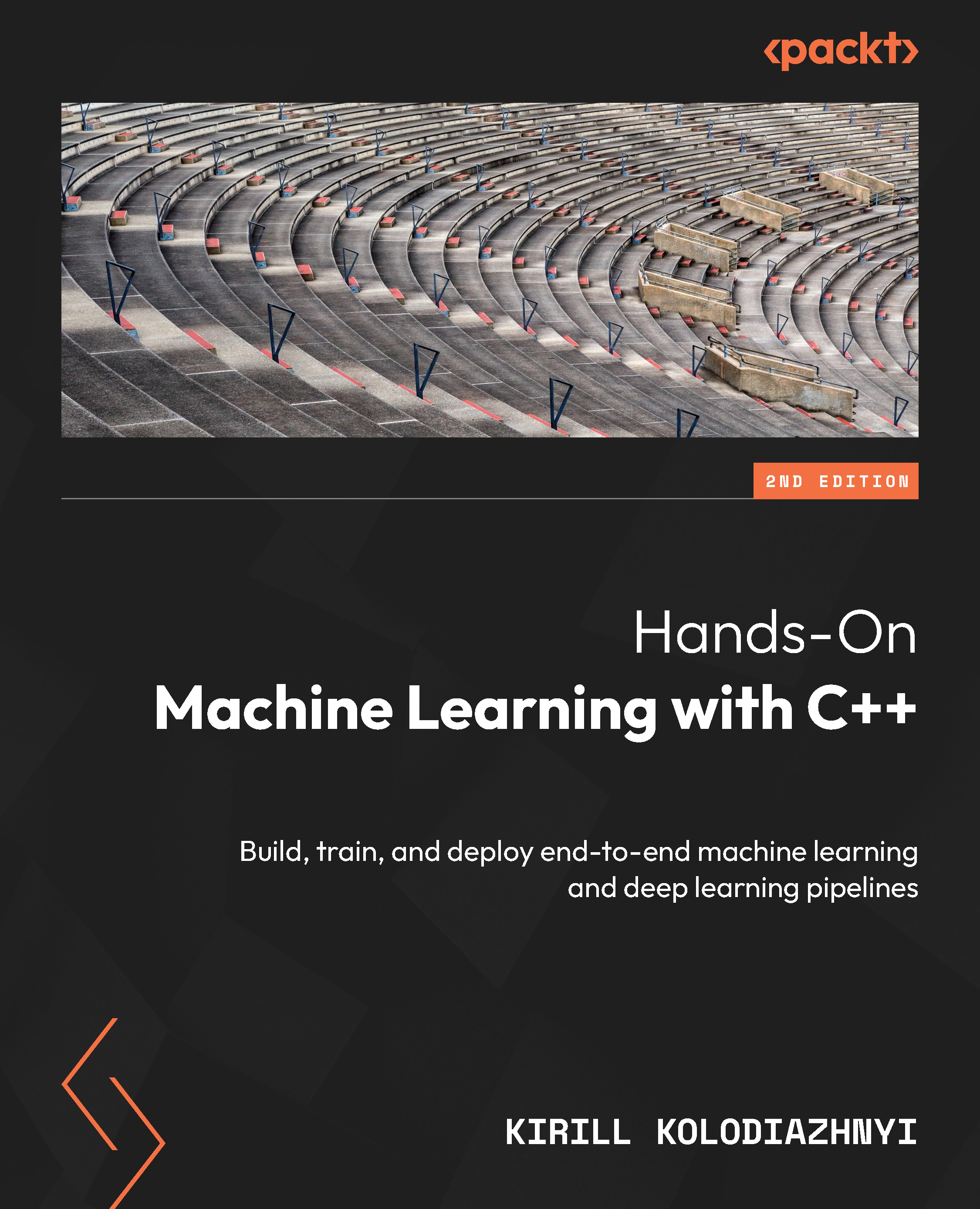
Hands-On Machine Learning with C++

Hands-On Machine Learning with C++

By : Kirill Kolodiazhnyi
3.8 (6)
close
close
Hands-On Machine Learning with C++

Hands-On Machine Learning with C++

3.8 (6)
By: Kirill Kolodiazhnyi

Overview of this book

C++ can make your machine learning models run faster and more efficiently. This handy guide will help you learn the fundamentals of machine learning (ML), showing you how to use C++ libraries to get the most out of your data. This book makes machine learning with C++ for beginners easy with its example-based approach, demonstrating how to implement supervised and unsupervised ML algorithms through real-world examples. This book will get you hands-on with tuning and optimizing a model for different use cases, assisting you with model selection and the measurement of performance. You’ll cover techniques such as product recommendations, ensemble learning, and anomaly detection using modern C++ libraries such as PyTorch C++ API, Caffe2, Shogun, Shark-ML, mlpack, and dlib. Next, you’ll explore neural networks and deep learning using examples such as image classification and sentiment analysis, which will help you solve various problems. Later, you’ll learn how to handle production and deployment challenges on mobile and cloud platforms, before discovering how to export and import models using the ONNX format. By the end of this C++ book, you will have real-world machine learning and C++ knowledge, as well as the skills to use C++ to build powerful ML systems.
Table of Contents (19 chapters)
close
close
1
Section 1: Overview of Machine Learning
5
Section 2: Machine Learning Algorithms
12
Section 3: Advanced Examples
15
Section 4: Production and Deployment Challenges

Introduction to Machine Learning with C++

There are different approaches to make computers solve tasks. One of them is to define an explicit algorithm, and another one is to use implicit strategies based on mathematical and statistical methods. Machine Learning (ML) is one of the implicit methods that uses mathematical and statistical approaches to solve tasks. It is an actively growing discipline, and a lot of scientists and researchers find it to be one of the best ways to move forward toward systems acting as human-level artificial intelligence (AI).

In general, ML approaches have the idea of searching patterns in a given dataset as their basis. Consider a recommendation system for a news feed, which provides the user with a personalized feed based on their previous activity or preferences. The software gathers information about the type of news article the user reads and calculates some statistics. For example, it could be the frequency of some topics appearing in a set of news articles. Then, it performs some predictive analytics, identifies general patterns, and uses them to populate the user's news feed. Such systems periodically track a user's activity, and update the dataset and calculate new trends for recommendations.

There are many areas where ML has started to play an important role. It is used for solving enterprise business tasks as well as for scientific researches. In customer relationship management (CRM) systems, ML models are used to analyze sales team activity, to help them to process the most important requests first. ML models are used in business intelligence (BI) and analytics to find essential data points. Human resource (HR) departments use ML models to analyze their employees' characteristics in order to identify the most effective ones and use this information when searching applicants for open positions.

A fast-growing direction of research is self-driving cars, and deep learning neural networks are used extensively in this area. They are used in computer vision systems for object identification as well as for navigation and steering systems, which are necessary for car driving.

Another popular use of ML systems is electronic personal assistants, such as Siri from Apple or Alexa from Amazon. Such products also use deep learning models to analyze natural speech or written text to process users' requests and make a natural response in a relevant context. Such requests can activate music players with preferred songs, as well as update a user's personal schedule or book flight tickets.

This chapter describes what ML is and which tasks can be solved with ML, and discusses different approaches used in ML. It aims to show the minimally required math to start implementing ML algorithms. It also covers how to perform basic linear algebra operations in libraries such as Eigen, xtensor, Shark-ML, Shogun, and Dlib, and also explains the linear regression task as an example.

The following topics will be covered in this chapter:

  • Understanding the fundamentals of ML
  • An overview of linear algebra
  • An overview of a linear regression example
CONTINUE READING
83
Tech Concepts
36
Programming languages
73
Tech Tools
Icon Unlimited access to the largest independent learning library in tech of over 8,000 expert-authored tech books and videos.
Icon Innovative learning tools, including AI book assistants, code context explainers, and text-to-speech.
Icon 50+ new titles added per month and exclusive early access to books as they are being written.
Hands-On Machine Learning with C++
notes
bookmark Notes and Bookmarks search Search in title playlist Add to playlist download Download options font-size Font size

Change the font size

margin-width Margin width

Change margin width

day-mode Day/Sepia/Night Modes

Change background colour

Close icon Search
Country selected

Close icon Your notes and bookmarks

Confirmation

Modal Close icon
claim successful

Buy this book with your credits?

Modal Close icon
Are you sure you want to buy this book with one of your credits?
Close
YES, BUY

Submit Your Feedback

Modal Close icon
Modal Close icon
Modal Close icon