Sign In Start Free Trial
Account

Add to playlist

Create a Playlist

Modal Close icon
You need to login to use this feature.
  • Book Overview & Buying Azure Data Factory Cookbook
  • Table Of Contents Toc
Azure Data Factory Cookbook

Azure Data Factory Cookbook

By : Dmitry Anoshin, Dmitry Foshin, Roman Storchak, Xenia Ireton
4.2 (13)
close
close
Azure Data Factory Cookbook

Azure Data Factory Cookbook

4.2 (13)
By: Dmitry Anoshin, Dmitry Foshin, Roman Storchak, Xenia Ireton

Overview of this book

Azure Data Factory (ADF) is a modern data integration tool available on Microsoft Azure. This Azure Data Factory Cookbook helps you get up and running by showing you how to create and execute your first job in ADF. You’ll learn how to branch and chain activities, create custom activities, and schedule pipelines. This book will help you to discover the benefits of cloud data warehousing, Azure Synapse Analytics, and Azure Data Lake Gen2 Storage, which are frequently used for big data analytics. With practical recipes, you’ll learn how to actively engage with analytical tools from Azure Data Services and leverage your on-premise infrastructure with cloud-native tools to get relevant business insights. As you advance, you’ll be able to integrate the most commonly used Azure Services into ADF and understand how Azure services can be useful in designing ETL pipelines. The book will take you through the common errors that you may encounter while working with ADF and show you how to use the Azure portal to monitor pipelines. You’ll also understand error messages and resolve problems in connectors and data flows with the debugging capabilities of ADF. By the end of this book, you’ll be able to use ADF as the main ETL and orchestration tool for your data warehouse or data platform projects.
Table of Contents (12 chapters)
close
close

Technical requirements

NOTE

To make fully understanding the recipes easier, we make naming suggestions for the accounts, pipelines, and so on throughout the chapter. Many services, such as Azure Storage and SQL Server, require that the names you assign are unique. Follow your own preferred naming conventions, making appropriate substitutions as you follow the recipes. For the Azure resource naming rules, refer to the documentation at https://learn.microsoft.com/en-us/azure/azure-resource-manager/management/resource-name-rules.

In addition to Azure Data Factory, we shall be using three other Azure services: Logic Apps, Blob Storage, and Azure SQL Database. You will need to have Azure Blob Storage and Azure SQL Database accounts set up to follow the recipes. The following steps describe the necessary preparation:

  • Create an Azure Blob Storage account and name it adforchestrationstorage. When creating the storage account, select the same region (that is, East US) as you selected when you created the Data Factory instance. This will reduce our costs when moving data.
  • Create a container named data within this storage account, and upload two CSV files to the folder: airlines.csv and countries.csv (the files can be found on GitHub: https://github.com/PacktPublishing/Azure-Data-Factory-Cookbook/tree/master/data).
  • Create an Azure SQL Database instance and name it AzureSQLDatabase. When you create the Azure SQL Database instance, you will have the option of creating a server on which the SQL database will be hosted. Create that server and take note of the credentials you entered. You will need these credentials later when you log in to your database.

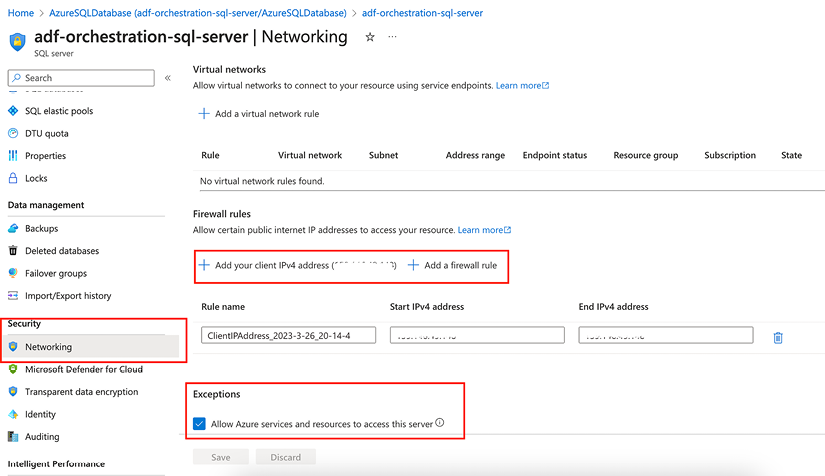
Choose the basic configuration for your SQL server to save on costs. Once your instance is up and running, configure the Networking settings for the SQL server as highlighted in Figure 2.1. Go to the Networking page under the Security menu, then under Firewall rules, create a rule to allow your IP to access the database. Under Exceptions, make sure that you check the Allow Azure services and resources to access this database option.

Figure 2.1: Firewall configuration

Download the following SQL scripts from GitHub at https://github.com/PacktPublishing/Azure-Data-Factory-Cookbook/tree/master/Chapter02/sql-scripts:

  • CreateAirlineTable.sql and CreateCountryTable.sql: These scripts will add two tables, Country and Airline, which are used in several recipes, including the first one.
  • CreateMetadataTable.sql: This will create the FileMetadata table and a stored procedure to insert data into that table. This table is necessary for the Using Metadata and Stored Procedure activities and Filtering your data and looping through your files recipes.
  • CreateActivityLogsTable.sql: This will create the PipelineLog table and a stored procedure to insert data into that table. This table is necessary for the Chaining and branching activities within your pipeline recipe.
  • CreateEmailRecipients.sql: This script will create the EmailRecipients table and populate it with a record. This table is used in the Using the Lookup, Web, and Execute Pipeline activities recipe. You will need to edit it to enter email recipient information.

To create tables from the downloaded files, open your Azure SQL Database instance, go to the Query editor page, then paste the SQL scripts from the downloaded files and run them one by one.

Now that we’re all set up, let’s move on to the first recipe.

Visually different images
CONTINUE READING
83
Tech Concepts
36
Programming languages
73
Tech Tools
Icon Unlimited access to the largest independent learning library in tech of over 8,000 expert-authored tech books and videos.
Icon Innovative learning tools, including AI book assistants, code context explainers, and text-to-speech.
Icon 50+ new titles added per month and exclusive early access to books as they are being written.
Azure Data Factory Cookbook
notes
bookmark Notes and Bookmarks search Search in title playlist Add to playlist download Download options font-size Font size

Change the font size

margin-width Margin width

Change margin width

day-mode Day/Sepia/Night Modes

Change background colour

Close icon Search
Country selected

Close icon Your notes and bookmarks

Confirmation

Modal Close icon
claim successful

Buy this book with your credits?

Modal Close icon
Are you sure you want to buy this book with one of your credits?
Close
YES, BUY

Submit Your Feedback

Modal Close icon
Modal Close icon
Modal Close icon