


-
Book Overview & Buying
-
Table Of Contents

Network Science with Python
By :


Network Science with Python
By:
Overview of this book
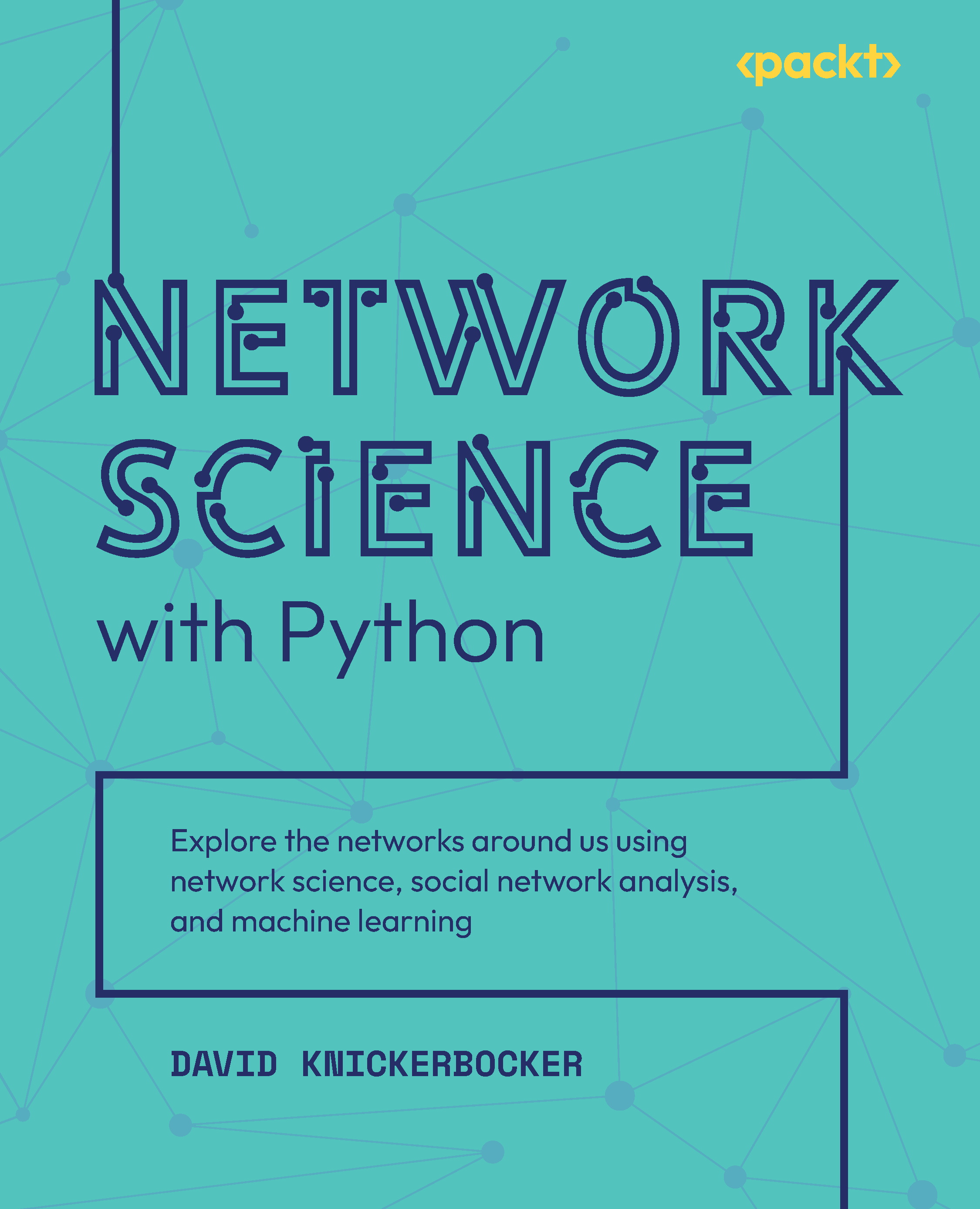
Network analysis is often taught with tiny or toy data sets, leaving you with a limited scope of learning and practical usage. Network Science with Python helps you extract relevant data, draw conclusions and build networks using industry-standard – practical data sets. You’ll begin by learning the basics of natural language processing, network science, and social network analysis, then move on to programmatically building and analyzing networks. You’ll get a hands-on understanding of the data source, data extraction, interaction with it, and drawing insights from it. This is a hands-on book with theory grounding, specific technical, and mathematical details for future reference. As you progress, you’ll learn to construct and clean networks, conduct network analysis, egocentric network analysis, community detection, and use network data with machine learning. You’ll also explore network analysis concepts, from basics to an advanced level.
By the end of the book, you’ll be able to identify network data and use it to extract unconventional insights to comprehend the complex world around you.
Table of Contents (17 chapters)
Preface


Part 1: Getting Started with Natural Language Processing and Networks
 Free Chapter
Chapter 1: Introducing Natural Language Processing
Chapter 2: Network Analysis
Chapter 3: Useful Python Libraries
Part 2: Graph Construction and Cleanup
Chapter 4: NLP and Network Synergy
Chapter 5: Even Easier Scraping!

Chapter 6: Graph Construction and Cleaning
Part 3: Network Science and Social Network Analysis
Chapter 7: Whole Network Analysis
Chapter 8: Egocentric Network Analysis
Chapter 9: Community Detection
Chapter 10: Supervised Machine Learning on Network Data
Chapter 11: Unsupervised Machine Learning on Network Data
Index


