


-
Book Overview & Buying
-
Table Of Contents

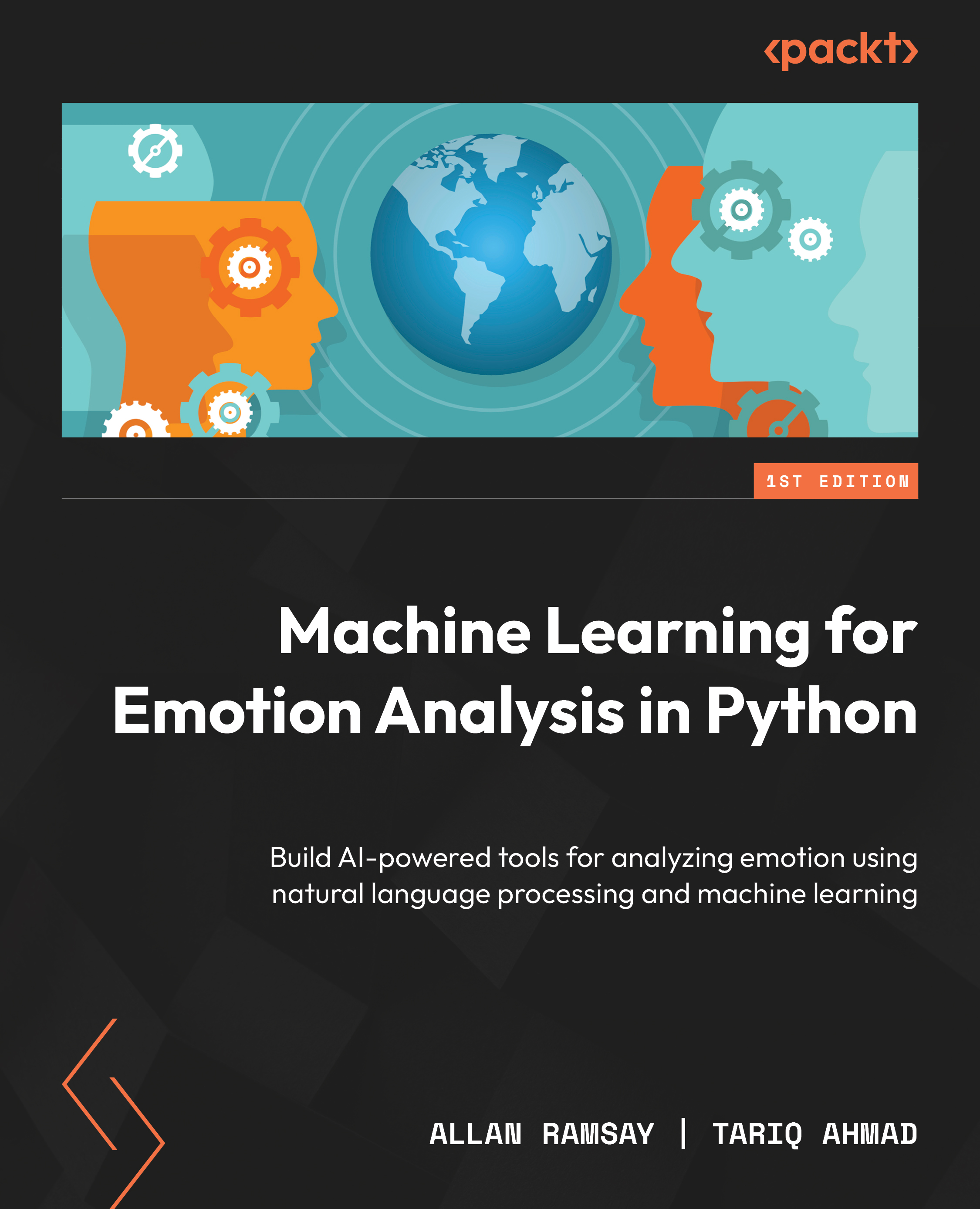
Machine Learning for Emotion Analysis in Python
By :


Machine Learning for Emotion Analysis in Python
By:
Overview of this book
Artificial intelligence and machine learning are the technologies of the future, and this is the perfect time to tap into their potential and add value to your business. Machine Learning for Emotion Analysis in Python helps you employ these cutting-edge technologies in your customer feedback system and in turn grow your business exponentially.
With this book, you’ll take your foundational data science skills and grow them in the exciting realm of emotion analysis. By following a practical approach, you’ll turn customer feedback into meaningful insights assisting you in making smart and data-driven business decisions.
The book will help you understand how to preprocess data, build a serviceable dataset, and ensure top-notch data quality. Once you’re set up for success, you’ll explore complex ML techniques, uncovering the concepts of deep neural networks, support vector machines, conditional probabilities, and more. Finally, you’ll acquire practical knowledge using in-depth use cases showing how the experimental results can be transformed into real-life examples and how emotion mining can help track short- and long-term changes in public opinion.
By the end of this book, you’ll be well-equipped to use emotion mining and analysis to drive business decisions.
Table of Contents (18 chapters)
Preface


Part 1:Essentials
 Free Chapter
Chapter 1: Foundations
Part 2:Building and Using a Dataset
Chapter 2: Building and Using a Dataset

Chapter 3: Labeling Data
Chapter 4: Preprocessing – Stemming, Tagging, and Parsing
Part 3:Approaches
Chapter 5: Sentiment Lexicons and Vector-Space Models
Chapter 6: Naïve Bayes
Chapter 7: Support Vector Machines
Chapter 8: Neural Networks and Deep Neural Networks
Chapter 9: Exploring Transformers
Chapter 10: Multiclassifiers
Part 4:Case Study
Chapter 11: Case Study – The Qatar Blockade
Index


