Sign In Start Free Trial
Account

Add to playlist

Create a Playlist

Modal Close icon
You need to login to use this feature.
  • Book Overview & Buying The AI Product Manager's Handbook
  • Table Of Contents Toc
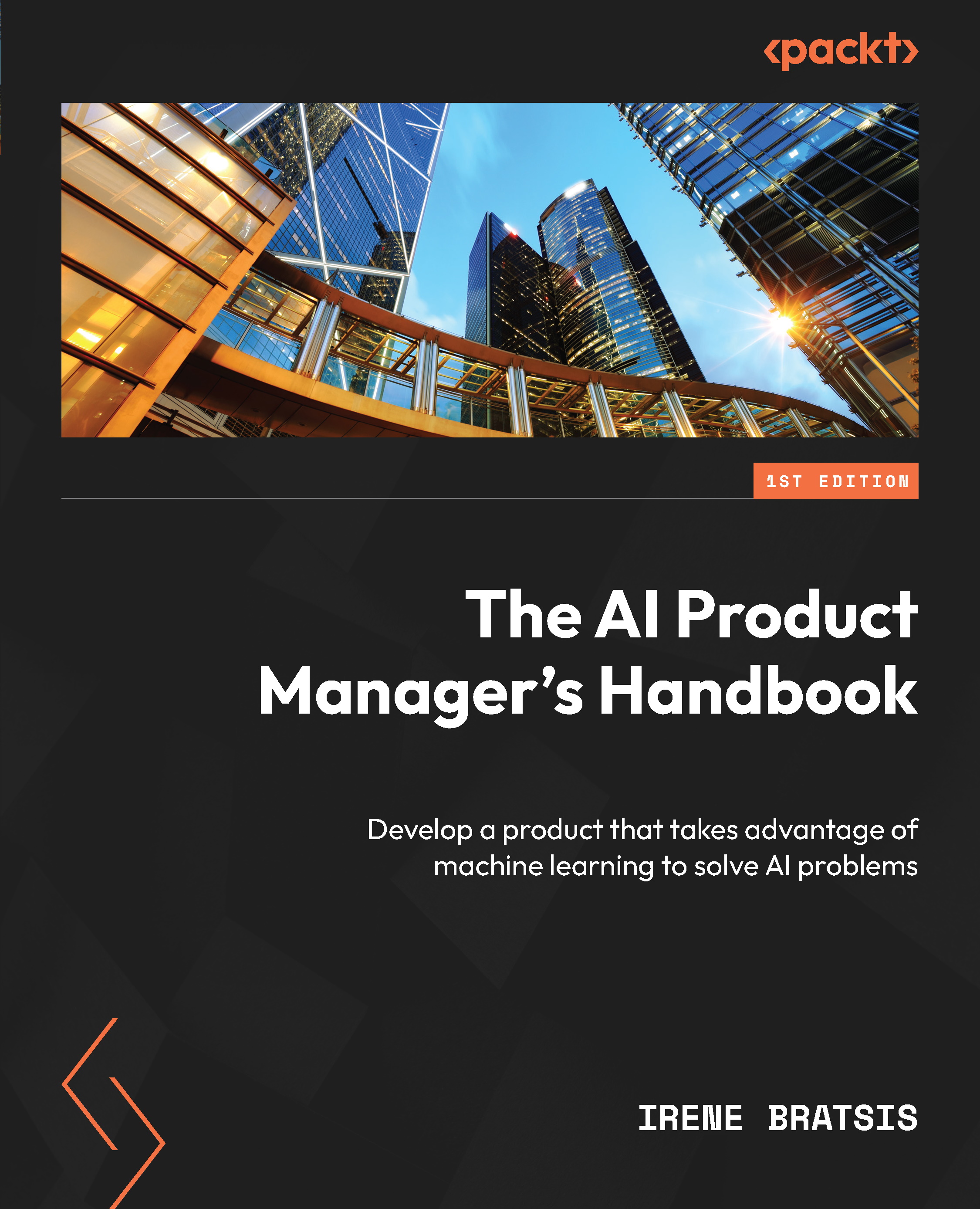
The AI Product Manager's Handbook

The AI Product Manager's Handbook

By : Irene Bratsis
4.6 (28)
close
close
The AI Product Manager's Handbook

The AI Product Manager's Handbook

4.6 (28)
By: Irene Bratsis

Overview of this book

Product managers working with artificial intelligence will be able to put their knowledge to work with this practical guide to applied AI. This book covers everything you need to know to drive product development and growth in the AI industry. From understanding AI and machine learning to developing and launching AI products, it provides the strategies, techniques, and tools you need to succeed. The first part of the book focuses on establishing a foundation of the concepts most relevant to maintaining AI pipelines. The next part focuses on building an AI-native product, and the final part guides you in integrating AI into existing products. You’ll learn about the types of AI, how to integrate AI into a product or business, and the infrastructure to support the exhaustive and ambitious endeavor of creating AI products or integrating AI into existing products. You’ll gain practical knowledge of managing AI product development processes, evaluating and optimizing AI models, and navigating complex ethical and legal considerations associated with AI products. With the help of real-world examples and case studies, you’ll stay ahead of the curve in the rapidly evolving field of AI and ML. By the end of this book, you’ll have understood how to navigate the world of AI from a product perspective.
Table of Contents (19 chapters)
close
close
1
Part 1 – Lay of the Land – Terms, Infrastructure, Types of AI, and Products Done Well
7
Part 2 – Building an AI-Native Product
13
Part 3 – Integrating AI into Existing Non-AI Products

Understanding the Infrastructure and Tools for Building AI Products

Laying a solid foundation is an essential part of understanding anything, and the frontier of artificial intelligence (AI) products seems a lot like our universe: ever-expanding. That rate of expansion is increasing with every passing year as we go deeper into a new way to conceptualize products, organizations, and the industries we’re all a part of. Virtually every aspect of our lives will be impacted in some way by AI and we hope those reading will come out of this experience more confident about what AI adoption will look like for the products they support or hope to build someday.

Part 1 of this book will serve as an overview of the lay of the land. We will cover terms, infrastructure, types of AI algorithms, and products done well, and by the end of this section, you will understand the various considerations when attempting to build an AI strategy, whether you’re looking to create a native-AI product or add AI features to an existing product.

Managing AI products is a highly iterative process, and the work of a product manager is to help your organization discover what the best combination of infrastructure, training, and deployment workflow is to maximize success in your target market. The performance and success of AI products lie in understanding the infrastructure needed for managing AI pipelines, the outputs of which will then be integrated into a product. In this chapter, we will cover everything from databases to workbenches to deployment strategies to tools you can use to manage your AI projects, as well as how to gauge your product’s efficacy.

This chapter will serve as a high-level overview of the subsequent chapters in Part 1 but it will foremost allow for a definition of terms, which are quite hard to come by in today’s marketing-heavy AI competitive landscape. These days, it feels like every product is an AI product, and marketing departments are trigger-happy with sprinkling that term around, rendering it almost useless as a descriptor. We suspect this won’t be changing anytime soon, but the more fluency consumers and customers alike have with the capabilities and specifics of AI, machine learning (ML), and data science, the more we should see clarity about how products are built and optimized. Understanding the context of AI is important for anyone considering building or supporting an AI product.

In this chapter, we will cover the following topics:

  • Definitions – what is and is not AI
  • ML versus DL – understanding the difference
  • Learning types in ML
  • The order – what is the optimal flow and where does every part of the process live?
  • DB 101 – databases, warehouses, data lakes, and lakehouses
  • Managing projects – IaaS
  • Deployment strategies – what do we do with these outputs?
  • Succeeding in AI – how well-managed AI companies do infrastructure right
  • The promise of AI – where is AI taking us?
CONTINUE READING
83
Tech Concepts
36
Programming languages
73
Tech Tools
Icon Unlimited access to the largest independent learning library in tech of over 8,000 expert-authored tech books and videos.
Icon Innovative learning tools, including AI book assistants, code context explainers, and text-to-speech.
Icon 50+ new titles added per month and exclusive early access to books as they are being written.
The AI Product Manager's Handbook
notes
bookmark Notes and Bookmarks search Search in title playlist Add to playlist font-size Font size

Change the font size

margin-width Margin width

Change margin width

day-mode Day/Sepia/Night Modes

Change background colour

Close icon Search
Country selected

Close icon Your notes and bookmarks

Confirmation

Modal Close icon
claim successful

Buy this book with your credits?

Modal Close icon
Are you sure you want to buy this book with one of your credits?
Close
YES, BUY

Submit Your Feedback

Modal Close icon
Modal Close icon
Modal Close icon