Sign In Start Free Trial
Account

Add to playlist

Create a Playlist

Modal Close icon
You need to login to use this feature.
  • Book Overview & Buying Hands-On Graph Neural Networks Using Python
  • Table Of Contents Toc
  • Feedback & Rating feedback
Hands-On Graph Neural Networks Using Python

Hands-On Graph Neural Networks Using Python

By : Maxime Labonne
4.1 (23)
close
close
Hands-On Graph Neural Networks Using Python

Hands-On Graph Neural Networks Using Python

4.1 (23)
By: Maxime Labonne

Overview of this book

Graph neural networks are a highly effective tool for analyzing data that can be represented as a graph, such as networks, chemical compounds, or transportation networks. The past few years have seen an explosion in the use of graph neural networks, with their application ranging from natural language processing and computer vision to recommendation systems and drug discovery. Hands-On Graph Neural Networks Using Python begins with the fundamentals of graph theory and shows you how to create graph datasets from tabular data. As you advance, you’ll explore major graph neural network architectures and learn essential concepts such as graph convolution, self-attention, link prediction, and heterogeneous graphs. Finally, the book proposes applications to solve real-life problems, enabling you to build a professional portfolio. The code is readily available online and can be easily adapted to other datasets and apps. By the end of this book, you’ll have learned to create graph datasets, implement graph neural networks using Python and PyTorch Geometric, and apply them to solve real-world problems, along with building and training graph neural network models for node and graph classification, link prediction, and much more.
Table of Contents (25 chapters)
close
close
1
Part 1: Introduction to Graph Learning
5
Part 2: Fundamentals
10
Part 3: Advanced Techniques
18
Part 4: Applications
22
Chapter 18: Unlocking the Potential of Graph Neural Networks for Real-World Applications

Why graph neural networks?

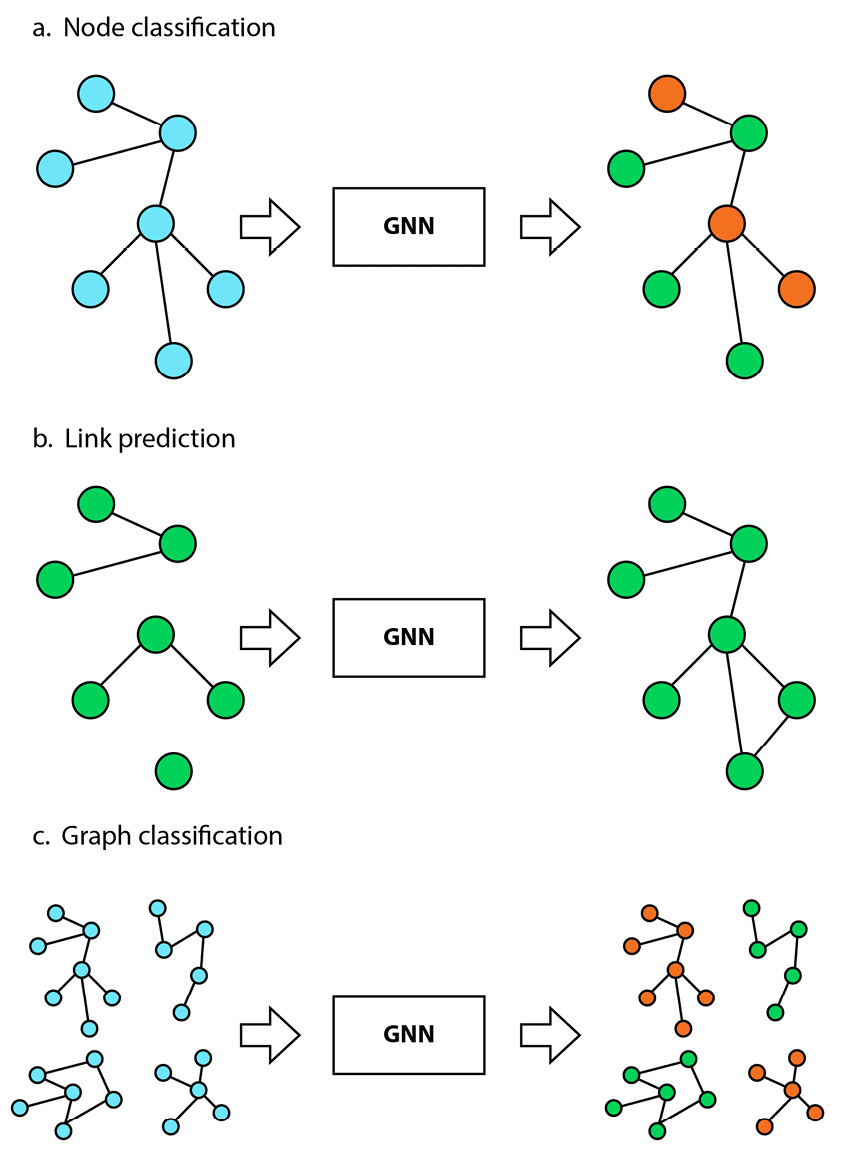
In this book, we will focus on the deep learning family of graph learning techniques, often referred to as graph neural networks. GNNs are a new category of deep learning architecture and are specifically designed for graph-structured data. Unlike traditional deep learning algorithms, which have been primarily developed for text and images, GNNs are explicitly made to process and analyze graph datasets (see Figure 1.4).

Figure 1.4 – High-level architecture of a GNN pipeline, with a graph as input and an output that corresponds to a given task

Figure 1.4 – High-level architecture of a GNN pipeline, with a graph as input and an output that corresponds to a given task

GNNs have emerged as a powerful tool for graph learning and have shown excellent results in various tasks and industries. One of the most striking examples is how a GNN model identified a new antibiotic [2]. The model was trained on 2,500 molecules and was tested on a library of 6,000 compounds. It predicted that a molecule called halicin should be able to kill many antibiotic-resistant bacteria while having low toxicity to human cells. Based on this prediction, the researchers used halicin to treat mice infected with antibiotic-resistant bacteria. They demonstrated its effectiveness and believe the model could be used to design new drugs.

How do GNNs work? Let’s take the example of a node classification task in a social network, like the previous family tree (Figure 1.3). In a node classification task, GNNs take advantage of information from different sources to create a vector representation of each node in the graph. This representation encompasses not only the original node features (such as name, age, and gender) but also information from edge features (such as the strength of relationships between nodes) and global features (such as network-wide statistics).

This is why GNNs are more efficient than traditional machine learning techniques on graphs. Instead of being limited to the original attributes, GNNs enrich the original node features with attributes from neighboring nodes, edges, and global features, making the representation much more comprehensive and meaningful. The new node representations are then used to perform a specific task, such as node classification, regression, or link prediction.

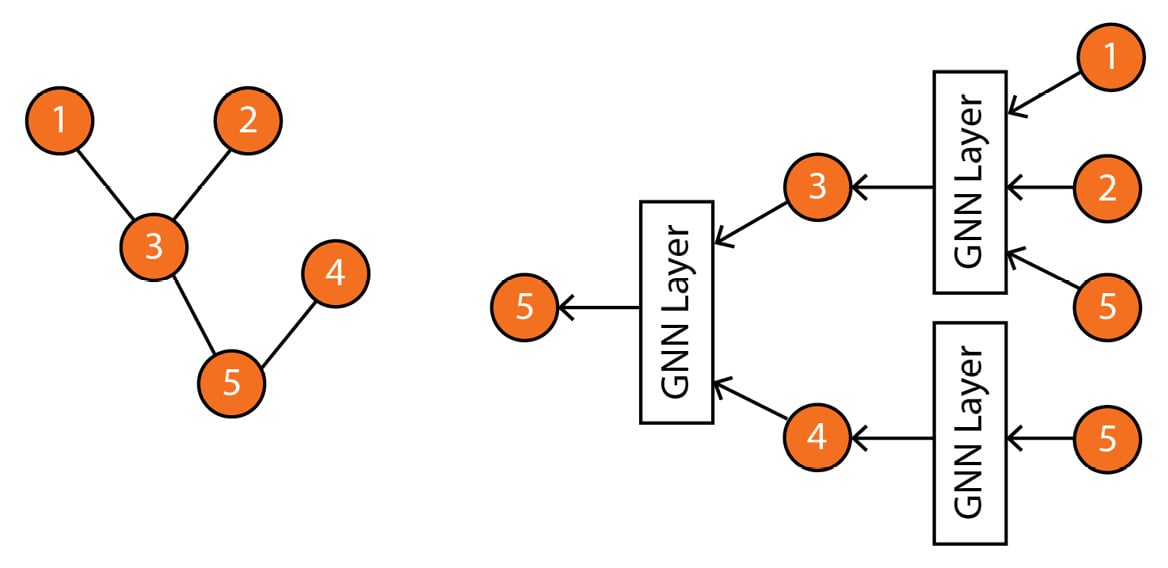
Specifically, GNNs define a graph convolution operation that aggregates information from the neighboring nodes and edges to update the node representation. This operation is performed iteratively, allowing the model to learn more complex relationships between nodes as the number of iterations increases. For example, Figure 1.5 shows how a GNN would calculate the representation of node 5 using neighboring nodes.

Figure 1.5 – Left: input graph; right: computation graph representing how a GNN computes the representation of node 5 based on its neighbors

Figure 1.5 – Left: input graph; right: computation graph representing how a GNN computes the representation of node 5 based on its neighbors

It is worth noting that Figure 1.5 provides a simplified illustration of a computation graph. In reality, there are various kinds of GNNs and GNN layers, each of which has a unique structure and way of aggregating information from neighboring nodes. These different variants of GNNs also have their own advantages and limitations and are well-suited for specific types of graph data and tasks. When selecting the appropriate GNN architecture for a particular problem, it is crucial to understand the characteristics of the graph data and the desired outcome.

More generally, GNNs, like other deep learning techniques, are most effective when applied to specific problems. These problems are characterized by high complexity, meaning that learning good representations is critical to solving the task at hand. For example, a highly complex task could be recommending the right products among billions of options to millions of customers. On the other hand, some problems, such as finding the youngest member of our family tree, can be solved without any machine learning technique.

Furthermore, GNNs require a substantial amount of data to perform effectively. Traditional machine learning techniques might be a better fit in cases where the dataset is small, as they are less reliant on large amounts of data. However, these techniques do not scale as well as GNNs. GNNs can process bigger datasets thanks to parallel and distributed training. They can also exploit the additional information more efficiently, which produces better results.

Visually different images
CONTINUE READING
83
Tech Concepts
36
Programming languages
73
Tech Tools
Icon Unlimited access to the largest independent learning library in tech of over 8,000 expert-authored tech books and videos.
Icon Innovative learning tools, including AI book assistants, code context explainers, and text-to-speech.
Icon 50+ new titles added per month and exclusive early access to books as they are being written.
Hands-On Graph Neural Networks Using Python
notes
bookmark Notes and Bookmarks search Search in title playlist Add to playlist download Download options font-size Font size

Change the font size

margin-width Margin width

Change margin width

day-mode Day/Sepia/Night Modes

Change background colour

Close icon Search
Country selected

Close icon Your notes and bookmarks

Confirmation

Modal Close icon
claim successful

Buy this book with your credits?

Modal Close icon
Are you sure you want to buy this book with one of your credits?
Close
YES, BUY

Submit Your Feedback

Modal Close icon
Modal Close icon
Modal Close icon