Sign In Start Free Trial
Account

Add to playlist

Create a Playlist

Modal Close icon
You need to login to use this feature.
  • Book Overview & Buying Context Engineering for Multi-Agent Systems
  • Table Of Contents Toc
Context Engineering for Multi-Agent Systems

Context Engineering for Multi-Agent Systems

By : Denis Rothman
4 (1)
close
close
Context Engineering for Multi-Agent Systems

Context Engineering for Multi-Agent Systems

4 (1)
By: Denis Rothman

Overview of this book

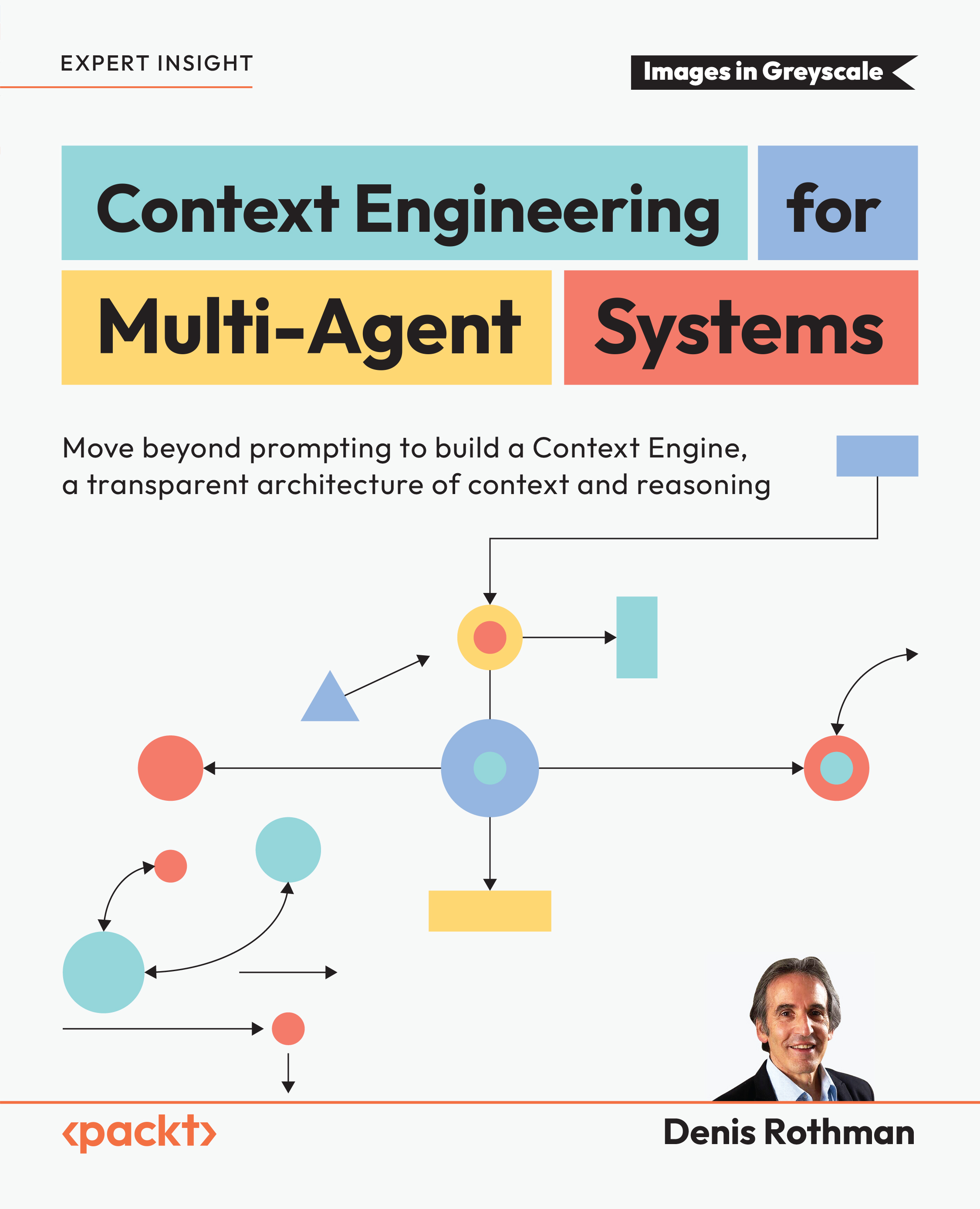
Generative AI is powerful, yet often unpredictable. This guide shows you how to turn that unpredictability into reliability by thinking beyond prompts and approaching AI like an architect. At its core is the Context Engine, a glass-box, multi-agent system you’ll learn to design and apply across real-world scenarios. Written by an AI guru and author of various cutting-edge AI books, this book takes you on a hands-on journey from the foundations of context design to building a fully operational Context Engine. Instead of relying on brittle prompts that give only simple instructions, you’ll begin with semantic blueprints that map goals and roles with precision, then orchestrate specialized agents using the Model Context Protocol. As the engine evolves, you’ll integrate memory and high-fidelity retrieval with citations, implement safeguards against data poisoning and prompt injection, and enforce moderation to keep outputs aligned with policy. You’ll also harden the system into a resilient architecture, then see it pivot across domains, from legal compliance to strategic marketing, proving its domain independence. By the end of this book, you’ll be equipped with the skills to engineer an adaptable, verifiable architecture you can repurpose across domains and deploy with confidence. *Email sign-up and proof of purchase required
Table of Contents (16 chapters)
close
close
12
Other Books You May Enjoy
13
Index

1

From Prompts to Context: Building the Semantic Blueprint

Context engineeringidx_7a4e8c2a is the discipline of transforming generative AI from an unpredictable collaborator into a fully controlled creative partner. Where a prompt oftenidx_e072e4f9 opens a door to random chance, a contextidx_bea49801 provides a structured blueprint for a predictable outcome. It is a fundamental shift from asking an LLM to continue a sequence to engineering a closed environment where it executes a precise plan. This evolution takes the interaction beyond simple requests into the realm of directed creation, telling the model not just what to do, but how to think within the boundaries you define.

For too long, we’ve treated generative AI like an oracle by sending prompts into the void and hoping for a coherent reply. We’ve praised its moments of brilliance and overlooked its inconsistencies, accepting unpredictability as part of the experience. But this is the art of asking, not the art of creating. This chapter is not about asking better questions; it is about providing better plans and telling the LLM what to do.

Our journey begins with a hands-on demonstration that progresses through five levels of contextual complexity, showing how each additional layer transforms output from random guesses into structured, goal-driven responses. We then move from linear sequences of words to multidimensional structures of meaning byidx_ec854d3b introducing Semantic Role Labeling (SRL), a linguistic technique that reveals who did what to whom, when, and why. With SRL as our foundation, we build a Python program that visualizes these structures as semantic blueprints. Finally, we synthesize these skills in a complete meeting analysis use case, where we will introduce context chaining and idx_4f559a6bdemonstrate how multi-step workflows can turn a raw transcript into insights, decisions, and professional actions.

By the end of this chapter, you will no longer be searching for answers in a digital wilderness. You will be the architect of that wilderness, capable of designing the very landscape of the AI model's thought and directing it toward any destination you choose.

This chapter covers the following topics:

  • Progressing through five levels of context engineering to build a semantic blueprint
  • Transitioning from linear text to multidimensional semantic structures through SRL
  • Building a Python program to parse and structure text using SRL
  • Applying context chaining as a method for step-by-step, controlled reasoning
  • Using a complete meeting analysis use case to turn raw transcripts into a professional email
CONTINUE READING
83
Tech Concepts
36
Programming languages
73
Tech Tools
Icon Unlimited access to the largest independent learning library in tech of over 8,000 expert-authored tech books and videos.
Icon Innovative learning tools, including AI book assistants, code context explainers, and text-to-speech.
Icon 50+ new titles added per month and exclusive early access to books as they are being written.
Context Engineering for Multi-Agent Systems
notes
bookmark Notes and Bookmarks search Search in title playlist Add to playlist download Download options font-size Font size

Change the font size

margin-width Margin width

Change margin width

day-mode Day/Sepia/Night Modes

Change background colour

Close icon Search
Country selected

Close icon Your notes and bookmarks

Confirmation

Modal Close icon
claim successful

Buy this book with your credits?

Modal Close icon
Are you sure you want to buy this book with one of your credits?
Close
YES, BUY

Submit Your Feedback

Modal Close icon
Modal Close icon
Modal Close icon