Sign In Start Free Trial
Account

Add to playlist

Create a Playlist

Modal Close icon
You need to login to use this feature.
  • Book Overview & Buying Mathematics of Machine Learning
  • Table Of Contents Toc
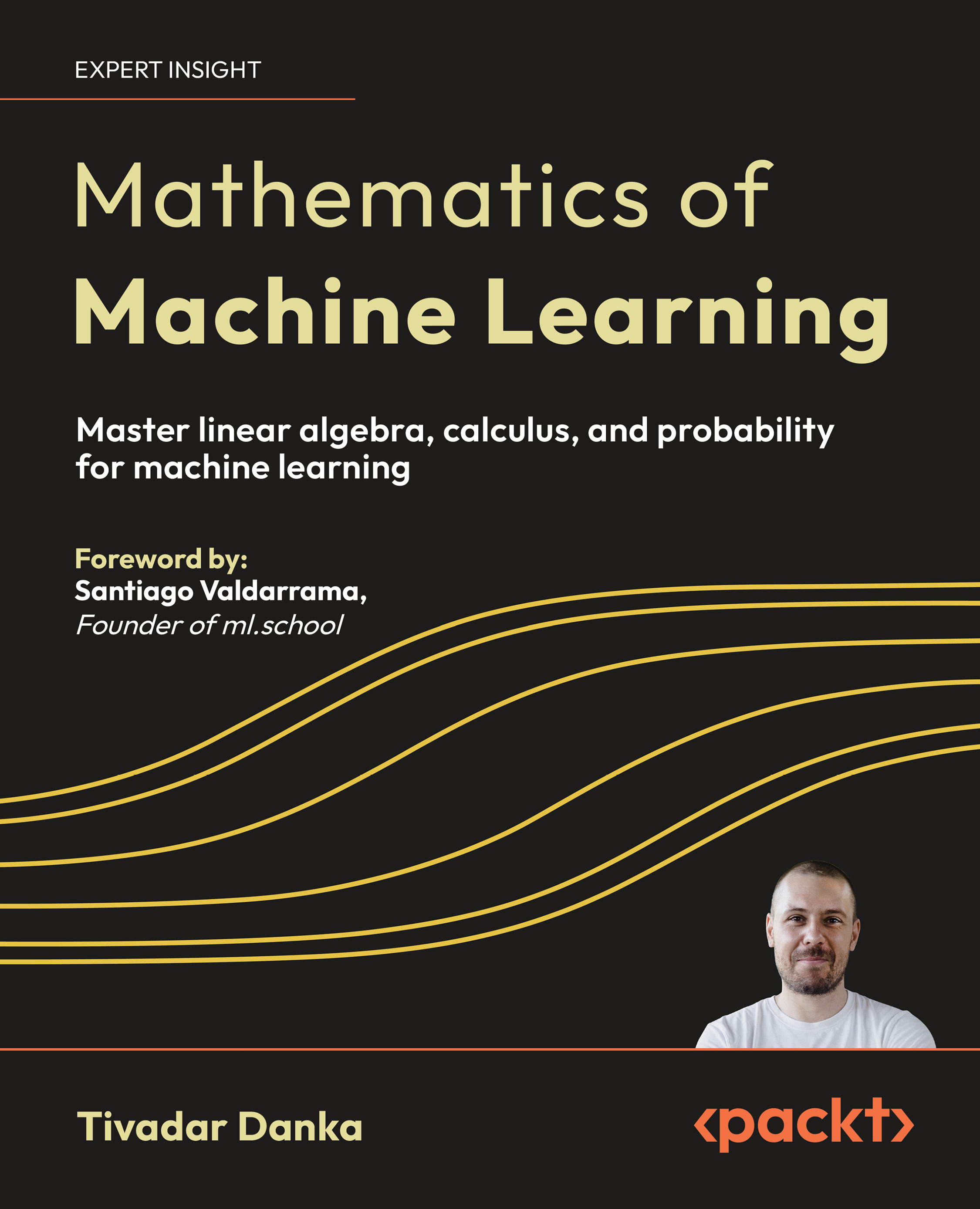
Mathematics of Machine Learning

Mathematics of Machine Learning

By : Tivadar Danka
close
close
Mathematics of Machine Learning

Mathematics of Machine Learning

By: Tivadar Danka

Overview of this book

Mathematics of Machine Learning provides a rigorous yet accessible introduction to the mathematical underpinnings of machine learning, designed for engineers, developers, and data scientists ready to elevate their technical expertise. With this book, you’ll explore the core disciplines of linear algebra, calculus, and probability theory essential for mastering advanced machine learning concepts. PhD mathematician turned ML engineer Tivadar Danka—known for his intuitive teaching style that has attracted 100k+ followers—guides you through complex concepts with clarity, providing the structured guidance you need to deepen your theoretical knowledge and enhance your ability to solve complex machine learning problems. Balancing theory with application, this book offers clear explanations of mathematical constructs and their direct relevance to machine learning tasks. Through practical Python examples, you’ll learn to implement and use these ideas in real-world scenarios, such as training machine learning models with gradient descent or working with vectors, matrices, and tensors. By the end of this book, you’ll have gained the confidence to engage with advanced machine learning literature and tailor algorithms to meet specific project requirements.
Table of Contents (36 chapters)
close
close
2
Part 1: Linear Algebra
11
References
12
Part 2: Calculus
19
References
20
Part 3: Multivariable Calculus
24
References
25
Part 4: Probability Theory
29
References
30
Part 5: Appendix
31
Other Books You May Enjoy
32
Index

Introduction

Why do I have to learn mathematics? - This is a question I am asked daily.

Well, you don’t have to. But you should!

On the surface, advanced mathematics doesn’t impact software engineering and machine learning in a production setting. You don’t have to calculate gradients, solve linear equations, or find eigenvalues by hand. Basic and advanced algorithms are abstracted away into libraries and APIs, performing all the hard work for you.

Nowadays, implementing a state-of-the-art deep neural network is almost equivalent to instantiating an object in PyTorch, loading the pre-trained weights, and letting the data blaze through the model. Just like all technological advances, this is a double-edged sword. On the one hand, frameworks that accelerate prototyping and development enable machine learning in practice. Without them, we wouldn’t have seen the explosion in deep learning that we witnessed in the last decade.

On the other hand, high-level abstractions are barriers between us and the underlying technology. User-level knowledge is only sufficient when one is treading on familiar paths. (Or until something breaks.)

If you are not convinced, let’s do a thought experiment! Imagine moving to a new country without speaking the language and knowing the way of life. However, you have a smartphone and a reliable internet connection.

How do you start exploring?

With Google Maps and a credit card, you can do many awesome things there: explore the city, eat in excellent restaurants, and have a good time. You can do the groceries every day without speaking a word: just put the stuff in your basket and swipe your card at the cashier.

After a few months, you’ll also start to pick up some language – simple things like saying greetings or introducing yourself. You are off to a good start!

There are built-in solutions for everyday tasks that just work – food ordering services, public transportation, etc. However, at some point, they will break down. For instance, you need to call the delivery person who dropped off your package at the wrong door. You need to call help if your rental car breaks down.

You may also want to do more. Get a job, or perhaps even start your own business. For that, you need to communicate with others effectively.

Learning the language when you plan to live somewhere for a few months is unnecessary. However, if you want to stay there for the rest of your life, it is one of the best investments you can make.

Now, replace the country with machine learning and the language with mathematics.

The fact is that algorithms are written in the language of mathematics. To get proficient with algorithms, you have to speak it.

Visually different images
CONTINUE READING
83
Tech Concepts
36
Programming languages
73
Tech Tools
Icon Unlimited access to the largest independent learning library in tech of over 8,000 expert-authored tech books and videos.
Icon Innovative learning tools, including AI book assistants, code context explainers, and text-to-speech.
Icon 50+ new titles added per month and exclusive early access to books as they are being written.
Mathematics of Machine Learning
notes
bookmark Notes and Bookmarks search Search in title playlist Add to playlist download Download options font-size Font size

Change the font size

margin-width Margin width

Change margin width

day-mode Day/Sepia/Night Modes

Change background colour

Close icon Search
Country selected

Close icon Your notes and bookmarks

Confirmation

Modal Close icon
claim successful

Buy this book with your credits?

Modal Close icon
Are you sure you want to buy this book with one of your credits?
Close
YES, BUY

Submit Your Feedback

Modal Close icon
Modal Close icon
Modal Close icon