Sign In Start Free Trial
Account

Add to playlist

Create a Playlist

Modal Close icon
You need to login to use this feature.
  • Book Overview & Buying Machine Learning Engineering  with Python
  • Table Of Contents Toc
  • Feedback & Rating feedback
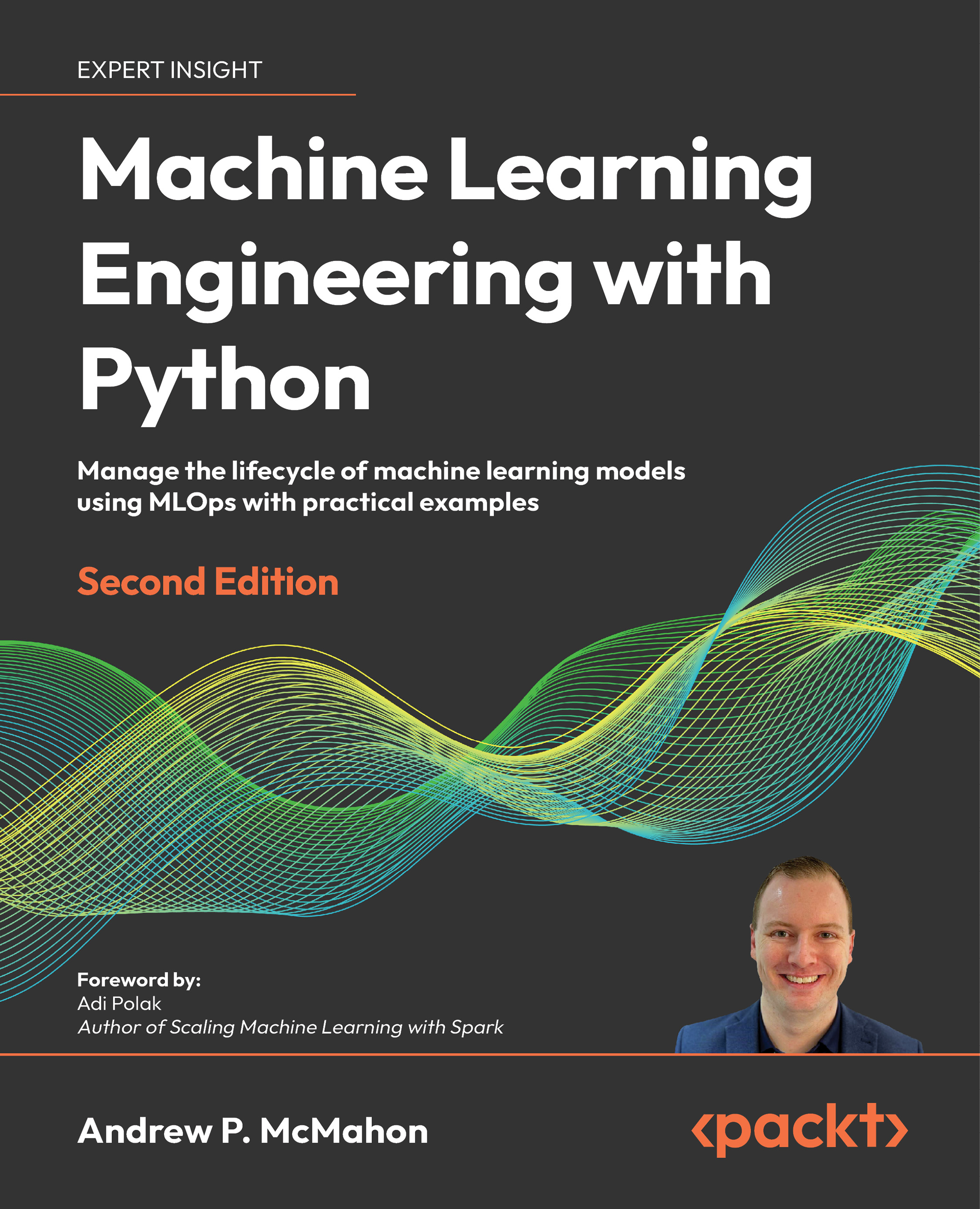
Machine Learning Engineering  with Python

Machine Learning Engineering with Python - Second Edition

By : Andrew P. McMahon
4.6 (37)
close
close
Machine Learning Engineering  with Python

Machine Learning Engineering with Python

4.6 (37)
By: Andrew P. McMahon

Overview of this book

The Second Edition of Machine Learning Engineering with Python is the practical guide that MLOps and ML engineers need to build solutions to real-world problems. It will provide you with the skills you need to stay ahead in this rapidly evolving field. The book takes an examples-based approach to help you develop your skills and covers the technical concepts, implementation patterns, and development methodologies you need. You'll explore the key steps of the ML development lifecycle and create your own standardized "model factory" for training and retraining of models. You'll learn to employ concepts like CI/CD and how to detect different types of drift. Get hands-on with the latest in deployment architectures and discover methods for scaling up your solutions. This edition goes deeper in all aspects of ML engineering and MLOps, with emphasis on the latest open-source and cloud-based technologies. This includes a completely revamped approach to advanced pipelining and orchestration techniques. With a new chapter on deep learning, generative AI, and LLMOps, you will learn to use tools like LangChain, PyTorch, and Hugging Face to leverage LLMs for supercharged analysis. You will explore AI assistants like GitHub Copilot to become more productive, then dive deep into the engineering considerations of working with deep learning.
Table of Contents (12 chapters)
close
close
10
Other Books You May Enjoy
11
Index

Executing the build

Execution of the build, in this case, will be very much about how we take the proof-of-concept code shown in Chapter 1, Introduction to ML Engineering, and then split this out into components that can be called by another scheduling tool such as Apache Airflow.

This will provide a showcase of how we can apply some of the ML engineering skills we learned throughout the book. In the next few sections, we will focus on how to build out an Airflow pipeline that leverages a series of different ML capabilities, creating a relatively complex solution in just a few lines of code.

Building an ETML pipeline with advanced Airflow features

We already discussed Airflow in detail in Chapter 5, Deployment Patterns and Tools, but there we covered more of the details around how to deploy your DAGs on the cloud. Here we will focus on building in more advanced capabilities and control flows into your DAGs. We will work locally here on the understanding that when you...

Visually different images
CONTINUE READING
83
Tech Concepts
36
Programming languages
73
Tech Tools
Icon Unlimited access to the largest independent learning library in tech of over 8,000 expert-authored tech books and videos.
Icon Innovative learning tools, including AI book assistants, code context explainers, and text-to-speech.
Icon 50+ new titles added per month and exclusive early access to books as they are being written.
Machine Learning Engineering  with Python
notes
bookmark Notes and Bookmarks search Search in title playlist Add to playlist download Download options font-size Font size

Change the font size

margin-width Margin width

Change margin width

day-mode Day/Sepia/Night Modes

Change background colour

Close icon Search
Country selected

Close icon Your notes and bookmarks

Confirmation

Modal Close icon
claim successful

Buy this book with your credits?

Modal Close icon
Are you sure you want to buy this book with one of your credits?
Close
YES, BUY

Submit Your Feedback

Modal Close icon
Modal Close icon
Modal Close icon