


-
Book Overview & Buying
-
Table Of Contents

Building Data Science Applications with FastAPI - Second Edition
By :


Building Data Science Applications with FastAPI
By:
Overview of this book
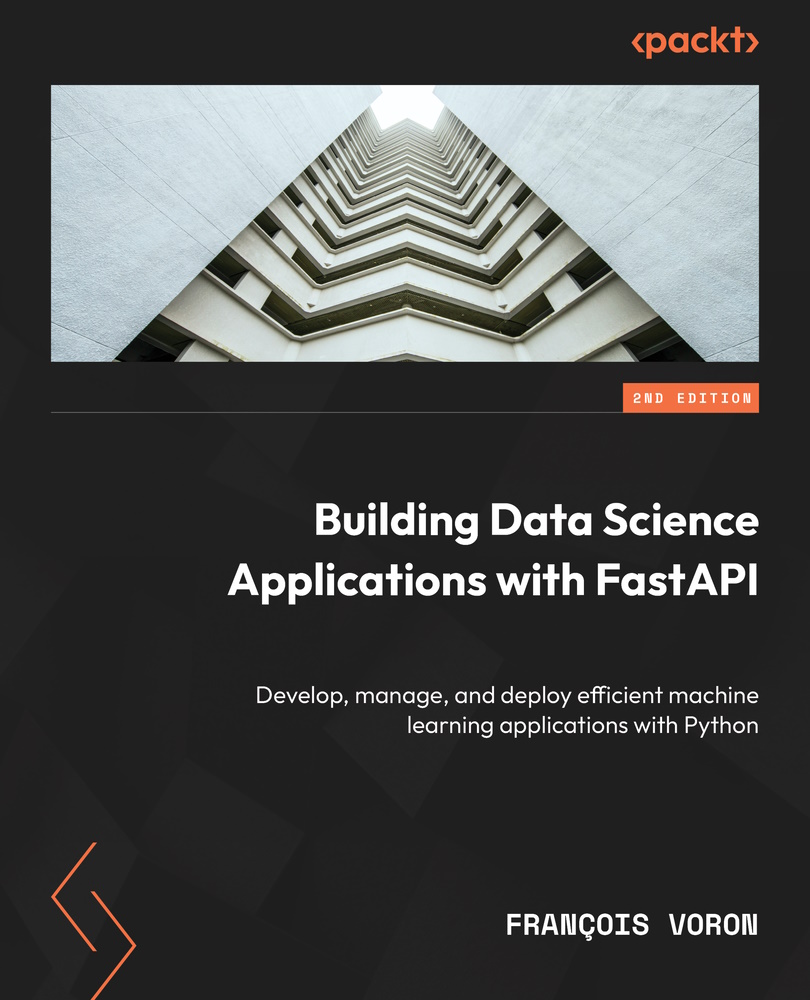
Building Data Science Applications with FastAPI is the go-to resource for creating efficient and dependable data science API backends. This second edition incorporates the latest Python and FastAPI advancements, along with two new AI projects – a real-time object detection system and a text-to-image generation platform using Stable Diffusion.
The book starts with the basics of FastAPI and modern Python programming. You'll grasp FastAPI's robust dependency injection system, which facilitates seamless database communication, authentication implementation, and ML model integration. As you progress, you'll learn testing and deployment best practices, guaranteeing high-quality, resilient applications.
Throughout the book, you'll build data science applications using FastAPI with the help of projects covering common AI use cases, such as object detection and text-to-image generation. These hands-on experiences will deepen your understanding of using FastAPI in real-world scenarios.
By the end of this book, you'll be well equipped to maintain, design, and monitor applications to meet the highest programming standards using FastAPI, empowering you to create fast and reliable data science API backends with ease while keeping up with the latest advancements.
Table of Contents (21 chapters)
Preface


Part 1: Introduction to Python and FastAPI
 Free Chapter
Chapter 1: Python Development Environment Setup
Chapter 2: Python Programming Specificities
Chapter 3: Developing a RESTful API with FastAPI
Chapter 4: Managing Pydantic Data Models in FastAPI
Chapter 5: Dependency Injection in FastAPI
Part 2: Building and Deploying a Complete Web Backend with FastAPI
Chapter 6: Databases and Asynchronous ORMs
Chapter 7: Managing Authentication and Security in FastAPI
Chapter 8: Defining WebSockets for Two-Way Interactive Communication in FastAPI
Chapter 9: Testing an API Asynchronously with pytest and HTTPX
Chapter 10: Deploying a FastAPI Project
Part 3: Building Resilient and Distributed Data Science Systems with FastAPI
Chapter 11: Introduction to Data Science in Python

Chapter 12: Creating an Efficient Prediction API Endpoint with FastAPI
Chapter 13: Implementing a Real-Time Object Detection System Using WebSockets with FastAPI
Chapter 14: Creating a Distributed Text-to-Image AI System Using the Stable Diffusion Model
Chapter 15: Monitoring the Health and Performance of a Data Science System
Index


