Sign In Start Free Trial
Account

Add to playlist

Create a Playlist

Modal Close icon
You need to login to use this feature.
  • Book Overview & Buying 15 Math Concepts Every Data Scientist Should Know
  • Table Of Contents Toc
  • Feedback & Rating feedback
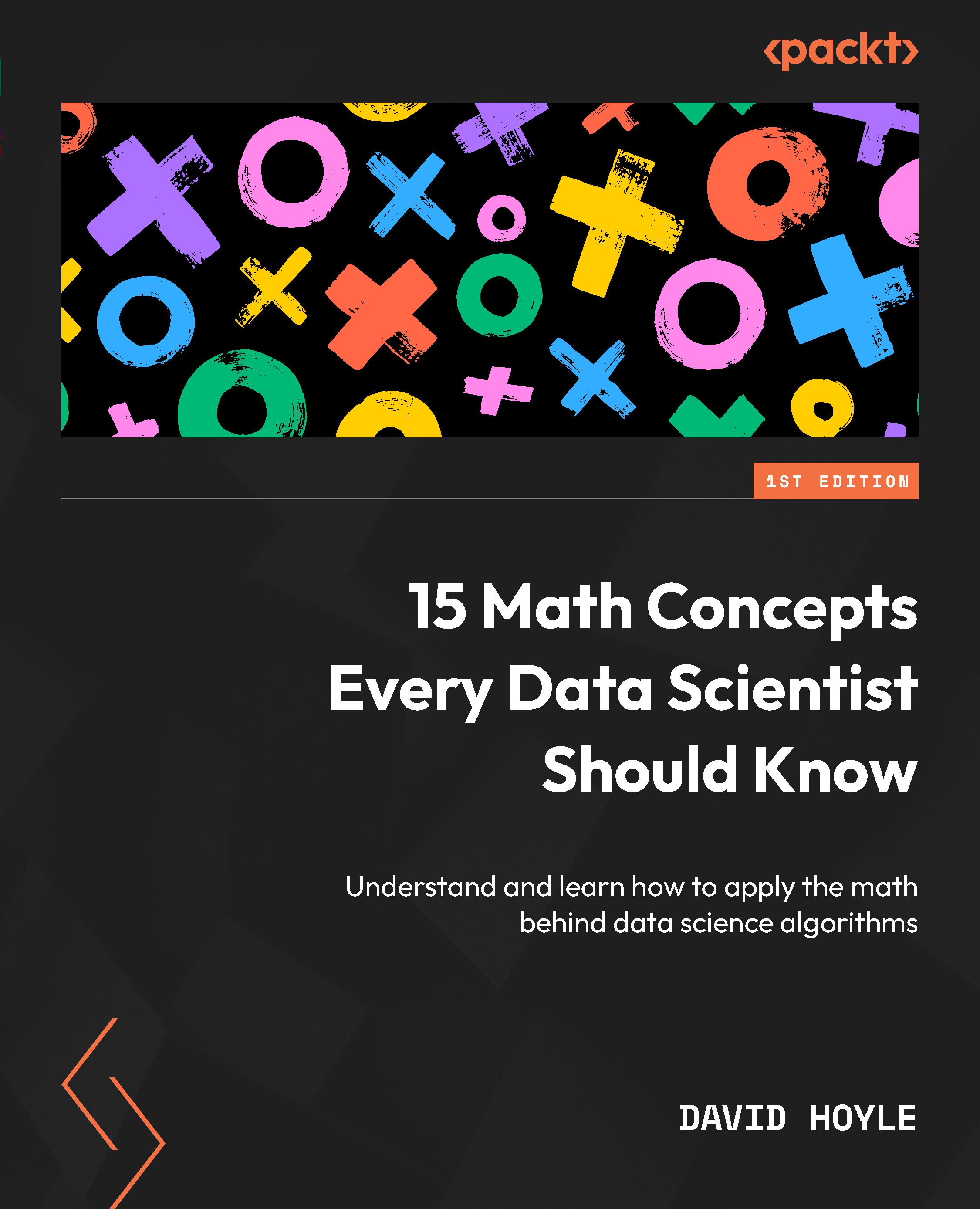
15 Math Concepts Every Data Scientist Should Know

15 Math Concepts Every Data Scientist Should Know

By : David Hoyle
4.3 (6)
close
close
15 Math Concepts Every Data Scientist Should Know

15 Math Concepts Every Data Scientist Should Know

4.3 (6)
By: David Hoyle

Overview of this book

Data science combines the power of data with the rigor of scientific methodology, with mathematics providing the tools and frameworks for analysis, algorithm development, and deriving insights. As machine learning algorithms become increasingly complex, a solid grounding in math is crucial for data scientists. David Hoyle, with over 30 years of experience in statistical and mathematical modeling, brings unparalleled industrial expertise to this book, drawing from his work in building predictive models for the world's largest retailers. Encompassing 15 crucial concepts, this book covers a spectrum of mathematical techniques to help you understand a vast range of data science algorithms and applications. Starting with essential foundational concepts, such as random variables and probability distributions, you’ll learn why data varies, and explore matrices and linear algebra to transform that data. Building upon this foundation, the book spans general intermediate concepts, such as model complexity and network analysis, as well as advanced concepts such as kernel-based learning and information theory. Each concept is illustrated with Python code snippets demonstrating their practical application to solve problems. By the end of the book, you’ll have the confidence to apply key mathematical concepts to your data science challenges.
Table of Contents (21 chapters)
close
close
Lock Free Chapter
1
Part 1: Essential Concepts
7
Part 2: Intermediate Concepts
13
Part 3: Selected Advanced Concepts

Linear models

We’ve already introduced, at a high level, the idea of OLS regression for a linear model. But this particular combination of squared loss for measuring the risk and a linear model for  ˆ y  has some very convenient and simple-to-use properties. This simplicity means that OLS regression is one of the most widely used and studied data science modeling techniques. That is why we are going to look in detail at fitting linear models to data using OLS regression.

To start with, we’ll revisit the squared-loss empirical risk function in Eq. 10 and look at what happens to it when we have a linear model  ˆ y . To recap, the squared-loss empirical risk is given by the following:

<mml:math xmlns:mml="http://www.w3.org/1998/Math/MathML" xmlns:m="http://schemas.openxmlformats.org/officeDocument/2006/math" display="block"><mml:mtext>Risk</mml:mtext><mml:mo> </mml:mo><mml:mo>=</mml:mo><mml:mfrac><mml:mrow><mml:mn>1</mml:mn></mml:mrow><mml:mrow><mml:mi>N</mml:mi></mml:mrow></mml:mfrac><mml:mo> </mml:mo><mml:mrow><mml:munderover><mml:mo stretchy="false">∑</mml:mo><mml:mrow><mml:mi>i</mml:mi><mml:mo>=</mml:mo><mml:mn>1</mml:mn></mml:mrow><mml:mrow><mml:mi>N</mml:mi></mml:mrow></mml:munderover><mml:mrow><mml:msup><mml:mrow><mml:mfenced separators="|"><mml:mrow><mml:msub><mml:mrow><mml:mi>y</mml:mi></mml:mrow><mml:mrow><mml:mi>i</mml:mi></mml:mrow></mml:msub><mml:mo>-</mml:mo><mml:msub><mml:mrow><mml:mover accent="true"><mml:mrow><mml:mi>y</mml:mi></mml:mrow><mml:mo>^</mml:mo></mml:mover></mml:mrow><mml:mrow><mml:mi>i</mml:mi></mml:mrow></mml:msub></mml:mrow></mml:mfenced></mml:mrow><mml:mrow><mml:mn>2</mml:mn></mml:mrow></mml:msup></mml:mrow></mml:mrow></mml:math>

Eq. 13

Now, for a linear model with <mml:math xmlns:mml="http://www.w3.org/1998/Math/MathML" xmlns:m="http://schemas.openxmlformats.org/officeDocument/2006/math"><mml:mi>d</mml:mi></mml:math> features, <mml:math xmlns:mml="http://www.w3.org/1998/Math/MathML" xmlns:m="http://schemas.openxmlformats.org/officeDocument/2006/math"><mml:msub><mml:mrow><mml:mi>x</mml:mi></mml:mrow><mml:mrow><mml:mn>1</mml:mn></mml:mrow></mml:msub><mml:mo>,</mml:mo><mml:msub><mml:mrow><mml:mi>x</mml:mi></mml:mrow><mml:mrow><mml:mn>2</mml:mn></mml:mrow></mml:msub><mml:mo>,</mml:mo><mml:mo>…</mml:mo><mml:mo>,</mml:mo><mml:msub><mml:mrow><mml:mi>x</mml:mi></mml:mrow><mml:mrow><mml:mi>d</mml:mi></mml:mrow></mml:msub></mml:math>, we can write the model as follows:

<math xmlns="http://www.w3.org/1998/Math/MathML" display="block"><mrow><mrow><mover><mi>y</mi><mo stretchy="true">ˆ</mo></mover><mo>=</mo><mspace width="0.25em" /><msub><mi>β</mi><mn>0</mn></msub><mo>+</mo><mspace width="0.25em" /><msub><mi>β</mi><mn>1</mn></msub><msub><mi>x</mi><mn>1</mn></msub><mo>+</mo><mspace width="0.25em" /><msub><mi>β</mi><mn>2</mn></msub><msub><mi>x</mi><mn>2</mn></msub><mo>+</mo><mspace width="0.25em" /><mo>⋯</mo><mo>+</mo><mspace width="0.25em" /><msub><mi>β</mi><mi>d</mi></msub><msub><mi>x</mi><mi>d</mi></msub></mrow></mrow></math>

Eq. 14

The vector of model parameters is <mml:math xmlns:mml="http://www.w3.org/1998/Math/MathML" xmlns:m="http://schemas.openxmlformats.org/officeDocument/2006/math"><mml:msup><mml:mrow><mml:munder><mml:mrow><mml:mi>β</mml:mi></mml:mrow><mml:mrow><mml:mo>_</mml:mo></mml:mrow></mml:munder></mml:mrow><mml:mrow><mml:mi mathvariant="normal">⊤</mml:mi></mml:mrow></mml:msup><mml:mo>=</mml:mo><mml:mo> </mml:mo><mml:mfenced separators="|"><mml:mrow><mml:msub><mml:mrow><mml:mi>β</mml:mi></mml:mrow><mml:mrow><mml:mn>0</mml:mn></mml:mrow></mml:msub><mml:mo>,</mml:mo><mml:mo> </mml:mo><mml:msub><mml:mrow><mml:mi>β</mml:mi></mml:mrow><mml:mrow><mml:mn>1</mml:mn></mml:mrow></mml:msub><mml:mo>,</mml:mo><mml:mo>…</mml:mo><mml:mo>,</mml:mo><mml:mo> </mml:mo><mml:msub><mml:mrow><mml:mi>β</mml:mi></mml:mrow><mml:mrow><mml:mi>d</mml:mi></mml:mrow></mml:msub></mml:mrow></mml:mfenced></mml:math>. We can write the features in vector form as well. We’ll write it as a row-vector, <mml:math xmlns:mml="http://www.w3.org/1998/Math/MathML" xmlns:m="http://schemas.openxmlformats.org/officeDocument/2006/math"><mml:munder><mml:mrow><mml:mi>x</mml:mi></mml:mrow><mml:mrow><mml:mo>_</mml:mo></mml:mrow></mml:munder><mml:mo>=</mml:mo><mml:mfenced separators="|"><mml:mrow><mml:mn>1</mml:mn><mml:mo>,</mml:mo><mml:mo> </mml:mo><mml:msub><mml:mrow><mml:mi>x</mml:mi></mml:mrow><mml:mrow><mml:mn>1</mml:mn></mml:mrow></mml:msub><mml:mo>,</mml:mo><mml:msub><mml:mrow><mml:mi>x</mml:mi></mml:mrow><mml:mrow><mml:mn>2</mml:mn></mml:mrow></mml:msub><mml:mo>,</mml:mo><mml:mo>…</mml:mo><mml:mo>,</mml:mo><mml:msub><mml:mrow><mml:mi>x</mml:mi></mml:mrow><mml:mrow><mml:mi>d</mml:mi></mml:mrow></mml:msub></mml:mrow></mml:mfenced></mml:math>. Doing so...

Visually different images
CONTINUE READING
83
Tech Concepts
36
Programming languages
73
Tech Tools
Icon Unlimited access to the largest independent learning library in tech of over 8,000 expert-authored tech books and videos.
Icon Innovative learning tools, including AI book assistants, code context explainers, and text-to-speech.
Icon 50+ new titles added per month and exclusive early access to books as they are being written.
15 Math Concepts Every Data Scientist Should Know
notes
bookmark Notes and Bookmarks search Search in title playlist Add to playlist download Download options font-size Font size

Change the font size

margin-width Margin width

Change margin width

day-mode Day/Sepia/Night Modes

Change background colour

Close icon Search
Country selected

Close icon Your notes and bookmarks

Confirmation

Modal Close icon
claim successful

Buy this book with your credits?

Modal Close icon
Are you sure you want to buy this book with one of your credits?
Close
YES, BUY

Submit Your Feedback

Modal Close icon
Modal Close icon
Modal Close icon