Sign In Start Free Trial
Account

Add to playlist

Create a Playlist

Modal Close icon
You need to login to use this feature.
  • Book Overview & Buying Deep Learning for Natural Language Processing
  • Table Of Contents Toc
  • Feedback & Rating feedback
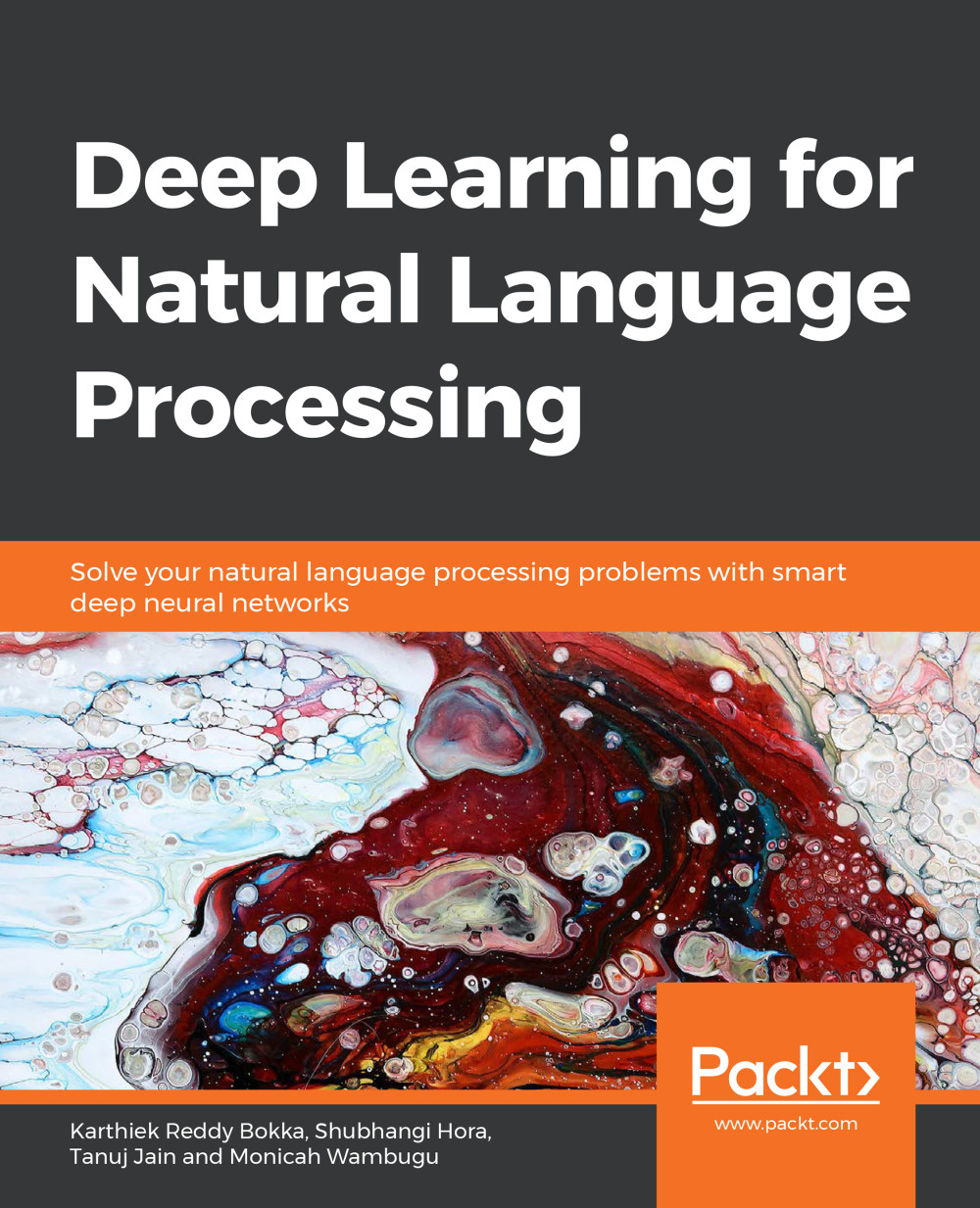
Deep Learning for Natural Language Processing

Deep Learning for Natural Language Processing

By : Karthiek Reddy Bokka, Shubhangi Hora , Tanuj Jain, Wambugu
1.5 (2)
close
close
Deep Learning for Natural Language Processing

Deep Learning for Natural Language Processing

1.5 (2)
By: Karthiek Reddy Bokka, Shubhangi Hora , Tanuj Jain, Wambugu

Overview of this book

Applying deep learning approaches to various NLP tasks can take your computational algorithms to a completely new level in terms of speed and accuracy. Deep Learning for Natural Language Processing starts by highlighting the basic building blocks of the natural language processing domain. The book goes on to introduce the problems that you can solve using state-of-the-art neural network models. After this, delving into the various neural network architectures and their specific areas of application will help you to understand how to select the best model to suit your needs. As you advance through this deep learning book, you’ll study convolutional, recurrent, and recursive neural networks, in addition to covering long short-term memory networks (LSTM). Understanding these networks will help you to implement their models using Keras. In later chapters, you will be able to develop a trigger word detection application using NLP techniques such as attention model and beam search. By the end of this book, you will not only have sound knowledge of natural language processing, but also be able to select the best text preprocessing and neural network models to solve a number of NLP issues.
Table of Contents (11 chapters)
close
close

POS Tagging

Before we dive straight into the algorithm, let's understand what parts of speech are. Parts of speech are something most of us are taught in our early years of learning the English language. They are categories assigned to words based on their syntactic or grammatical functions. These functions are the functional relationships that exist between different words.

Parts of Speech

The English language has nine main parts of speech:

  • Nouns: Things or people
  • Examples: table, dog, piano, London, towel
  • Pronouns: Words that replace nouns
  • Examples: I, you, he, she, it
  • Verbs: Action words
  • Examples: to be, to have, to study, to learn, to play
  • Adjectives: Words that describe nouns
  • Examples: intelligent, small, silly, intriguing, blue
  • Determiners: Words that limit nouns
  • Examples: a few, many, some, three

    Note

    For more examples of determiners, visit https://www.ef.com/in/english-resources/english-grammar/determiners/.

  • Adverbs: Words that describe...
Visually different images
CONTINUE READING
83
Tech Concepts
36
Programming languages
73
Tech Tools
Icon Unlimited access to the largest independent learning library in tech of over 8,000 expert-authored tech books and videos.
Icon Innovative learning tools, including AI book assistants, code context explainers, and text-to-speech.
Icon 50+ new titles added per month and exclusive early access to books as they are being written.
Deep Learning for Natural Language Processing
notes
bookmark Notes and Bookmarks search Search in title playlist Add to playlist font-size Font size

Change the font size

margin-width Margin width

Change margin width

day-mode Day/Sepia/Night Modes

Change background colour

Close icon Search
Country selected

Close icon Your notes and bookmarks

Confirmation

Modal Close icon
claim successful

Buy this book with your credits?

Modal Close icon
Are you sure you want to buy this book with one of your credits?
Close
YES, BUY

Submit Your Feedback

Modal Close icon
Modal Close icon
Modal Close icon