
Sign In Start Free Trial
Account

Add to playlist

Create a Playlist

Modal Close icon
You need to login to use this feature.
  • Book Overview & Buying Hands-On Big Data Analytics with PySpark
  • Table Of Contents Toc
Hands-On Big Data Analytics with PySpark

Hands-On Big Data Analytics with PySpark

By : Rudy Lai, Bartłomiej Potaczek
1.8 (5)
close
close
Hands-On Big Data Analytics with PySpark

Hands-On Big Data Analytics with PySpark

1.8 (5)
By: Rudy Lai, Bartłomiej Potaczek

Overview of this book

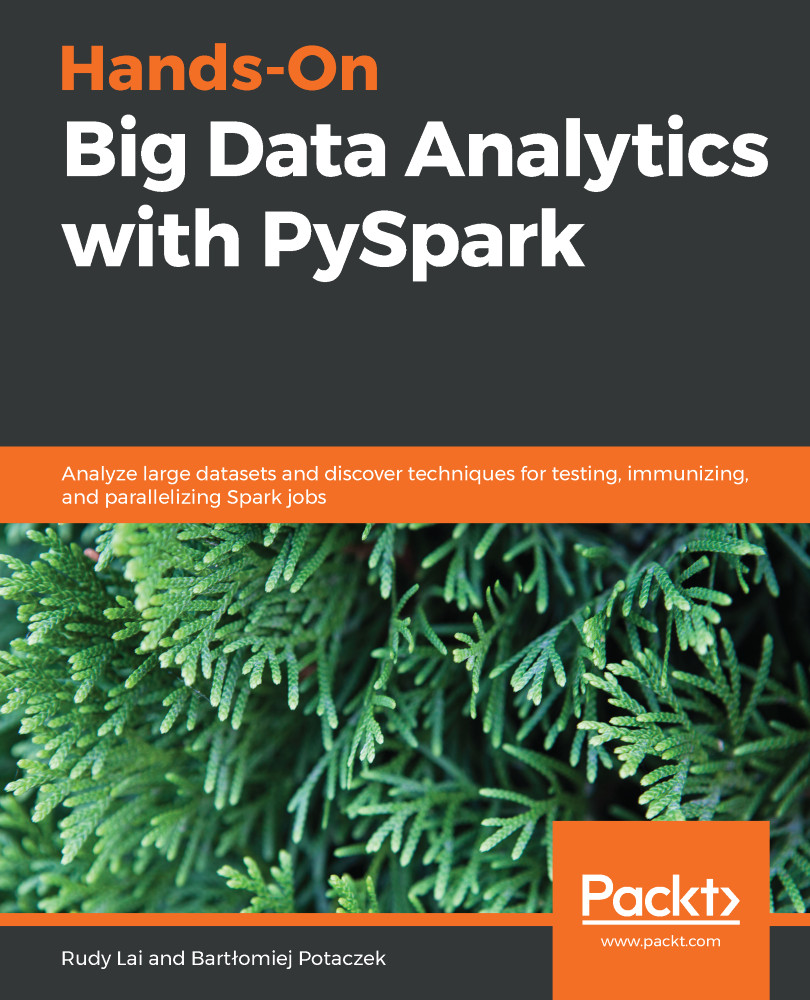
Apache Spark is an open source parallel-processing framework that has been around for quite some time now. One of the many uses of Apache Spark is for data analytics applications across clustered computers. In this book, you will not only learn how to use Spark and the Python API to create high-performance analytics with big data, but also discover techniques for testing, immunizing, and parallelizing Spark jobs. You will learn how to source data from all popular data hosting platforms, including HDFS, Hive, JSON, and S3, and deal with large datasets with PySpark to gain practical big data experience. This book will help you work on prototypes on local machines and subsequently go on to handle messy data in production and at scale. This book covers installing and setting up PySpark, RDD operations, big data cleaning and wrangling, and aggregating and summarizing data into useful reports. You will also learn how to implement some practical and proven techniques to improve certain aspects of programming and administration in Apache Spark. By the end of the book, you will be able to build big data analytical solutions using the various PySpark offerings and also optimize them effectively.
Table of Contents (15 chapters)
close
close

Working with the Spark Key/Value API

In this chapter, we'll be working with the Spark key/value API. We will start by looking at the available transformations on key/value pairs. We will then learn how to use the aggregateByKey method instead of the groupBy() method. Later, we'll be looking at actions on key/value pairs and looking at the available partitioners on key/value data. At the end of this chapter, we'll be implementing an advanced partitioner that will be able to partition our data by range.

In this chapter, we will be covering the following topics:

  • Available actions on key/value pairs
  • Using aggregateByKey instead of groupBy()
  • Actions on key/value pairs
  • Available partitioners on key/value data
  • Implementing a custom partitioner
CONTINUE READING
83
Tech Concepts
36
Programming languages
73
Tech Tools
Icon Unlimited access to the largest independent learning library in tech of over 8,000 expert-authored tech books and videos.
Icon Innovative learning tools, including AI book assistants, code context explainers, and text-to-speech.
Icon 50+ new titles added per month and exclusive early access to books as they are being written.
Hands-On Big Data Analytics with PySpark
notes
bookmark Notes and Bookmarks search Search in title playlist Add to playlist download Download options font-size Font size

Change the font size

margin-width Margin width

Change margin width

day-mode Day/Sepia/Night Modes

Change background colour

Close icon Search
Country selected

Close icon Your notes and bookmarks

Confirmation

Modal Close icon
claim successful

Buy this book with your credits?

Modal Close icon
Are you sure you want to buy this book with one of your credits?
Close
YES, BUY

Submit Your Feedback

Modal Close icon
Modal Close icon
Modal Close icon