
Sign In Start Free Trial
Account

Add to playlist

Create a Playlist

Modal Close icon
You need to login to use this feature.
  • Book Overview & Buying Learn SQL Database Programming
  • Table Of Contents Toc
Learn SQL Database Programming

Learn SQL Database Programming

By : Josephine Bush
4.2 (6)
close
close
Learn SQL Database Programming

Learn SQL Database Programming

4.2 (6)
By: Josephine Bush

Overview of this book

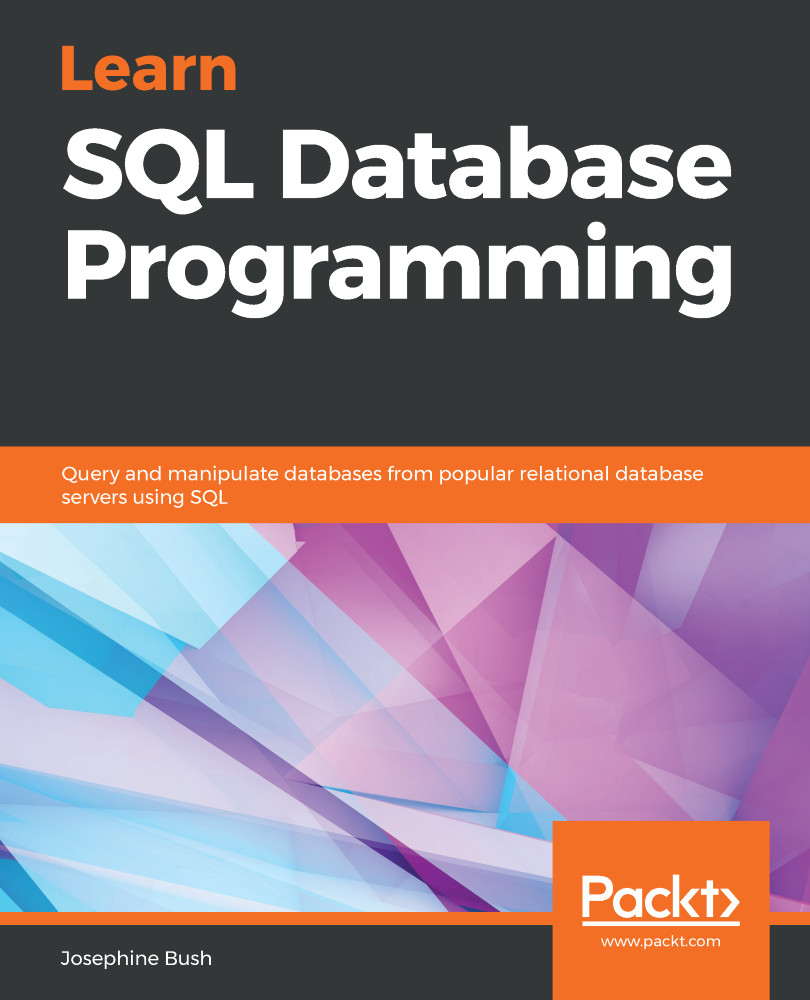
SQL is a powerful querying language that's used to store, manipulate, and retrieve data, and it is one of the most popular languages used by developers to query and analyze data efficiently. If you're looking for a comprehensive introduction to SQL, Learn SQL Database Programming will help you to get up to speed with using SQL to streamline your work in no time. Starting with an overview of relational database management systems, this book will show you how to set up and use MySQL Workbench and design a database using practical examples. You'll also discover how to query and manipulate data with SQL programming using MySQL Workbench. As you advance, you’ll create a database, query single and multiple tables, and modify data using SQL querying. This SQL book covers advanced SQL techniques, including aggregate functions, flow control statements, error handling, and subqueries, and helps you process your data to present your findings. Finally, you’ll implement best practices for writing SQL and designing indexes and tables. By the end of this SQL programming book, you’ll have gained the confidence to use SQL queries to retrieve and manipulate data.
Table of Contents (24 chapters)
close
close
1
Section 1: Database Fundamentals
7
Section 2: Basic SQL Querying
11
Section 3: Advanced SQL Querying
16
Section 4: Presenting Your Findings
19
Section 5: SQL Best Practices

Summary

In this chapter, you learned how to query a single table. This included learning how to use the SQL SELECT statement and the FROM, WHERE, and ORDER BY clauses.

With the SELECT and FROM clauses, you learned how to select distinct records with the DISTINCT keyword, how to limit results with the LIMIT keyword, how to save a SQL query to a file, and how to add proper comments to SQL code.

With the WHERE clause, you learned how and when to use the WHERE clause, along with AND, OR, NOT, IN, and BETWEEN, and how to use with the percent sign (%) and underscore (_) wildcards.

With the ORDER BY clause, you learned how to order query results by one or more columns.

Finally, you learned how to tell which index your query is using and if you need additional indexes by using EXPLAIN or the visual explain tool in MySQL Workbench. You also learned how to add an index to make the query...

CONTINUE READING
83
Tech Concepts
36
Programming languages
73
Tech Tools
Icon Unlimited access to the largest independent learning library in tech of over 8,000 expert-authored tech books and videos.
Icon Innovative learning tools, including AI book assistants, code context explainers, and text-to-speech.
Icon 50+ new titles added per month and exclusive early access to books as they are being written.
Learn SQL Database Programming
notes
bookmark Notes and Bookmarks search Search in title playlist Add to playlist download Download options font-size Font size

Change the font size

margin-width Margin width

Change margin width

day-mode Day/Sepia/Night Modes

Change background colour

Close icon Search
Country selected

Close icon Your notes and bookmarks

Confirmation

Modal Close icon
claim successful

Buy this book with your credits?

Modal Close icon
Are you sure you want to buy this book with one of your credits?
Close
YES, BUY

Submit Your Feedback

Modal Close icon
Modal Close icon
Modal Close icon